Day 10: Master the Middle-of-the-Night Wake-Up
If you wake and can't fall back asleep within 15–20 minutes, get up. Do a calm activity, then return to bed when sleepy.

Day 10: Master the Middle-of-the-Night Wake-Up
You're Doing This ✨
Here's something brave: waking up at 3 AM and knowing exactly what to do about it. You're on Day 10 now, and if you've been lying awake in the middle of the night wondering what went wrong, let me tell you something important: nothing went wrong. Waking up during the night is incredibly common. What matters is how you respond.
Today, we're giving you a plan for those middle-of-the-night moments. The same gentle rule you learned on Day 8 applies here too: if you can't fall back asleep within 15 to 20 minutes, it's time to get up.
Why This Actually Helps
When you wake up at 2 AM or 4 AM and can't drift back off, your first instinct might be to stay put. Close your eyes harder. Try to force sleep to come back. But here's what really happens: the longer you lie there awake and frustrated, the more your brain starts linking your bed with being awake and anxious.
Getting up breaks that cycle.
It tells your brain: "Bed is for sleeping. When I'm not sleeping, I'm not in bed." That distinction is powerful. Over time, your brain learns the pattern. Bed equals sleep. Everywhere else equals wakefulness.
And here's the tender truth: getting up doesn't mean you failed. It means you're taking care of yourself. You're refusing to lie there struggling, and instead, you're doing something kind. You're giving your body and mind the space to reset so sleep can find you again.
How to Handle Tonight (and Every Night After)
If you wake up tonight and sleep doesn't come back within 15 or 20 minutes, here's your plan:
Get up slowly and calmly. You're not stomping out of bed in defeat. You're moving with intention. Keep your body language soft, like you're still half in a dream.
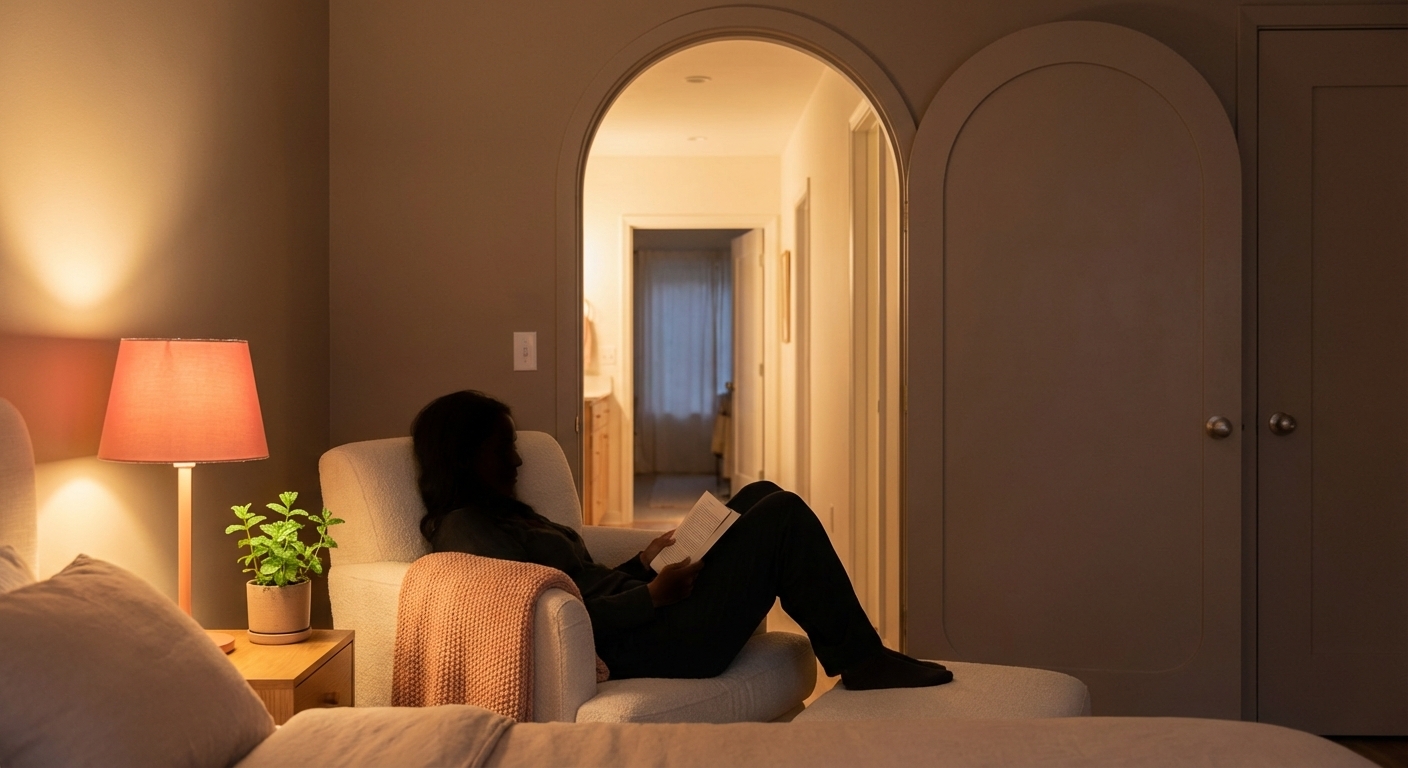
Go to another room. Not the kitchen where bright lights and the fridge might wake you up fully. Go somewhere quiet. Your living room. A cozy chair. Anywhere that feels calm.
Do something gentle and boring. Read a book (nothing too thrilling). Write in your journal. Listen to soft music or a calming podcast. Stretch lightly. The key is low stimulation. No scrolling, no emails, no screens if you can help it.
Wait for sleepiness to return. You'll know it when you feel it: your eyelids get heavy, your thoughts start to drift, your body feels ready. That's your signal. Head back to bed.
Repeat if you need to. Some nights, you might do this twice. That's okay. You're teaching your brain a new way. Be patient with the process.
Making It Easier on Yourself
The middle of the night can feel disorienting. Make your plan ahead of time so you don't have to think when you're groggy.
Set up your space now. Put a pair of cozy slippers (maybe coral or taupe) by your bed. Leave a book or journal in another room where you can easily find it. Keep a small nightlight or dim lamp ready so you're not stumbling in the dark.
Remember: you have a plan now. You're not lying there helpless anymore. You know what to do. That knowledge alone can ease some of the anxiety that keeps you awake.

This Is Temporary, and You're Handling It
Middle-of-the-night wake-ups are one of the most frustrating parts of poor sleep. But with this plan, you're not powerless anymore. You're responding with care, with strategy, with gentleness.
Some nights will be harder than others. That's just true. But you're building new patterns now, and patterns take time to settle in. Every time you get up instead of lying there frustrated, you're reinforcing the connection between your bed and actual sleep.
You're doing this with such grace. Keep going.
See You Tomorrow 🌙
Tomorrow is Day 11, and we're going to talk about something that might surprise you: your bedtime. Not making it earlier, but making it smarter. I'll see you then. Rest well tonight, and remember: you have a plan now.