Home Sleep Apnea Test App: What Works, What Doesn't, and How to Get a Real Diagnosis
This article explains what home sleep apnea test apps can and cannot do when screening for obstructive sleep apnea. It reviews common options like SnoreLab, Sleep Cycle, and the research-based ApneaApp, plus connected devices such as the NightOwl Companion app. It clarifies why smartphone-only tools cannot measure the core signals needed for diagnosis, including airflow, oxygen saturation, and respiratory effort. You will learn how the Apnea-Hypopnea Index (AHI) is used to grade severity and why apps cannot reliably calculate it. It outlines when a validated home sleep apnea test (HSAT) is appropriate, when an in-lab polysomnography may be needed, and what practical risk factors should prompt formal testing. It also describes how CPAP companion apps like ResMed myAir and Philips DreamMapper fit after diagnosis for therapy monitoring.
Struggling with sleep?
Find out if sleep apnea is the reason.
FDA-cleared. $149 flat. Physician-reviewed results in 48 hours.

Home Sleep Apnea Test App: What Works, What Doesn't, and How to Get a Real Diagnosis
A home sleep apnea test app is a smartphone application designed to record or analyze sleep-related data such as snoring, breathing movements, and oxygen levels to screen for signs of obstructive sleep apnea. According to the American Academy of Sleep Medicine, an estimated 30 million adults in the United States have obstructive sleep apnea, yet roughly 80% remain undiagnosed. This article is for anyone considering a phone-based approach to sleep apnea screening, including commercial drivers, people with chronic snoring, and anyone who suspects disrupted breathing during sleep. You will learn which apps exist, how they compare to clinical-grade home sleep apnea tests, where the technology falls short, and how to move from screening to an actual diagnosis. Understanding the difference between a consumer app and a validated home sleep test could change how you approach your sleep health.
Quick Answer
A home sleep apnea test app uses your smartphone microphone, accelerometer, or connected sensor to record snoring and breathing patterns overnight. These apps can flag possible sleep apnea symptoms, but they are not diagnostic devices. A clinical home sleep apnea test, which measures airflow, oxygen saturation, and respiratory effort simultaneously, is required for an actual obstructive sleep apnea diagnosis. dumbo.health offers a validated home sleep test for $149 with physician interpretation included in monthly care plans.
Key Takeaways
- Consumer sleep apnea apps like SnoreLab, Sleep Cycle, and ApneaApp record snoring and movement but cannot measure oxygen saturation or airflow with clinical accuracy
- A validated home sleep apnea test (HSAT) measures at least four channels, including airflow, respiratory effort, oxygen levels, and heart rate, and is the accepted standard for diagnosing obstructive sleep apnea at home
- The Apnea-Hypopnea Index (AHI), measured as events per hour of sleep, is the primary metric used to determine sleep apnea severity, and smartphone apps cannot reliably calculate it
- dumbo.health provides a clinical home sleep test for $149 with no insurance required, plus monthly care plans starting at $59/month that include physician interpretation and CPAP therapy
- Apps can serve as useful pre-screening tools to identify patterns worth discussing with a sleep specialist, but they should never replace a clinical sleep study or home sleep test
- The American Academy of Sleep Medicine recommends that home sleep apnea testing be performed with devices that meet specific technical standards, which smartphone-only solutions currently do not
How Home Sleep Apnea Test Apps Work
Home sleep apnea test apps use built-in smartphone hardware to detect signs of disordered breathing while you sleep. Most rely on the phone's microphone to capture snoring sounds and the accelerometer or gyroscope to track body movement and breathing movements during the night.
Smartphone Sensors Used by Sleep Apps
The microphone is the primary sensor for most sleep apnea screening apps. Apps like SnoreLab and ApneaApp use audio recording to detect snoring intensity, frequency, and duration. ApneaApp, developed at the University of Washington, explored a more advanced approach by emitting frequency-modulated sound signals from the smartphone speaker and using the microphone to detect chest and abdominal breathing movements through sonar-like tracking.
Beyond audio, many apps use the accelerometer and gyroscope to estimate sleep position, restlessness, and total sleep time. Sleep Cycle, for example, uses the accelerometer to analyze movement patterns and estimate sleep stages. Some apps also pair with external hardware. The NightOwl Device, a small fingertip sensor, connects to the NightOwl Companion app to measure oxygen saturation and heart rate using photoplethysmography, which brings the screening closer to clinical-grade data collection.
Smartphones running Android phones and iPhones can access these apps through Google Play and the Apple App Store, making them widely accessible. However, accessibility does not equal clinical validity.
What These Apps Actually Measure
Most apps capture a narrow set of data points. SnoreLab records and scores snoring volume. Sleep Cycle tracks movement and estimates sleep quality. DreamMapper (also known as Philips DreamMapper) is a companion app for existing CPAP users rather than a diagnostic tool. The myAir app by Resmed tracks CPAP therapy data, including mask seal, mask leak, and a myAir score that reflects nightly treatment quality, but it is designed for monitoring ongoing CPAP treatment rather than initial testing.
None of these apps independently measure all four channels required for a validated home sleep test: nasal airflow, respiratory effort, blood oxygen saturation, and heart rate. Without these measurements, calculating a reliable Apnea-Hypopnea Index is not possible.
DID YOU KNOW: The Apnea-Hypopnea Index (AHI) counts the number of apnea and hypopnea events per hour of sleep. According to the American Academy of Sleep Medicine, an AHI of 5 to 14 indicates mild sleep apnea, 15 to 29 indicates moderate, and 30 or above indicates severe.
KEY TAKEAWAY: Sleep apnea apps use smartphone microphones and motion sensors to detect snoring and movement, but they cannot measure the airflow, oxygen, and respiratory effort channels needed for a clinical diagnosis.
Understanding what apps can and cannot measure makes it easier to evaluate specific options on the market today.
Popular Sleep Apnea Apps and What They Offer
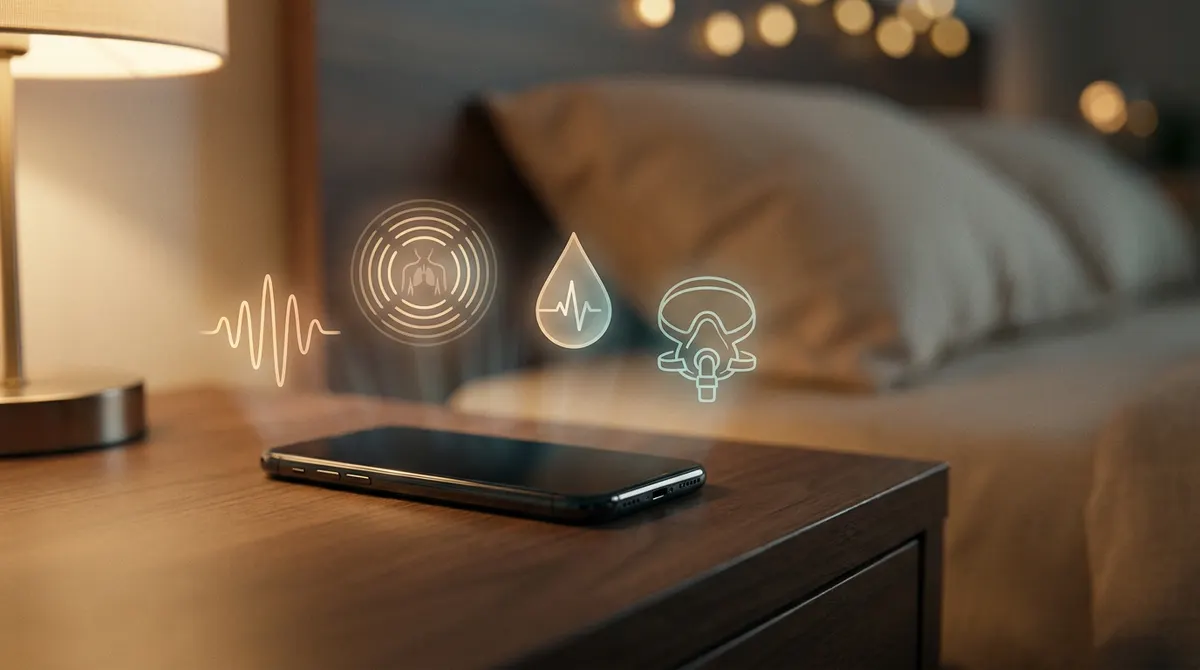
Several apps claim to help users identify sleep apnea symptoms, but their capabilities vary significantly. Knowing the differences helps you decide whether an app is useful as a screening tool or whether you need to move directly to clinical testing.
SnoreLab
SnoreLab is one of the most downloaded snoring analysis apps on both Google Play and the Apple App Store. It records audio throughout the night, measures snoring intensity, and provides a Snore Score. Users can track snoring patterns over time and identify factors that worsen snoring, such as alcohol consumption or sleep position. SnoreLab does not measure oxygen levels, heart rate, or airflow. It is a snoring tracker, not a sleep apnea diagnostic tool.
ApneaApp
ApneaApp was a research project from the University of Washington that used the smartphone speaker to emit inaudible frequency-modulated sound signals. The microphone then captured reflections of those signals from the sleeper's chest to detect breathing movements and breathing pauses. Early research showed promising accuracy for detecting apnea events, and the study used devices including the HTC One during testing. However, ApneaApp was a proof-of-concept and has not been widely released as a consumer product with regulatory clearance for clinical diagnosis.
Sleep Cycle
Sleep Cycle uses the accelerometer (or microphone in older versions) to monitor movement and estimate sleep stages. It provides sleep quality scores and tracks sleep patterns over time. While helpful for general sleep hygiene awareness, Sleep Cycle does not detect apnea events, oxygen desaturation, or hypopnea episodes.
NightOwl Device and Companion App
The NightOwl Device is a small disposable or reusable fingertip sensor that pairs with the NightOwl Companion app to measure oxygen saturation, heart rate, and actigraphy data. This combination provides more clinically relevant information than a smartphone-only app. NightOwl holds certification CE for use in parts of Europe and positions itself as a home sleep apnea test rather than just a screening app. The NightOwlHome Sleep Apnea Test approach bridges the gap between consumer apps and clinical HSAT devices.
CPAP Companion Apps
Apps like myAir by Resmed, DreamMapper by Philips, OSCAR (open-source CPAP analysis software), and CPAP Tracker are designed for people already on CPAP therapy. myAir provides a nightly myAir score based on usage hours, mask seal quality, mask leak data, mask on/off times, and events per hour while on therapy. The AirSense and AirCurve series of CPAP machines from Resmed sync with myAir to track therapy session data. These apps are monitoring and adherence tools, not diagnostic instruments.
Other Notable Apps
Sleepio is a digital sleep therapy program developed with clinical research backing, focused on treating insomnia through cognitive behavioral therapy rather than diagnosing sleep apnea. Sleep by Cleveland Clinic provides sleep education, sleep tips, and a validated sleep questionnaire for general sleep screening. SleepTracker and other sleep tracker apps available on the Apple App Store and Google Play offer general sleep pattern tracking but lack the sensor capabilities for apnea detection.
KEY TAKEAWAY: Consumer apps range from basic snoring recorders to connected sensor platforms, but only devices that measure oxygen, airflow, and respiratory effort simultaneously can support a clinical sleep apnea diagnosis.
Knowing the limits of apps naturally raises the question of how they compare to validated clinical home sleep tests.
Consumer Sleep Apps vs. Clinical Home Sleep Apnea Tests
The most important distinction in home sleep apnea testing is the difference between a consumer app and a clinical-grade home sleep test (HSAT). These serve fundamentally different purposes, and confusing them can delay diagnosis and treatment.
A clinical home sleep apnea test is a medical device prescribed or ordered through a provider that measures multiple physiological channels simultaneously during sleep. The data is then reviewed by a physician who calculates the Apnea-Hypopnea Index and determines whether obstructive sleep apnea is present. Consumer apps, by contrast, provide self-reported or sensor-limited data that may suggest a sleep disorder but cannot confirm one.
Structured Comparison: Consumer App vs. Clinical HSAT
What Is Measured
- Consumer Sleep App: Snoring audio, movement, estimated sleep stages
- Clinical Home Sleep Apnea Test: Nasal airflow, blood oxygen saturation, respiratory effort, heart rate, body position
Diagnostic Validity
- Consumer Sleep App: Screening or awareness only, not clinically validated for diagnosis
- Clinical Home Sleep Apnea Test: Validated for diagnosing obstructive sleep apnea per American Academy of Sleep Medicine guidelines
AHI Calculation
- Consumer Sleep App: Cannot reliably calculate AHI (apnea-hypopnea index)
- Clinical Home Sleep Apnea Test: Produces a clinical apnea-hypopnea score reviewed by a physician
Physician Involvement
- Consumer Sleep App: None unless user shares data with a doctor
- Clinical Home Sleep Apnea Test: Results interpreted by a sleep specialist or qualified physician
Cost
- Consumer Sleep App: Free to $15 per month
- Clinical Home Sleep Apnea Test: $149 through dumbo.health; $300 to $600 through many clinics; $1,000 or more for in-lab polysomnography
Regulatory Status
- Consumer Sleep App: Generally classified as wellness products, not medical devices
- Clinical Home Sleep Apnea Test: FDA-cleared or CE-certified medical devices
For most people who suspect sleep apnea, a clinical home sleep test is the appropriate next step. dumbo.health provides a home sleep apnea test for $149 with no insurance or prior authorization required. The test device measures airflow, oxygen saturation, respiratory effort, and heart rate during one night of sleep at home.
A home sleep apnea test from dumbo.health measures airflow, blood oxygen saturation, respiratory effort, and heart rate during a single night of sleep. The results are interpreted by a physician who calculates the Apnea-Hypopnea Index and determines whether obstructive sleep apnea is present. This process replaces the need for an in-lab polysomnography study for most patients with suspected obstructive sleep apnea.
KEY TAKEAWAY: Consumer sleep apps can flag snoring patterns and poor sleep quality, but only a clinical home sleep apnea test with physician interpretation can produce an official sleep apnea diagnosis.
Once you understand the testing landscape, the next logical question is how the clinical process actually works from start to finish.
How to Get a Validated Home Sleep Apnea Test
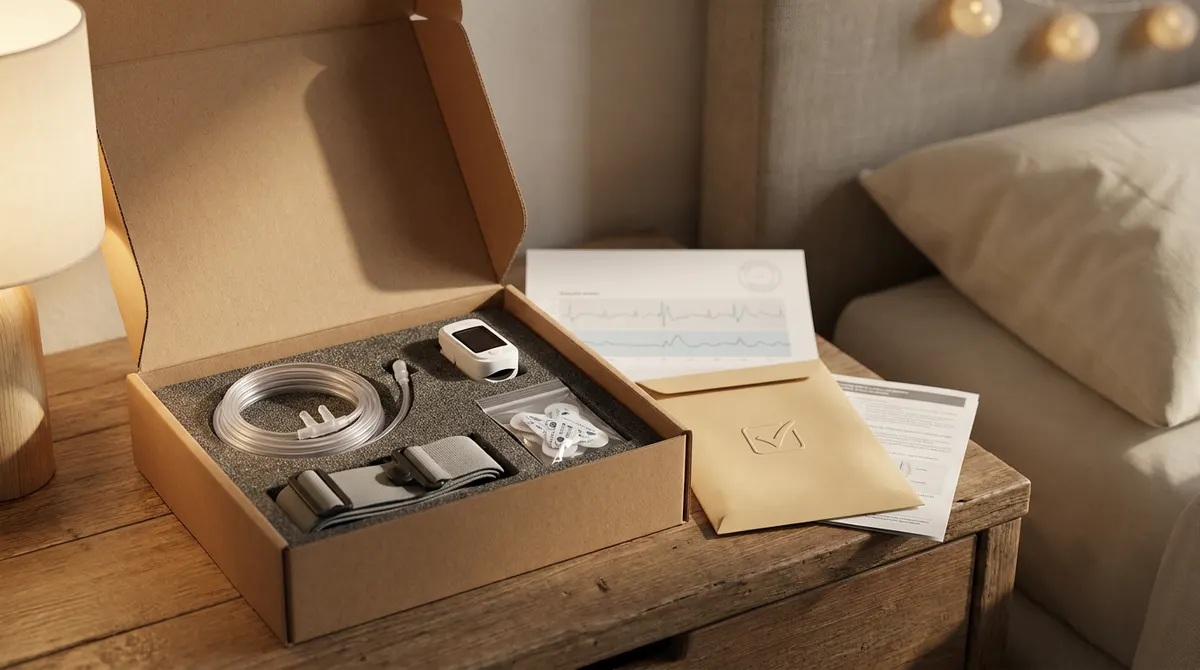
Getting a clinical home sleep test is simpler than most people expect, especially when you use a cash-pay service that removes insurance barriers. The process involves ordering, wearing the device for one night, and receiving a physician-reviewed report.
Step-by-Step Process for Home Sleep Testing
1. Complete an initial screening assessment. dumbo.health offers a free sleep assessment that evaluates your symptoms, risk factors, and medical history to determine whether a home sleep test is appropriate for you.
2. Order your home sleep test device. Through dumbo.health, the test costs $149 as a one-time purchase with no insurance needed and no prior authorizations. The device is shipped directly to your home.
3. Wear the device for one night of sleep. The test typically involves placing a nasal cannula, a finger pulse oximeter sensor, and a chest or abdominal effort belt before going to bed. Follow the included instructions carefully to ensure accurate data collection.
4. Return the device or upload the data. Depending on the specific test system, you either return the device by mail or the data transfers automatically for analysis.
5. Receive your physician-interpreted results. A qualified physician reviews the recorded data, calculates your Apnea-Hypopnea Index, and prepares a diagnostic report. With dumbo.health's Premium Plan at $89/month, you receive priority results turnaround along with ongoing care.
6. Discuss your results and next steps with a provider. If your AHI indicates obstructive sleep apnea, your care team will recommend a treatment plan. dumbo.health's monthly plans include CPAP therapy and equipment if treatment is needed.
After completing these steps, you have a clinical diagnosis and a clear path to treatment. The entire process, from ordering to receiving results, often takes less than two weeks.
IMPORTANT: A home sleep apnea test is designed primarily to diagnose obstructive sleep apnea. If your provider suspects central sleep apnea, a shift work sleep disorder, or other complex sleep disorders, an in-lab polysomnography study may be required instead.
KEY TAKEAWAY: A validated home sleep test follows a straightforward process: screen, order, wear for one night, and receive a physician-reviewed diagnosis, all without needing insurance or a sleep center appointment.
Not everyone is a good candidate for home testing, and understanding the limitations matters for making an informed decision.
Limitations and Risks of Sleep Apnea Apps and Home Testing
Home sleep apnea testing and consumer apps are valuable tools, but they are not appropriate for every person or every situation. Acknowledging these limitations protects your health and ensures you pursue the right diagnostic pathway.
When Consumer Apps Fall Short
Consumer apps cannot detect oxygen desaturation events, which are the hallmark of clinically significant obstructive sleep apnea. A person may have dozens of apnea episodes per night with dangerous drops in oxygen saturation, yet an app recording only snoring audio would miss these entirely. The Sleep Foundation notes that some people with sleep apnea do not snore loudly, which means relying on a snoring app alone could provide false reassurance.
Apps also cannot differentiate between obstructive apnea (caused by physical airway collapse) and central apnea (caused by the brain failing to signal breathing muscles). This distinction is critical because the treatments differ significantly. Central sleep apnea may require specialized devices rather than standard CPAP therapy.
When Home Sleep Tests May Not Be Sufficient
According to the American Academy of Sleep Medicine, home sleep apnea testing (HSAT) is recommended primarily for adults with a high pretest probability of moderate to severe obstructive sleep apnea and no significant comorbid conditions. Home sleep testing may not be appropriate when:
- The patient has significant cardiopulmonary disease, neuromuscular conditions, or a history of central sleep apnea, because these conditions require the additional channels monitored during in-lab polysomnography
- The initial home sleep test result is negative but clinical suspicion remains high, because HSAT can underestimate the AHI due to the inability to distinguish sleep time from wake time as precisely as polysomnography
- The patient has insomnia, insufficient sleep, or a suspected shift work sleep disorder alongside potential sleep apnea, because multiple overlapping sleep disorders complicate interpretation
Data Accuracy Concerns
Smartphone microphones vary in sensitivity across devices. Research conducted with specific models like the HTC One may not generalize to all Android phones or iPhones. Environmental noise, bed partner movement, and device placement all affect recording quality. Even connected devices like smartwatches that track heart rate and movement lack the airflow and respiratory effort channels needed for a complete apnea assessment.
Battery backup is another practical consideration. If a phone or connected sensor runs out of battery during the night, the data is incomplete. Clinical HSAT devices are designed with sufficient battery life, often using stable chemistries like LiFePO4 in some sensor designs, to record a full night reliably.
How dumbo.health Addresses Common Limitations
dumbo.health mitigates several barriers that cause people to delay proper testing. The $149 home sleep test price eliminates cost uncertainty. Cash-pay pricing with no insurance required removes authorization delays. Every test includes access to physician interpretation through a monthly care plan, and the telehealth model means you do not need to find a sleep center near you or schedule an in-person appointment. If your home sleep test results suggest a condition that requires further evaluation, such as possible central sleep apnea, the dumbo.health care team can direct you to the appropriate next step.
KEY TAKEAWAY: Apps cannot measure oxygen or airflow, and home sleep tests have clinical boundaries. Knowing when each tool is and is not appropriate prevents misdiagnosis and ensures you receive the right level of care.
Understanding limitations in the abstract is helpful, but seeing how real people navigate these decisions makes the information more practical.
Real-World Scenarios: When Apps Help and When You Need More
Putting sleep apnea screening into the context of real situations shows where consumer apps add value and where clinical testing becomes necessary.
Common Scenarios
Scenario 1: A 45-year-old long-haul truck driver with a BMI of 34 notices that his partner has recorded him gasping for air during sleep. He downloads SnoreLab and confirms loud, frequent snoring every night for two weeks. The app gives him useful data to share with a provider, but it cannot diagnose sleep apnea. He orders a clinical at-home sleep test through dumbo.health for $149. His results show an AHI of 22 events per hour, confirming moderate obstructive sleep apnea. He enrolls in the Essentials Plan at $59/month and starts CPAP therapy with equipment included. His DOT medical examiner receives the required documentation.
Scenario 2: A 38-year-old office worker experiences daytime fatigue and poor sleep quality but does not snore. She uses Sleep Cycle for a month and notices fragmented sleep patterns with frequent wake periods. The app cannot detect whether her breathing is interrupted during sleep. She completes the free sleep assessment at dumbo.health and learns that her symptoms, combined with a neck circumference above 16 inches, warrant a home sleep apnea test. Her HSAT reveals mild obstructive sleep apnea with an AHI of 8. She begins positional therapy and sleep hygiene changes guided by her care team.
Scenario 3: A 52-year-old owner-operator uses the myAir app with his Resmed AirSense CPAP machine. His myAir score has been declining over the past three weeks, and the app shows increasing mask leak and reduced usage hours. The app helps him identify the problem, but he needs clinical support to adjust his mask fit and reassess his treatment plan. He contacts his provider for a therapy session review. In cases like this, dumbo.health's Premium Plan provides a dedicated sleep coach and advanced adherence monitoring for $89/month, which includes ongoing support for exactly these kinds of treatment challenges.
These scenarios illustrate a consistent pattern: apps provide awareness and tracking, but clinical decisions require validated data and physician oversight.
KEY TAKEAWAY: Consumer apps help users recognize sleep problems and track patterns, but every scenario where sleep apnea is suspected ultimately requires a validated clinical test and professional interpretation.
With real-world context established, it helps to examine the claims and misconceptions that often confuse people researching this topic.
Common Myths About Home Sleep Apnea Test Apps Debunked
Misinformation about sleep apnea apps causes people to either over-rely on unvalidated tools or avoid testing altogether. These myths address the most common decision barriers.
MYTH: A smartphone app can diagnose sleep apnea.
FACT: No smartphone app currently has FDA clearance to diagnose obstructive sleep apnea on its own. The American Academy of Sleep Medicine requires that sleep apnea diagnosis be based on a clinical sleep study, either in-lab polysomnography or a validated home sleep apnea test (HSAT), with results interpreted by a qualified physician. Apps can record snoring and estimate sleep quality, but they cannot replace clinical testing.
MYTH: If my snoring app says I do not snore much, I probably do not have sleep apnea.
FACT: Not all people with sleep apnea snore loudly. The NIH notes that obstructive sleep apnea involves repeated airway collapse during sleep, which can cause silent pauses in breathing, gasps of air, and oxygen desaturation without producing loud snoring every time. A low snoring score on SnoreLab does not rule out sleep apnea.
MYTH: Home sleep tests are less accurate than in-lab sleep studies.
FACT: For diagnosing obstructive sleep apnea in adults with a high pretest probability, validated home sleep tests show strong agreement with in-lab polysomnography. The key difference is that HSAT may slightly underestimate the AHI because it cannot perfectly distinguish sleep from wakefulness. However, for the vast majority of patients with suspected moderate to severe obstructive sleep apnea, an HSAT provides clinically sufficient diagnostic accuracy. The convenience of testing in your own bed also means the sleep data may better reflect your actual sleep patterns than a single night in an unfamiliar sleep center.
MYTH: You need insurance to get a home sleep apnea test.
FACT: Insurance is not required. dumbo.health offers a home sleep test for $149 as a one-time cash payment with no insurance, no prior authorization, and no surprise bills. Monthly care plans covering physician interpretation, CPAP therapy, and follow-up start at $59/month with no contracts.
MYTH: CPAP apps like myAir can tell you if your treatment is working well enough.
FACT: Apps like myAir and DreamMapper provide useful adherence data, including usage hours, mask leak levels, and residual AHI on therapy. However, determining whether treatment is clinically adequate requires physician review. A residual AHI below 5 on CPAP is generally the target, but symptoms, oxygen levels, and overall sleep quality also matter. Using a CPAP companion app without periodic clinical oversight can mask undertreated sleep apnea.
KEY TAKEAWAY: Apps are useful for awareness and tracking, but clinical decisions about sleep apnea diagnosis and treatment adequacy require validated testing and physician involvement.
Now that common misconceptions are clarified, here is a practical checklist for anyone deciding between an app and a clinical test.
Deciding Between a Sleep App and a Clinical Home Sleep Test
Choosing between downloading an app and ordering a clinical test depends on where you are in the process of evaluating your sleep health. This section provides a framework for making that decision.
Pre-Screening Checklist: Do You Need a Clinical Home Sleep Test?
Use this checklist to determine whether your situation calls for more than a consumer app:
- You snore loudly most nights, or a bed partner has observed you stopping breathing or gasping for air during sleep
- You experience excessive daytime sleepiness despite sleeping 7 or more hours
- Your BMI is 30 or above, which the CDC identifies as a risk factor for obstructive sleep apnea
- Your neck circumference is greater than 17 inches (men) or 16 inches (women)
- You have been told by a doctor, DOT medical examiner, or provider that you need a sleep apnea test
- You hold a commercial driver's license and need documentation for your DOT physical
- You have high blood pressure, type 2 diabetes, or atrial fibrillation, all of which are associated with higher sleep apnea prevalence
- You have used a sleep app and it consistently shows loud snoring, fragmented sleep patterns, or both
- You want a definitive diagnosis rather than ongoing uncertainty about your symptoms
- Complete the free sleep assessment at dumbo.health to determine whether a home sleep test is the right next step for you
If you checked three or more items, a clinical home sleep test is likely more appropriate than continued app-based monitoring. For commercial drivers specifically, dumbo.health offers a streamlined path from testing to CPAP treatment that satisfies DOT requirements.
When an App Alone May Be Enough
If you are simply curious about your snoring patterns, want to optimize your sleep hygiene, or are tracking how lifestyle changes affect your sleep quality, a consumer app like SnoreLab or Sleep Cycle can provide useful insights. These apps work well for ongoing self-monitoring after you have already been evaluated by a provider and found not to have sleep apnea.
TIP: If you use a consumer sleep app and notice consistent heavy snoring, frequent awakenings, or declining sleep quality scores over several weeks, treat that as a signal to pursue clinical testing rather than continuing to monitor with the app alone.
KEY TAKEAWAY: A consumer app is reasonable for general sleep awareness, but if you have risk factors or symptoms that suggest sleep apnea, a clinical home sleep test with physician review is the appropriate next step.
With a clear decision framework in place, the final consideration is understanding how treatment and ongoing monitoring work after diagnosis.
What Happens After Diagnosis: Treatment, Monitoring, and the Role of Apps
A positive sleep apnea diagnosis is the beginning of treatment, not the end of the process. CPAP therapy is the most common and effective treatment for moderate to severe obstructive sleep apnea, and apps play a legitimate role in the monitoring phase.
CPAP Therapy and Equipment
CPAP (Continuous Positive Airway Pressure) works by delivering a steady stream of pressurized air through a mask to keep the airway open during sleep. According to the National Heart, Lung, and Blood Institute, CPAP therapy reduces apnea events, improves oxygen levels, and decreases daytime sleepiness when used consistently. The standard clinical target is a minimum of 4 hours of use per night on at least 70% of nights, though more usage generally produces better outcomes.
dumbo.health includes CPAP therapy and equipment in all monthly plans. The Essentials Plan at $59/month covers a CPAP machine, standard follow-up care, and physician interpretation. The Premium Plan at $89/month adds a dedicated sleep coach, advanced adherence monitoring, and priority results turnaround. The Elite Plan at $129/month includes concierge clinical support, direct physician messaging, and custom reporting for referring providers.
Where CPAP Companion Apps Fit
After starting CPAP therapy, apps like myAir by Resmed become genuinely useful. myAir syncs with AirSense and AirCurve devices to track nightly usage, mask seal quality, mask on/off events, mask leak levels, residual events per hour, and an overall myAir score. The Personal Therapy Assistant feature within myAir provides tips for improving comfort and adherence. DreamMapper by Philips offers similar tracking for Philips devices, and OSCAR provides open-source detailed analysis of CPAP data for users who want granular control over their therapy data.
These apps help patients stay engaged with their treatment plan between provider visits. Clinicians frequently observe that patients who regularly check their therapy data maintain higher adherence rates. However, app data alone should not replace periodic clinical review. A declining myAir score or increasing mask leak may indicate a problem that requires professional assessment, such as a mask fitting issue, a pressure adjustment, or a change in the underlying sleep disorder.
Monitoring Sleep Quality Over Time
Beyond CPAP-specific apps, general sleep tracker apps and smartwatches can help you track broader sleep patterns, including total sleep time, sleep stages, and restfulness. While these tools cannot replace clinical monitoring, they provide complementary information that you can share with your sleep health team members during follow-up consultations.
For dumbo.health patients on the Premium or Elite plans, the support team and dedicated sleep coach review adherence data and provide ongoing guidance. This combination of technology-enabled tracking and human clinical oversight represents the most effective approach to long-term sleep apnea care.
KEY TAKEAWAY: CPAP companion apps are valuable monitoring tools for ongoing therapy, but they work best when paired with regular clinical oversight from a provider or sleep care team.
Conclusion
Home sleep apnea test apps serve a real purpose as awareness and screening tools, but they do not replace validated clinical testing for diagnosing obstructive sleep apnea. Understanding where apps fit in the diagnostic process helps you avoid false reassurance and move toward evidence-based care when your symptoms warrant it. If you suspect sleep apnea, the most direct path to answers is a clinical home sleep test with physician interpretation. dumbo.health offers a home sleep apnea test for $149 with no insurance required, no contracts, and monthly care plans starting at $59/month that include CPAP therapy and ongoing clinical support. Getting tested is the step that turns uncertainty into a plan.
Frequently Asked Questions About Home Sleep Apnea Test Apps
What is a home sleep apnea test app?
A home sleep apnea test app is a smartphone application designed to support sleep apnea screening, monitoring, or CPAP therapy management from home. Some apps use the phone's microphone or sensors to record snoring and breathing sounds during sleep. Others connect to CPAP machines to track therapy data such as the apnea-hypopnea index, mask seal, and hours of use. These apps are not the same as a medically validated home sleep apnea test, and a healthcare professional should interpret any results that raise concern.
How do sleep apnea apps work?
Sleep apnea apps work in different ways depending on their purpose. Snore-recording apps use your smartphone's microphone to detect snoring sounds and generate a sleep quality score. CPAP companion apps such as ResMed myAir connect wirelessly to compatible CPAP machines and display therapy data including events per hour, mask leak, and mask on and off times. Some apps use the phone's accelerometer or gyroscope to estimate sleep movement. A small number of research-stage apps have explored using frequency-modulated sound signals to detect breathing interruptions. The American Academy of Sleep Medicine notes that consumer apps vary significantly in accuracy and clinical validation.
Can any app detect sleep apnea on its own?
No app currently available on the Apple App Store or Google Play can diagnose obstructive sleep apnea on its own. Consumer smartphone apps can record snoring, estimate sleep quality, or flag possible breathing disruptions, but they do not produce a clinically validated apnea-hypopnea index. According to the FDA, over-the-counter devices to assess risk of sleep apnea are classified separately from diagnostic tools, and a formal diagnosis of obstructive sleep apnea requires a medically validated home sleep apnea test or an in-lab polysomnography study interpreted by a qualified sleep physician.
What is ApneaApp and how does it work?
ApneaApp is a research-developed smartphone application that uses frequency-modulated sound signals emitted from the phone's speaker and received by its microphone to detect breathing movements and pauses during sleep. It was designed to work without any additional hardware. In research settings, ApneaApp was tested on Android phones including the HTC One. However, ApneaApp is not a clinically approved diagnostic tool and is not available as a validated consumer product for diagnosing sleep apnea. It does not replace a medically validated home sleep apnea test or polysomnography interpreted by a sleep specialist.
Does ApneaApp work on any smartphone?
ApneaApp was originally developed and tested on specific Android devices, including the HTC One, as part of academic research. It was not designed to work universally across all Android or iPhone models. The app relies on precise acoustic signal transmission and reception, which varies across smartphone hardware. Because ApneaApp has not received broad clinical validation or FDA clearance as a diagnostic device, it is not recommended as a reliable standalone tool for sleep apnea testing. A healthcare professional can help determine whether a validated home sleep apnea test is appropriate for your situation.
Would ApneaApp work with two people sharing a bed?
ApneaApp was designed to monitor a single user lying closest to the smartphone. Shared sleeping environments introduce additional breathing sounds, movement noise, and acoustic interference that could reduce the app's ability to isolate one person's breathing patterns accurately. The research behind ApneaApp acknowledged this limitation. If both people in a shared bed are concerned about possible sleep apnea symptoms such as snoring, gasps of air, or daytime sleepiness, a validated home sleep apnea test worn individually during a test night is a more reliable option.
What medically significant metrics does ApneaApp produce?
In research settings, ApneaApp was designed to estimate an apnea-hypopnea score by detecting breathing pauses and shallow breaths using acoustic signals. It aimed to identify obstructive apnea events per hour in a way that could be compared to standard polysomnography results. However, ApneaApp has not been validated as a clinical diagnostic tool for widespread patient use, and the metrics it produces have not been accepted as a substitute for the apnea-hypopnea index generated by a medically validated home sleep apnea test or in-lab sleep study. A sleep physician should interpret any results suggesting abnormal breathing during sleep.
Can I download ApneaApp and get a sleep apnea diagnosis today?
No. ApneaApp was a research project and is not available as an FDA-cleared diagnostic application for consumer download. Even if an app claiming similar functionality were available, a smartphone app cannot provide a clinical sleep apnea diagnosis. Diagnosis of obstructive sleep apnea requires a validated diagnostic study, such as a home sleep apnea test interpreted by a physician or an in-lab polysomnography. If you are experiencing symptoms such as loud snoring, gasps of air during sleep, or significant daytime sleepiness, speaking with a healthcare professional is the appropriate next step.
What is SnoreLab and how does it measure snoring?
SnoreLab is a snore-recording app available on iPhone and Android that uses your smartphone's microphone to record sounds during sleep. It generates a personalised Snore Score based on the intensity and frequency of snoring detected overnight. The standard version of SnoreLab is free but includes ads and offers in-app purchases. Premium editions remove ads and allow full-night recordings, giving you a more complete picture of snoring patterns across the entire sleep period. SnoreLab can help identify snoring trends over time, but it does not diagnose obstructive sleep apnea and is not a substitute for clinical sleep testing.
What is Sleep Cycle and what does it offer?
Sleep Cycle is a sleep tracker app available on iPhone and Android that uses the phone's microphone or accelerometer to estimate sleep stages and wake you during a light sleep phase within a set alarm window. The free version includes basic sleep quality tracking. In-app purchases unlock additional features. A notable feature is access to aggregated global sleep statistics, including comparisons of sleep patterns across different countries and a real-time display of users currently asleep worldwide. Sleep Cycle focuses on sleep quality and timing rather than clinical sleep apnea detection, and it should not be used as a substitute for a validated sleep apnea test.
What is the Sleep by Cleveland Clinic app?
Sleep by Cleveland Clinic is a sleep health app developed with input from Cleveland Clinic sleep specialists. It is available on iPhone and costs $0.99. The app includes a white noise generator to support falling asleep and uses AI-based technology to offer insights into your sleeping patterns based on data you record. It draws on sleep education content developed by Cleveland Clinic experts. Like other consumer sleep apps, it is designed to support general sleep health awareness rather than to diagnose sleep disorders such as obstructive sleep apnea or insomnia. A sleep specialist should be consulted if you have ongoing sleep concerns.
What is the Sleep Cycle family sharing feature?
Some sleep tracker app tiers, including certain premium sleep app plans, offer family sharing that allows up to six people to use the app under a single subscription at a cost of around $4.99. This makes it a practical option for households where multiple family members want to monitor their sleep quality. Family sharing plans typically include access to sleep programs and personalised recommendations. These apps track sleep patterns and quality but do not perform diagnostic testing for sleep apnea. If multiple family members show signs of a sleep disorder, each person should be evaluated individually by a healthcare professional.
What is ResMed myAir?
ResMed myAir is an online support program and companion app developed by ResMed for users of compatible AirSense and AirCurve CPAP and bilevel therapy devices. Shortly after each therapy session, data from the ResMed machine is transmitted wirelessly and made available in the myAir app. Users can access key therapy information including their myAir score, events per hour, mask seal quality, mask on and off times, and hours of use per night. myAir also provides tailored coaching and support through its Care Check-In feature and functions as a Personal Therapy Assistant to help users stay engaged with CPAP treatment.
How does ResMed myAir differ from OSCAR?
ResMed myAir is a consumer-facing app designed to give CPAP users an accessible summary of their nightly therapy data with coaching support and a simplified myAir score. OSCAR is free, open-source software designed for more advanced analysis of CPAP and bilevel therapy data, allowing users and clinicians to review detailed waveforms, flow rate charts, pressure changes, and event classifications such as obstructive apnea, hypopnea, and central apnea. OSCAR is typically used by technically experienced patients or sleep clinicians who want detailed data beyond what myAir displays. Both tools require a compatible ResMed AirSense or AirCurve machine to function.
What is Philips DreamMapper?
Philips DreamMapper is a CPAP companion app developed by Philips for use with compatible Philips CPAP machines. It is available on iPhone and Android, but your CPAP machine must be compatible with the app. DreamMapper is free to use and allows CPAP users to track therapy data, set personal goals to stay motivated with treatment, and review their progress over time. The goal-setting feature is designed to encourage consistent CPAP use, which is important for long-term treatment effectiveness. DreamMapper is a therapy support tool and does not perform sleep apnea diagnosis. Learn more about CPAP therapy and equipment options.
My CPAP app shows a normal AHI but I still feel tired. What could explain that?
A normal apnea-hypopnea index on your CPAP app means your device is controlling breathing events during sleep, but it does not account for all possible causes of daytime fatigue. Other factors that can cause persistent tiredness despite treated sleep apnea include residual upper airway resistance, poor sleep quality from mask discomfort or pressure issues, mask leak, central sleep apnea events not fully resolved by the device, insufficient total sleep time, insomnia, shift work sleep disorder, or an unrelated medical condition. Mayo Clinic explains that daytime sleepiness has many possible causes. A sleep specialist or your treating physician can help identify why fatigue persists despite apparently controlled therapy.
Do I need a sleep apnea app if my CPAP therapy is working well?
A sleep apnea app is not essential if your CPAP therapy is working well and you feel consistently rested. However, CPAP companion apps such as ResMed myAir can still be useful for tracking adherence trends, flagging changes in events per hour, identifying mask seal issues, and maintaining motivation. Regular data review can catch problems early before they affect sleep quality. If you are managing CPAP therapy and want structured adherence monitoring alongside physician oversight, dumbo.health monthly plans include advanced adherence monitoring and physician follow-up as part of ongoing sleep apnea care.
Will CPAP apps track therapy data when I am traveling?
Most CPAP companion apps including ResMed myAir sync data wirelessly when the CPAP machine is connected to a power source and a cellular or Wi-Fi network. Therapy data is generally still recorded locally on the device's SD card even when connectivity is unavailable, and it syncs when a connection is restored. Travelers should check whether their CPAP machine's cellular module works in their destination country, as some AirSense devices use regional network bands. A battery backup compatible with your CPAP machine can maintain therapy during travel without mains power. Check your specific machine documentation or contact your care provider for travel mode details.
What is a NightOwl home sleep study?
The NightOwl home sleep apnea test is a small, single-use sensor worn on the fingertip during sleep that uses photoplethysmography and peripheral arterial tone technology to measure oxygen saturation, heart rate, and breathing patterns overnight. It connects to the NightOwl Companion app on your smartphone, which records and transmits the data for physician interpretation. The NightOwl device is designed to be comfortable and unobtrusive for a single test night at home. Because it captures relevant physiological signals without requiring a laboratory visit, it is classified as a home sleep apnea test rather than a full polysomnography.
How does the NightOwl home sleep study work?
The NightOwl home sleep test involves attaching a small fingertip sensor on the night of your test. The sensor communicates with the NightOwl Companion app installed on your smartphone via Bluetooth. During sleep, the device records peripheral arterial tone signals, oxygen saturation, heart rate, and actigraphy data. After the test night, the data is transmitted for physician review. Results are typically available within a few days. The NightOwl device uses a LiFePO4 chemistry battery for stable overnight performance. This process mirrors the general workflow of other validated home sleep apnea tests used by sleep care providers and telehealth platforms including Sleep Care Online.
How long does it take to get NightOwl home sleep study results?
NightOwl home sleep study results are typically processed and returned within a few business days after the test night data is uploaded through the NightOwl Companion app. Turnaround time can vary depending on the reviewing provider or care platform. Some telehealth sleep care services offer faster results as part of premium plans. If you need prompt results, for example for a DOT physical or an upcoming medical appointment, confirming the expected turnaround with your testing provider in advance is advisable. dumbo.health's Premium and Elite plans include priority results turnaround as part of the monthly plan.
Can I use a NightOwl home sleep test without a prescription?
In the United States, a physician order or prescription is typically required to conduct a home sleep apnea test and have results interpreted for diagnostic purposes. The FDA classifies devices to assess risk of sleep apnea under regulated medical device categories. The NightOwl home sleep test is a medical device used within a supervised care pathway that includes physician interpretation. Platforms such as dumbo.health include physician oversight as part of the testing process, meaning patients do not need to arrange a separate prescription before ordering. A healthcare professional can help determine whether an at-home sleep test is appropriate for your situation.
Is the NightOwl home sleep test covered by insurance?
The NightOwl home sleep test may be covered by insurance depending on your plan, your provider network, and whether prior authorization has been obtained. Coverage varies significantly between insurers and individual policy types. For patients who prefer to avoid insurance complexity, dumbo.health offers a $149 one-time at-home sleep test with transparent cash-pay pricing, no prior authorizations, and no surprise bills. The home sleep test is purchased separately before the test night and is not included in monthly care plans. Cash-pay testing can be a practical option for patients who want clear upfront pricing regardless of their insurance status.
How accurate is a NightOwl home sleep test compared to an in-lab study?
The NightOwl home sleep test has been validated in clinical studies comparing its peripheral arterial tone and photoplethysmography measurements against in-lab polysomnography. Research has shown reasonable agreement for detecting moderate to severe obstructive sleep apnea. However, home sleep apnea tests including the NightOwl device have known limitations. They do not measure brain wave activity, leg movements, or sleep staging, and they may underestimate sleep apnea severity in some patients. The American Academy of Sleep Medicine recommends in-lab polysomnography when a home sleep test result is inconclusive or when central sleep apnea, complex sleep disorders, or significant comorbidities are suspected.
What should I do if my home sleep study shows I have sleep apnea?
If your home sleep study results suggest obstructive sleep apnea, the next step is to discuss the findings with a qualified healthcare professional or sleep physician who can review your apnea-hypopnea index, oxygen saturation data, and clinical symptoms. Treatment options typically include CPAP therapy, positional therapy, or other interventions depending on severity. A physician interpretation report is part of the testing process at dumbo.health, and monthly care plans are available to support CPAP therapy, equipment, and adherence follow-up once a treatment plan is established. Do not start or change treatment without clinician guidance.
Where can I find home sleep testing near me?
Home sleep testing is available through many sleep centers, primary care providers, pulmonologists, and telehealth sleep platforms. Because a home sleep apnea test is conducted at home rather than in a laboratory, your physical location matters less than finding a provider who can ship you a validated test device and arrange physician interpretation. To find options in your area, you can search the American Academy of Sleep Medicine's sleep center directory or ask your primary care provider for a referral. dumbo.health ships at-home sleep tests directly to patients with transparent cash-pay pricing and physician interpretation included, without requiring insurance or prior authorization.
Can sleep health apps detect obstructive sleep apnea?
Consumer sleep health apps currently available on smartphones and smartwatches cannot reliably detect obstructive sleep apnea. Apps that record snoring, estimate sleep stages using actigraphy, or use photoplethysmography via wearables may flag possible risk factors, but they do not produce a validated apnea-hypopnea index and cannot replace a medically validated home sleep apnea test or polysomnography. The Sleep Foundation notes that consumer sleep trackers measure sleep indirectly and have significant accuracy limitations for clinical purposes. If a sleep tracker app or snoring app consistently suggests disrupted breathing, speaking with a healthcare professional about formal sleep apnea testing is a reasonable next step.
What is the difference between a home sleep apnea test and a sleep tracker app?
A home sleep apnea test is a medical-grade device worn during sleep that measures physiological signals such as airflow, oxygen saturation, respiratory effort, and heart rate to produce a clinically validated apnea-hypopnea index. It is used by physicians to diagnose obstructive sleep apnea. A sleep tracker app, in contrast, uses a smartphone's microphone, accelerometer, or gyroscope to estimate sleep quality and movement patterns, or records snoring sounds. Sleep tracker apps are consumer wellness tools and do not produce diagnostic data. Only a medically validated home sleep apnea test interpreted by a qualified physician can support a clinical diagnosis of sleep apnea.
How does sleep apnea affect commercial drivers, and why does testing matter?
Obstructive sleep apnea is a significant concern for commercial drivers because untreated sleep apnea causes excessive daytime sleepiness, which is a known risk factor for drowsy driving and road accidents. The FMCSA does not currently have a published federal sleep apnea rule, but certified medical examiners are required to assess whether a driver's medical condition could impair safe driving, and untreated sleep apnea may affect DOT medical certification. Commercial drivers who show risk factors for sleep apnea during a DOT physical may be referred for a sleep study. Learn more about sleep apnea testing for CDL drivers and what the process involves.
Can a home sleep apnea test support a commercial driver's DOT physical process?
A home sleep apnea test can support the clinical pathway for commercial drivers who are referred for sleep apnea evaluation as part of their DOT physical process. A validated at-home sleep apnea test interpreted by a physician can provide the documentation a certified medical examiner may use when reviewing a driver's fitness for duty. dumbo.health can support testing and care documentation for commercial drivers, but it does not guarantee DOT certification or medical clearance. All certification decisions are made by a certified medical examiner based on the full clinical picture. See the at-home sleep test for truck drivers guide for more detail.
Are you at risk for a sleep disorder?
Common risk factors for obstructive sleep apnea include loud or frequent snoring, observed breathing pauses during sleep, gasping or choking sounds, excessive daytime sleepiness, morning headaches, high blood pressure, a body mass index above 30, a large neck circumference, and being male or postmenopausal. Risk factors for insomnia include stress, irregular sleep schedules, shift work sleep disorder, and certain medications. A validated sleep questionnaire such as the Epworth Sleepiness Scale or STOP-BANG questionnaire can help quantify risk. If multiple risk factors apply to you, a healthcare professional can help determine whether formal sleep testing is appropriate. You can also start with a free sleep assessment at dumbo.health.
Related Home Sleep Apnea Test Topics
- What Is a Home Sleep Apnea Test How At-Home Sleep Testing Works, What It Measures, and Who Needs One
- At Home Sleep Apnea Test with Ring How Ring-Based Sleep Testing Works and Whether It Can Diagnose Sleep Apnea
- Sleep Study for Sleep Apnea What the Test Measures, How It Works, and What Your Results Mean
- Home Sleep Apnea Test Ring How Ring-Based Sleep Testing Works for Sleep Apnea Detection
- How Do You Get a Home Sleep Apnea Test The Complete Guide to At-Home Sleep Testing
- How to Get a Sleep Apnea Test at Home The Complete Guide to Home Sleep Testing
- Home Sleep Apnea Test Types A Clinical Guide to At-Home Sleep Testing Devices and What They Measure
- Sleep Study for Sleep Apnea What Happens, What It Measures, and What Your Results Mean
- What Happens After a Home Sleep Apnea Test Results, Diagnosis, and Next Steps
- Sleep Test What It Measures, How It Works, and What Your Results Mean
- How Is a Home Sleep Apnea Test Done A Complete Guide to At-Home Sleep Testing
- How Does a Home Sleep Apnea Test Work A Complete Guide to At-Home Sleep Testing
- Sleep Apnea Diagnosis How Sleep Apnea Is Detected, Tested, and Confirmed
- Sleep Apnea Test The Complete Guide to Diagnosis, Home Testing, and What Your Results Mean
- How to Get Tested for Sleep Apnea The Complete Guide to Diagnosis, Sleep Studies, and Treatment
- FDA Approved Home Sleep Apnea Test What Devices Are Cleared, How They Work, and How to Get Tested
- Sleep Apnea Testing at Home The Complete Guide to Home Sleep Tests, Devices, and Results
- Sleep Apnea Diagnosis at Home The Complete Guide to Home Sleep Testing
- Best Home Sleep Apnea Test A Clinical Guide to Choosing the Right At-Home Sleep Study
- Sleep Study Test for Sleep Apnea The Complete Guide to Diagnosis, Testing Types, and Next Steps
- Home Sleep Apnea Test FSA Eligible How to Use Your Flexible Spending Account for Sleep Testing
- At-Home Sleep Apnea Test FSA How to Use Your Flexible Spending Account for Sleep Testing
- At Home Sleep Apnea Test HSA How to Use Your Health Savings Account for Sleep Testing
- Home Sleep Apnea Test for Children What Parents Need to Know About Pediatric Sleep Testing
- Sleep Apnea Test at Home The Complete Guide to Home Sleep Testing for Adults
- Home Sleep Apnea Test for Kids What Parents Need to Know About Pediatric Sleep Testing
- Kids at Home Sleep Apnea Test What Parents Need to Know About Pediatric Sleep Testing
- At-Home Sleep Apnea Test for Toddlers What Parents Need to Know About Pediatric Sleep Testing
- Home Sleep Test The Complete Guide to At-Home Sleep Apnea Testing
- Can You Test for Sleep Apnea at Home A Complete Guide to Home Sleep Testing
- Sleep Apnea Testing The Complete Guide to Diagnosis, Home Tests, and What Your Results Mean
- Sleep Apnea Testing Near Me How to Find the Right Test, Provider, and Path to Diagnosis
- Sleep Test at Home The Complete Guide to Home Sleep Apnea Testing
- Home Sleep Testing Companies A Complete Guide to At-Home Sleep Apnea Diagnosis
- CPT for Home Sleep Apnea Test Complete Coding and Billing Guide for Sleep Study Providers
- How to Read Home Sleep Apnea Test Results A Complete Guide to Understanding Your Sleep Study Report
- Sleep Apnea Test at Home with Insurance What Your Plan Actually Covers and How to Get Tested
- Level 3 Home Sleep Apnea Test What It Measures, How It Works, and Who Should Use One
- Home Sleep Apnea Test Type 3 What It Measures, How It Works, and Who It Is For
- Type 3 Home Sleep Apnea Test What It Measures, How It Works, and Who It Is For
- Unattended Home Sleep Apnea Test What It Measures, How It Works, and Who Qualifies
- Portable Home Sleep Apnea Test How It Works, What It Measures, and Who Needs One
- Disposable Home Sleep Apnea Test What It Is, How It Works, and Which Devices Lead the Market
- Home Sleep Apnea Test Strap What Each Belt and Sensor Does and How to Wear Them Correctly
- Home Sleep Apnea Test Finger Sensor How Finger-Based Devices Detect Sleep Apnea at Home
- Requisition for Home Sleep Apnea Test What You Need, Who Can Order It, and How to Get Tested
- Sleep Apnea Sleep Study The Complete Guide to Testing, Diagnosis, and Treatment
- Sleep Test to CPAP How Sleep Apnea Testing Leads to Treatment
- Can a Sleep Study Diagnose Sleep Apnea and Other Sleep Disorders
- Obstructive Sleep Apnea Sleep Study The Complete Guide to Diagnosis, Testing, and Treatment
- Home Sleep Test Cost What You Actually Pay With and Without Insurance
- Polysomnography at Home How Home Sleep Testing Compares to In-Lab Sleep Studies
- Home Sleep Apnea Test FDA Approved What Devices Are Cleared and How They Work
- Home Sleep Apnea Test ICD-10 Codes The Complete Coding and Diagnostic Guide for Sleep Apnea Testing
- What Does a Home Sleep Apnea Test Consist Of Sensors, Equipment, and What to Expect
- Home Sleep Apnea Test Near Me How to Get Tested Without a Sleep Lab Visit
- Home Sleep Apnea Test The Complete Guide to At-Home Sleep Apnea Testing
- How Long Does a Home Sleep Apnea Test Take What to Expect Before, During, and After Testing
- Sleep Apnea Checker How to Screen for Sleep Apnea and What Your Results Mean
- Home Sleep Apnea Test Negative What It Means, Why It Happens, and What to Do Next
- Overnight Home Sleep Apnea Test The Complete Guide to At-Home Sleep Apnea Testing
- Self Home Sleep Apnea Test The Complete Guide to Testing for Sleep Apnea at Home
- Home Sleep Apnea Test Results What Your Report Means and What Happens Next
- Home Sleep Apnea Test Report What Your Results Mean and What Happens Next
- How Does a Sleep Study Diagnose Sleep Apnea
- At Home Sleep Study for Sleep Apnea The Complete Guide to Testing in Your Own Bed
- What to Expect During a Sleep Study for Sleep Apnea
- Sleep Study Apnea Hypopnea Index What Your AHI Score Means and Why It Matters
- Disadvantages of Home Sleep Testing What Patients and Providers Need to Know
- Home Sleep Testing The Complete Guide to Diagnosing Sleep Apnea From Your Own Bed
- Home Sleep Apnea Testing The Complete Guide to Diagnosing Sleep Apnea at Home
- Home Sleep Apnea Test Cost What You Actually Pay With and Without Insurance
- CPAP Test What It Is, How It Works, and What Your Results Mean
- Sleep Apnea Test Near Me How to Find Local and At-Home Testing Options
- Home Sleep Apnea Test CPT Code Complete Coding and Billing Guide for Sleep Studies
- CPAP Test at Home The Complete Guide to Home Sleep Apnea Testing and Treatment
- Home Sleep Apnea Test Indications Who Qualifies and When At-Home Testing Is Clinically Appropriate
- Home Sleep Apnea Test Guidelines Clinical Standards, Eligibility, and What Every Patient Should Know
- Home Sleep Apnea Test Parameters What Every Measurement Means and Why It Matters
- Can a Home Sleep Apnea Test Be Wrong Accuracy, False Negatives, and What to Do Next
- Home Sleep Apnea Test Questionnaire Screening Tools, Risk Scores, and What Happens Next
- Home Sleep Apnea Test False Negative Why It Happens and What to Do Next
- How Much Does a Home Sleep Apnea Test Cost Complete Pricing Breakdown for Self-Pay and Insured Patients
- What Is the Best At-Home Sleep Apnea Test A Clinical Comparison of Devices, Accuracy, and Cost
- At-Home Sleep Apnea Test False Positive Why It Happens and What to Do Next
- Level 2 Home Sleep Apnea Test The Complete Guide to At-Home Sleep Diagnostics
- Can Sleep Apnea Be Diagnosed Without a Sleep Study
- Where Can I Get a Take-Home Sleep Study Kit
- Can I Get a CPAP Machine After a Home Sleep Apnea Test
- At-Home Sleep Apnea Test The Complete Guide to Testing, Results, and Treatment
- Does Insurance Cover a Home Sleep Apnea Test What You Actually Pay
- Does Medicare Cover a Home Sleep Apnea Test What Beneficiaries Need to Know
- How Do Home Sleep Apnea Tests Compare to In-Lab Sleep Studies
- Can Dentists Prescribe a Home Sleep Apnea Test What You Need to Know
- What Is the Cost of a Sleep Apnea Test at Home
- At-Home Sleep Apnea Test Covered by Medicaid What You Need to Know Before Getting Tested
- Home Sleep Apnea Test Medicaid Coverage What Patients Need to Know
- CPT Code for Home Sleep Apnea Test The Complete Coding and Billing Guide
- Can My Doctor Prescribe a Home Sleep Apnea Test What You Need to Know
- Are Home Sleep Apnea Tests Reliable Clinical Evidence, Accuracy, and What the Data Actually Shows
AI summary
A home sleep apnea test app is a consumer smartphone tool that records sleep-related signals such as snoring audio and movement to screen for possible obstructive sleep apnea (OSA). These apps commonly use the microphone, accelerometer, or gyroscope, and some pair with external sensors. Consumer examples include SnoreLab (snoring intensity and Snore Score) and Sleep Cycle (movement-based sleep estimates). ApneaApp (University of Washington) used frequency-modulated sound to detect breathing movement but is not a widely released, clinically cleared diagnostic product. CPAP companion apps such as ResMed myAir and Philips DreamMapper track treatment data (usage, mask leak, events per hour) after therapy starts. A validated home sleep apnea test (HSAT) is different. It measures multiple channels, including nasal airflow, blood oxygen saturation, respiratory effort, and heart rate, enabling a physician to calculate the Apnea-Hypopnea Index (AHI). AHI thresholds are 5–14 mild, 15–29 moderate, and 30+ severe. HSAT may be inappropriate with significant comorbidities, suspected central sleep apnea, or persistent symptoms after a negative test, where in-lab polysomnography may be needed.

Nicolas Nemeth
Co-Founder
Nico is the co-founder of Dumbo Health, a digital sleep clinic that brings the entire obstructive sleep apnea journey home. Patients skip the sleep lab and the long wait to see a specialist. Dumbo Health ships an at home test, connects patients with licensed sleep clinicians by video, and delivers CPAP or a custom oral appliance with ongoing coaching and automatic resupply in one clear subscription.
Keep reading

VA At Home Sleep Apnea Test: The Complete Guide for Veterans

Requisition for Home Sleep Apnea Test: What You Need, Who Can Order It, and How to Get Tested


