Home Sleep Apnea Test False Negative: Why It Happens and What to Do Next
A false negative home sleep apnea test happens when HSAT results look normal even though obstructive sleep apnea is present. This guide explains why missed diagnoses occur, especially in mild apnea, and why HSATs can undercount events because they use recording time instead of true sleep time. It reviews common technical failures like signal loss, displaced nasal cannula, loose effort belts, or a slipped pulse oximeter. It also covers clinical drivers such as positional apnea, night-to-night variability, insomnia, and medication or alcohol effects. You will learn symptoms and risk factors that should override a negative test, including STOP-BANG and Epworth Sleepiness Scale thresholds. It outlines next steps: physician review of raw data, repeat or multi-night HSAT, or in-lab polysomnography when suspicion stays high.
Struggling with sleep?
Find out if sleep apnea is the reason.
FDA-cleared. $149 flat. Physician-reviewed results in 48 hours.

Home Sleep Apnea Test False Negative: Why It Happens and What to Do Next
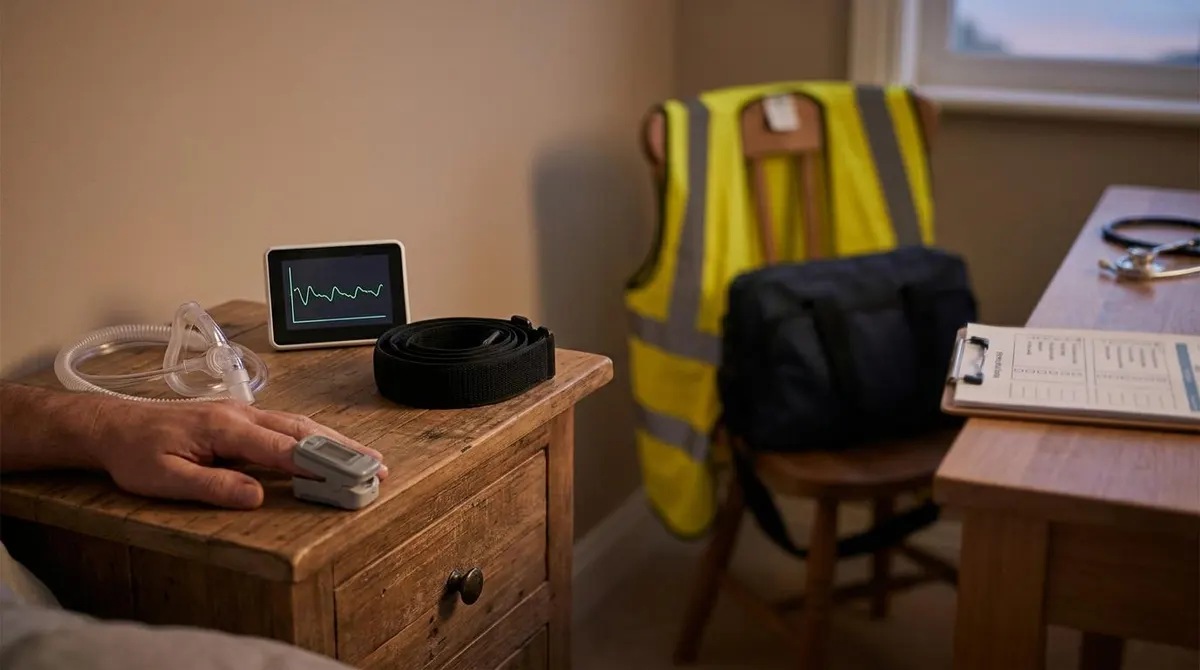
A home sleep apnea test false negative occurs when the test shows normal results despite the presence of obstructive sleep apnea. According to the American Academy of Sleep Medicine, home sleep apnea tests can underestimate the severity of sleep disordered breathing in certain patients, meaning some people receive a missed diagnosis after testing at home. This article is for commercial drivers, CDL holders, and anyone who suspects their home sleep test results may not tell the full story. You will learn why false negatives happen, which clinical and technical factors contribute to inaccurate results, how to recognize when further testing is needed, and what steps to take if your home sleep study does not match your symptoms. Understanding this topic could protect both your health and your livelihood.
Quick Answer
A home sleep apnea test false negative happens when the test fails to detect obstructive sleep apnea that is actually present. Common causes include sensor displacement, mild apnea severity, night-to-night variability in breathing patterns, and the inability of home devices to measure brain activity or sleep staging. If clinical suspicion remains high after a negative result, a follow-up polysomnography or repeat home test is recommended. dumbo.health provides physician-reviewed home sleep testing starting at $149 with clinical oversight to reduce the risk of missed diagnoses.
Key Takeaways
- Home sleep apnea tests can produce false negatives in up to 17% of cases according to some clinical estimates, particularly in patients with mild obstructive sleep apnea.
- Unlike polysomnography, home sleep tests do not measure brain activity, sleep architecture, or sleep staging, which limits their ability to detect all apnea events.
- Sensor issues such as signal loss during the night, displaced nasal cannula, or loose respiratory effort belts are among the most common technical causes of false negative results.
- Clinical suspicion based on symptoms like loud snoring, witnessed apnea events, and excessive daytime sleepiness should override a single negative home sleep study result.
- The AASM recommends follow-up polysomnography when a home sleep apnea test is negative but pretest probability of sleep apnea remains high.
- dumbo.health offers a $149 home sleep test with physician interpretation included in monthly plans starting at $59/month, helping ensure your results receive proper clinical review.
What Is a Home Sleep Apnea Test and How Does It Work
A home sleep apnea test is a simplified sleep study performed in your own bed that records breathing patterns, oxygen saturation, heart rate, and airflow to screen for obstructive sleep apnea. The American Academy of Sleep Medicine classifies these devices as Type III or Type IV portable monitors.
Channels Measured by a Typical Home Sleep Test
Most home sleep testing devices measure between four and seven channels. A standard setup includes a nasal pressure cannula to track airflow, a pulse oximeter on the finger to monitor blood oxygen levels and heart rate, and respiratory effort belts worn around the chest and abdomen to detect breathing effort. Some devices also include a microphone or vibration sensor to capture the Snore Index.
The key metric generated by a home sleep apnea test is the Respiratory Event Index, which is similar to the apnea-hypopnea index used in polysomnography. This index counts the number of apnea events and hypopneas per hour of recording time. A Respiratory Event Index of 5 or higher, combined with symptoms, typically supports a diagnosis of obstructive sleep apnea.
What a Home Sleep Test Does Not Measure
Unlike in-lab polysomnography, home sleep apnea testing does not include electroencephalography to measure brain activity, electrooculography to track eye movements, or electromyography to record muscle activity. This means the device cannot perform sleep staging or detect how much time you actually spent asleep versus lying awake. The test also cannot reliably detect central sleep apnea, insomnia, narcolepsy, or other sleep disorders that require detailed sleep architecture data.
This distinction matters because the home sleep test calculates events per hour of recording time, not per hour of actual sleep. If you spent two hours lying awake, those hours still count in the denominator, which dilutes the severity score and can contribute to a false negative result.
DID YOU KNOW: The AASM estimates that home sleep apnea tests have a sensitivity of approximately 83% to 97% for moderate to severe obstructive sleep apnea, but sensitivity drops significantly for mild cases, which is where most false negatives occur.
KEY TAKEAWAY: A home sleep apnea test measures breathing, oxygen, and airflow but cannot assess brain activity or sleep staging, which creates an inherent risk of underestimating apnea severity.
Understanding what a home sleep test can and cannot detect is the first step toward recognizing why false negative results happen in the first place.
Why Home Sleep Apnea Tests Produce False Negatives
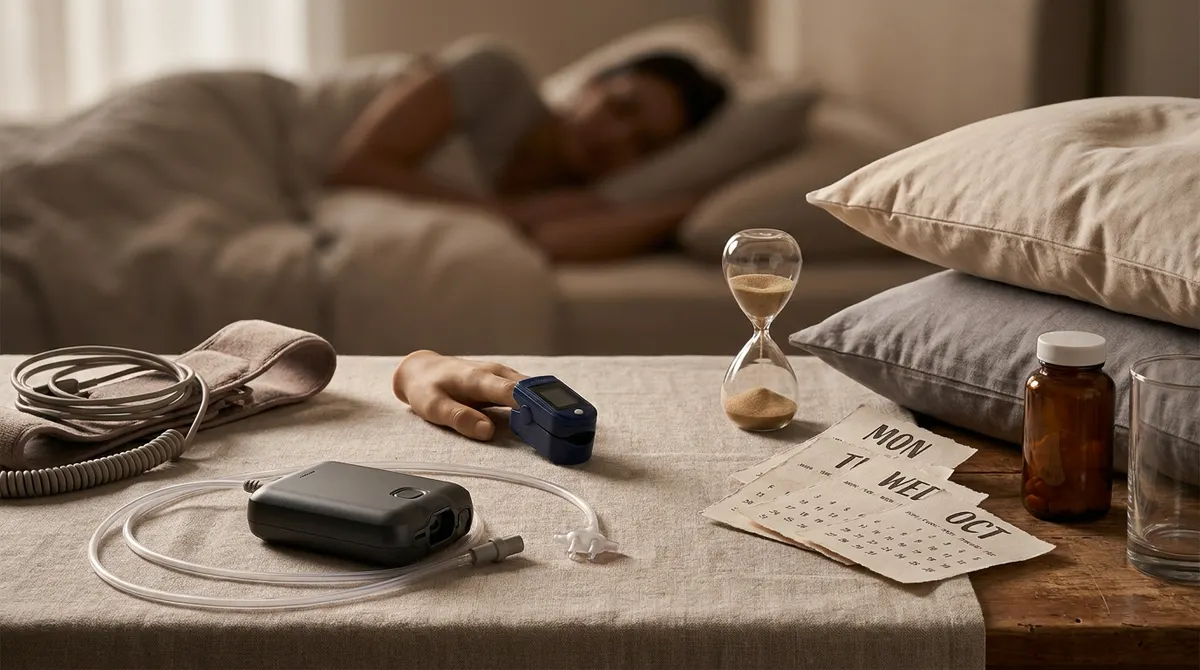
False negatives from home sleep apnea testing occur when technical, physiological, or situational factors cause the test to undercount or miss apnea events entirely. Recognizing these causes helps patients and providers make better decisions about follow-up testing.
Technical Causes of False Negative Results
Equipment-related problems are the most preventable cause of false negative studies. Signal loss during the night from a displaced sensor can render portions of the recording unusable. If the nasal cannula shifts out of position, airflow data becomes unreliable. Loose respiratory effort belts around the chest or abdomen may fail to capture breathing effort accurately, and a pulse oximeter that slips off the finger loses oxygen saturation and heart rate data.
A study published through the National Institutes of Health found that technically inadequate recordings occur in roughly 5% to 18% of home sleep studies, depending on the device and the patient population. When significant signal loss occurs, the remaining data may not reflect the true severity of the sleep condition.
Physiological and Clinical Causes
Several patient-specific factors increase the risk of a false negative sleep apnea test result:
- Mild obstructive sleep apnea with an apnea-hypopnea index between 5 and 15 is the most commonly missed severity range because the event count is low enough to fall below the diagnostic threshold on a single night of testing.
- Night-to-night variability in breathing patterns means one recording may capture a relatively good night while the patient typically experiences more severe apnea events on other nights. This first night effect can work in both directions, but for home testing it often results in undercounting.
- Positional dependence is another factor. Some patients experience apnea events primarily when sleeping on their back. If you sleep mostly on your side during the test night, fewer events are recorded.
- Co-morbidities such as insomnia, chronic pain, or anxiety may reduce total sleep time during the test, and since the device cannot distinguish sleep from wakefulness, the denominator inflates while the event count stays low.
- Medications including sedatives, muscle relaxants, or alcohol consumed before the test can alter sleep architecture and suppress certain breathing patterns, further masking symptoms.
The Denominator Problem
The most underappreciated reason for false negatives in home sleep testing is the denominator problem. Polysomnography in a sleep center calculates the apnea-hypopnea index using actual sleep time confirmed by electroencephalography. A home sleep test uses total recording time instead. For a patient who records 8 hours but only sleeps 5 hours, the home test spreads the same number of events across 8 hours, producing a lower severity score. This mathematical dilution can shift a true mild or moderate case below the diagnostic threshold.
IMPORTANT: A negative home sleep apnea test does not rule out obstructive sleep apnea. The American College of Chest Physicians and the AASM both recommend that clinical suspicion should guide the decision to pursue further testing, regardless of a single negative result.
KEY TAKEAWAY: False negatives from home sleep tests arise from sensor problems, mild severity, night-to-night variability, positional factors, and the inability to measure actual sleep time, all of which can undercount apnea events.
Knowing why false negatives happen naturally leads to the question of how to tell whether your results might be inaccurate.
How to Recognize a Potential False Negative Sleep Apnea Test Result
A false negative sleep apnea test result should be suspected whenever your symptoms do not match the test outcome. Clinical suspicion remains the most reliable guide when a single home sleep study comes back normal.
Symptoms That Suggest Sleep Apnea Despite a Negative Test
If your home sleep test results show a normal Respiratory Event Index but you experience persistent symptoms, the result may not reflect your true condition. Key warning signs include:
- Loud, chronic snoring reported by a bed partner or household member
- Witnessed pauses in breathing during sleep
- Gasping or choking episodes that wake you from sleep
- Excessive daytime sleepiness that interferes with driving, work, or daily functioning
- Morning headaches that resolve within a few hours of waking
- Night sweats without another medical explanation
- Difficulty concentrating or cognitive limitations during the day
- Unrefreshing sleep despite spending adequate time in bed
The Epworth Sleepiness Scale is a validated questionnaire used by sleep medicine physicians to quantify daytime sleepiness. A score of 10 or higher suggests clinically significant sleepiness that warrants further investigation, even if the home sleep study was negative. The STOP-BANG questionnaire is another screening tool that evaluates risk factors including snoring, tiredness, observed apnea, blood pressure, body mass index above 35, age over 50, neck circumference greater than 40 cm, and male gender. A STOP-BANG score of 5 or higher indicates high probability of moderate to severe obstructive sleep apnea.
Physical Risk Factors to Consider
Certain physical characteristics increase the pretest probability of obstructive sleep apnea and should factor into whether a negative home test is trusted. These include a body mass index of 30 or higher, a neck circumference (sometimes referred to as collar size) of 17 inches or more in men or 16 inches or more in women, a crowded or narrow airway, and a history of nasal obstruction. According to the Sleep Foundation, approximately 60% of moderate to severe obstructive sleep apnea cases are found in patients with a BMI over 30.
When Your Provider Should Order Additional Testing
A sleep medicine physician or sleep specialist should consider ordering a follow-up polysomnography or a repeat home sleep test when:
- The HSAT is negative but clinical suspicion of sleep apnea is high based on symptoms and risk factors
- The recording was technically inadequate due to signal loss or equipment malfunction
- The patient has co-morbidities that may confound home testing accuracy, such as central sleep apnea, insomnia, narcolepsy, or chronic heart failure
- The patient reports that the test night was not representative of their typical sleep
Clinicians frequently observe that patients dismiss persistent symptoms after receiving a negative test result, which can lead to treatment deferment. If your physician or provider is not a sleep specialist, requesting a referral to a sleep medicine provider or sleep centers in your area can ensure the result receives appropriate clinical judgement.
KEY TAKEAWAY: Persistent symptoms like loud snoring, witnessed apnea events, and excessive daytime sleepiness should prompt further evaluation even when a home sleep apnea test returns negative results.
The next logical step after recognizing a potential false negative is understanding exactly what to do about it.
What to Do After a Suspected False Negative Home Sleep Test
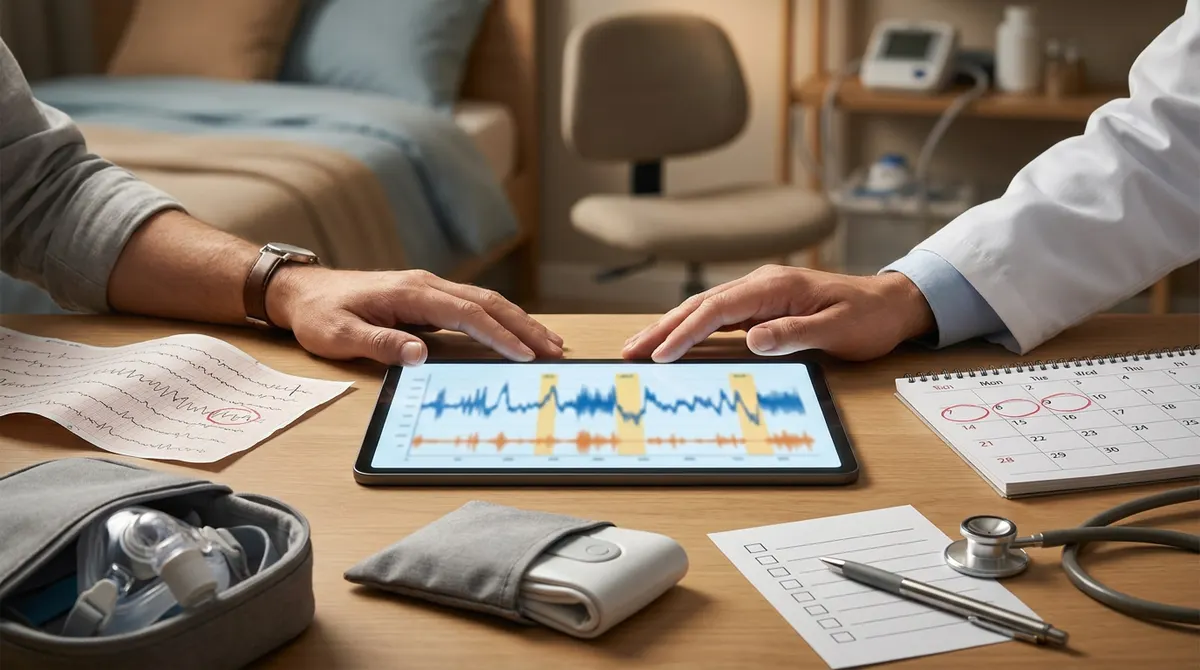
The appropriate response to a suspected false negative is not to ignore the result or assume you are healthy. Follow-up testing guided by a sleep specialist is the clinical standard when symptoms and risk factors do not align with a negative home sleep study.
Step-by-Step Process for Addressing a Suspected False Negative
1. Review your test data with a sleep medicine physician who can assess the recording quality, check for signal loss, and determine whether the study was technically adequate.
2. Complete a validated screening tool such as the STOP-BANG questionnaire or Epworth Sleepiness Scale to quantify your symptom burden and risk profile.
3. Discuss your test night with your provider, including how much time you spent awake, your sleep position, any medications taken, and whether the night felt representative of your usual sleep.
4. Request a follow-up polysomnography at an accredited sleep center if clinical suspicion remains high, as in-lab testing measures brain activity, sleep staging, and sleep architecture that home tests cannot capture.
5. Consider multi-night testing if your provider suspects night-to-night variability contributed to the negative result, since repeating the home sleep test over two or more nights can improve diagnostic accuracy.
6. Order a home sleep test through dumbo.health for $149 if you need a repeat test with physician interpretation included as part of a care plan, ensuring your results receive clinical review rather than being returned without context.
7. Follow through on the recommended pathway, whether that means proceeding to CPAP therapy, scheduling an in-lab study, or pursuing additional evaluation for other sleep disorders.
After completing these steps, you will have either confirmed or ruled out obstructive sleep apnea with a higher degree of confidence. The goal is to avoid treatment deferment based on a single test that may have been inaccurate.
Why Physician Interpretation Matters
Raw data from a home sleep apnea test requires expert review. The device generates a recording, but the interpretation determines whether the result is clinically meaningful. A sleep medicine physician examines the tracing for artifacts, evaluates the quality of each sensor channel, and applies clinical judgement to determine whether the study is reliable. Without this layer of review, a technically inadequate study can be reported as normal.
dumbo.health addresses this directly. Every home sleep test ordered through dumbo.health includes physician interpretation as part of the Essentials Plan at $59/month. The Premium Plan at $89/month adds a dedicated sleep coach and advanced adherence monitoring for patients who proceed to CPAP therapy. This structure ensures that no patient receives a raw result without professional clinical review.
TIP: If you received a home sleep test result from another provider and are unsure about its accuracy, you can take the free sleep assessment at dumbo.health to evaluate whether retesting is warranted.
KEY TAKEAWAY: A suspected false negative should trigger a structured follow-up process that includes physician review of the original data, validated symptom screening, and consideration of in-lab polysomnography or repeat testing.
Understanding how home testing compares to in-lab polysomnography clarifies why the gold standard test catches cases that home devices miss.
Home Sleep Apnea Test vs. In-Lab Polysomnography: Accuracy Comparison
In-lab polysomnography remains the gold standard for diagnosing sleep disorders because it measures a comprehensive set of physiological signals that home devices cannot replicate. Understanding the differences between these two approaches is essential when evaluating whether a home sleep test result is trustworthy.
Channels Measured
- Home Sleep Apnea Test: 4 to 7 channels including nasal pressure airflow, pulse oximetry for oxygen saturation and heart rate, and Respiratory Inductance Plethysmography belts for breathing/respiratory effort
- Polysomnography: 16 or more channels including all home test channels plus electroencephalography for brain activity, electrooculography for eye movements, electromyography for muscle tone, electrocardiography, leg movement sensors, body position monitoring, and audio/video recording
Sleep Staging Capability
- Home Sleep Apnea Test: Cannot perform sleep staging because no brain activity monitoring is included
- Polysomnography: Full sleep staging with identification of NREM stages 1, 2, 3 and REM sleep, providing complete sleep architecture data
Apnea Severity Metric
- Home Sleep Apnea Test: Calculates the Respiratory Event Index using total recording time as the denominator
- Polysomnography: Calculates the apnea-hypopnea index using actual sleep time confirmed by electroencephalography, producing a more accurate severity score
Detection of Central Sleep Apnea
- Home Sleep Apnea Test: Cannot reliably distinguish central sleep apnea from obstructive sleep apnea in most devices
- Polysomnography: Differentiates central and obstructive events using respiratory effort belts combined with airflow sensors and brain activity data
Cost
- Home Sleep Apnea Test: Typically $149 to $500 out of pocket, with dumbo.health offering home sleep testing at $149
- Polysomnography: Often $1,000 to $3,000 or more, depending on location and insurance coverage
Setting
- Home Sleep Apnea Test: Your own bed at home, no travel required
- Polysomnography: Sleep center or hospital, requiring an overnight stay with technician monitoring
Best For
- Home Sleep Apnea Test: Patients with high pretest probability of moderate to severe obstructive sleep apnea and no significant co-morbidities
- Polysomnography: Patients with suspected central sleep apnea, co-existing sleep disorders, inconclusive or negative home test results despite high clinical suspicion, or complex medical histories
For most patients with a straightforward clinical picture and high probability of obstructive sleep apnea, a home sleep apnea test is an appropriate and cost-effective first step. However, when the home test is negative and symptoms persist, polysomnography provides the definitive answer. The AASM guidelines are clear that a negative HSAT should not be used as the sole basis for excluding obstructive sleep apnea when clinical suspicion is high.
KEY TAKEAWAY: Home sleep tests are effective screening tools for moderate to severe obstructive sleep apnea, but polysomnography remains necessary when home test results do not match the clinical picture due to its superior measurement capabilities.
Comparing the two tests makes it clear that certain patient populations face a higher risk of receiving false negative results from home testing.
Who Is Most at Risk for a False Negative Home Sleep Test
Certain patients are more likely to receive a false negative from a home sleep apnea test due to specific clinical, demographic, or technical factors. Identifying these risk groups helps providers make better testing decisions upfront.
Patients with Mild Obstructive Sleep Apnea
Patients whose true apnea-hypopnea index falls between 5 and 15 are the most vulnerable to false negative home sleep test results. Because the event count is already low, any data loss, recording time inflation, or positional variability can push the calculated score below the diagnostic cutoff. A study referenced through PubMed found that home sleep tests miss approximately 17% of mild obstructive sleep apnea cases that would be detected by in-lab polysomnography.
Patients with Significant Insomnia
Patients who experience insomnia alongside suspected sleep apnea present a particular challenge for home testing. Extended periods of wakefulness during the recording inflate the denominator used to calculate the Respiratory Event Index. This dilution effect can transform a moderate case into what appears to be a normal result. Since the home sleep test cannot distinguish sleep from wakefulness, the equipment has no way to correct for this.
Patients with Central Sleep Apnea or Complex Sleep Disorders
Home sleep apnea testing is designed to detect obstructive sleep apnea. It does not reliably identify central sleep apnea, which involves pauses in breathing caused by the brain failing to signal the respiratory muscles rather than a physical airway obstruction. Patients with suspected central sleep apnea, narcolepsy, or other complex sleep disorders require in-lab polysomnography for accurate diagnosis.
Patients Who Are Unfamiliar with the Equipment
Incorrect sensor placement is a common cause of technically inadequate recordings. Patients who do not receive clear instructions or who have cognitive limitations that make self-application of the equipment difficult may generate recordings with significant signal loss. If the nasal cannula, pulse oximeter, or respiratory effort belts are not properly positioned, the resulting data may be incomplete.
Commercial Drivers and CDL Holders
Commercial drivers face unique pressure around sleep apnea testing. The FMCSA requires that drivers with suspected sleep apnea be evaluated, and a false negative can lead to treatment deferment that puts both the driver and the public at risk. A 42-year-old long-haul truck driver with a body mass index of 34, a neck circumference of 18 inches, and reports of chronic snoring would be considered high risk for obstructive sleep apnea. If that driver's home sleep test comes back negative, it should not be accepted at face value. Clinicians frequently observe that drivers in this risk category benefit from physician-reviewed testing with structured follow-up. dumbo.health provides this through its sleep apnea care solutions, where every test is reviewed by a physician and ongoing care is available through monthly plans with no contracts.
KEY TAKEAWAY: Patients with mild apnea, insomnia, central sleep apnea, equipment handling difficulties, or high-risk profiles such as commercial drivers are most likely to receive a false negative from a home sleep test and should be considered for follow-up testing.
Knowing who is at risk raises the question of what practical steps can reduce the chance of a false negative in the first place.
How to Reduce the Risk of a False Negative on Your Home Sleep Test
Proper preparation and correct use of the testing equipment are the most effective ways to minimize the chance of a false negative home sleep apnea test result. Most preventable false negatives stem from technical errors that patients can address themselves.
Pre-Test Preparation Checklist
- Confirm you have received clear written or video instructions for applying all sensors before your test night
- Avoid alcohol for at least 24 hours before the test, as it can alter breathing patterns and sleep architecture
- Avoid sedative medications on the test night unless prescribed and discussed with your doctor
- Try to sleep on your back for at least part of the night if your usual sleep includes supine positioning, since positional obstructive sleep apnea is common
- Ensure your fingernail is clean and free of nail polish on the finger where the pulse oximeter will be placed
- Charge the device fully or confirm battery status per the equipment instructions
- Choose a test night that represents your typical sleep routine and environment
- Complete the free sleep assessment at dumbo.health before testing to help determine whether a home test is the right starting point for your situation
- Keep a phone or support contact number accessible in case you have questions during setup
Sensor Application Tips
Correct sensor placement is the single most impactful factor in producing a reliable recording. The nasal cannula should rest securely in both nostrils with the tubing looped over both ears and secured under the chin. The pulse oximeter should sit snugly on the index or middle finger without being so tight that it restricts circulation. Respiratory effort belts should be positioned around the chest at nipple level and around the abdomen at navel level, firm enough to detect movement but not so tight they are uncomfortable.
If any sensor feels loose when you lie down, adjust it before falling asleep. Signal loss during the night from a single displaced sensor can compromise the entire recording. Many patients report that practicing the setup once during the daytime helps them apply the equipment more confidently at night.
Consider Multi-Night Testing
A single night of home sleep testing captures one snapshot of your breathing. Night-to-night variability in apnea severity is well documented, and the first night effect can influence results in either direction. Multi-night testing, where the device is worn for two or more consecutive nights, increases the likelihood of capturing a representative sample of your sleep patterns.
Some providers and devices now support multi-night protocols. If your initial home sleep test was negative and your symptoms persist, asking your sleep medicine provider about multi-night testing is a reasonable next step before proceeding to an in-lab study.
dumbo.health's home sleep test at $149 covers one night of testing with a physician-reviewed interpretation. If a repeat test is clinically indicated, the process is straightforward and does not require insurance authorization or prior approval.
KEY TAKEAWAY: Correct sensor placement, proper pre-test preparation, and consideration of multi-night testing are the most effective strategies for reducing the risk of a false negative home sleep apnea test result.
Even with optimal preparation, there are situations where a home sleep test is simply not the right diagnostic tool.
Limitations and Risks: When a Home Sleep Test May Not Be the Right Choice
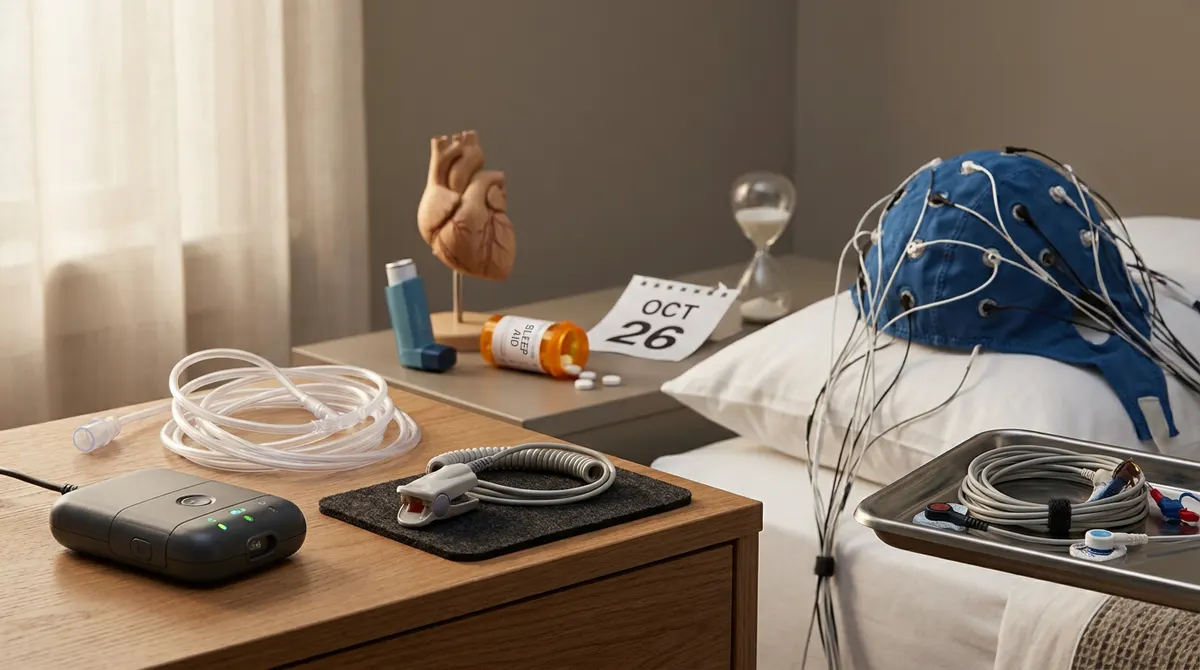
A home sleep apnea test is not appropriate for every patient. Recognizing its limitations prevents misdiagnosis and ensures patients who need comprehensive evaluation receive it.
Limitation 1: Cannot Diagnose Central Sleep Apnea
Home sleep tests are validated for obstructive sleep apnea only. Central sleep apnea, which involves the brain failing to send proper signals to breathing muscles, requires measurement of brain activity through electroencephalography available only in polysomnography. Patients with heart failure, opioid use, or neurological conditions are at higher risk for central sleep apnea and should be tested in a sleep center rather than at home. The American Academy of Sleep Medicine explicitly recommends against using HSAT for patients with suspected central sleep apnea.
Limitation 2: Cannot Detect Other Sleep Disorders
Insomnia, narcolepsy, periodic limb movement disorder, and REM sleep behavior disorder all require detailed sleep architecture analysis and sleep staging that home devices do not provide. If your doctor suspects a sleep disorder other than obstructive sleep apnea, a home sleep test will not provide the information needed for diagnosis. An in-lab sleep study at an accredited sleep center is the appropriate path.
Limitation 3: Unreliable for Patients with Significant Co-Morbidities
Patients with chronic obstructive pulmonary disease, congestive heart failure, neuromuscular disease, or other conditions that affect breathing patterns may produce complex recordings that home devices cannot interpret accurately. The American College of Chest Physicians notes that HSAT results in these populations require particularly careful clinical judgement and may not be sufficient for a definitive diagnosis.
Limitation 4: Single-Night Snapshot
One night of recording may not capture the full range of a patient's sleep apnea severity. Alcohol consumption, medication changes, sleep position, nasal congestion, and stress can all influence a single night's results. This limitation is not unique to home testing, as in-lab studies also capture only one night, but the reduced sensor array of a home test amplifies the impact of an unrepresentative night.
Limitation 5: Patient-Dependent Setup
Unlike polysomnography where a trained technician applies and monitors all sensors throughout the night, home sleep testing relies entirely on the patient for equipment setup. Patients with limited dexterity, cognitive limitations, or unfamiliarity with medical devices may struggle to apply sensors correctly, increasing the risk of a technically inadequate study.
How dumbo.health Helps Mitigate These Limitations
dumbo.health addresses several of these limitations through its care model. Every test is reviewed by a physician who can identify technically inadequate recordings and recommend retesting or in-lab follow-up. The Premium Plan at $89/month includes a dedicated sleep coach who provides guidance on equipment setup and helps patients understand their results in clinical context. For patients whose home test raises questions, the care team can facilitate referral to sleep centers near you for further evaluation. The cash-pay model with no insurance required and no prior authorizations removes the administrative barriers that often delay follow-up testing.
IMPORTANT: A home sleep apnea test is a screening tool, not a comprehensive diagnostic study. When results are negative but symptoms persist, the test's limitations should be weighed against the clinical evidence before accepting the result as definitive.
KEY TAKEAWAY: Home sleep tests cannot diagnose central sleep apnea, detect other sleep disorders, or fully compensate for unrepresentative test nights and patient-dependent setup errors, making physician oversight essential for interpreting results.
Understanding these limitations in context becomes clearer when applied to real patient scenarios.
Real-World Scenarios: When False Negatives Impact Real Patients
False negative home sleep test results are not abstract clinical concepts. They affect real people making real health and career decisions. The following scenarios illustrate how false negatives occur and how they are resolved.
Scenario 1: The Long-Haul Truck Driver Facing DOT Recertification
A 48-year-old male owner-operator with a body mass index of 36 and a neck circumference of 18.5 inches is flagged for sleep apnea screening during his DOT physical. He completes a home sleep apnea test and receives a Respiratory Event Index of 4.2, which falls below the diagnostic threshold. However, his wife reports witnessing frequent breathing pauses and loud snoring every night. He scores 14 on the Epworth Sleepiness Scale and 6 on the STOP-BANG questionnaire.
His sleep medicine physician reviews the recording and identifies two hours of signal loss from a displaced nasal cannula. The technically inadequate portion of the study likely missed a significant number of apnea events. The physician orders a follow-up polysomnography, which reveals an apnea-hypopnea index of 22, confirming moderate obstructive sleep apnea. He is started on CPAP therapy and eventually obtains his medical certification with documentation of treatment adherence.
This scenario demonstrates why a single negative home sleep study should not override high clinical suspicion in a patient with multiple risk factors.
Scenario 2: The Night-Shift Worker with Insomnia
A 35-year-old female night-shift healthcare worker has been experiencing daytime sleepiness, difficulty concentrating, and morning headaches. Her doctor suspects sleep apnea and orders a home sleep test. She records the test on a night off but spends nearly three hours awake due to anxiety about the test and disrupted circadian rhythm. Her Respiratory Event Index comes back at 3.8.
Her physician recognizes that her significant insomnia likely inflated the recording time denominator, diluting her true event rate. Rather than accepting the result, the physician refers her to a sleep specialist for in-lab polysomnography. The in-lab study, which uses electroencephalography to calculate actual sleep time, reveals an apnea-hypopnea index of 11, confirming mild obstructive sleep apnea. She begins treatment with an oral appliance and reports improved symptoms within weeks.
Scenario 3: The Retired Veteran Tested Through Telehealth
A 62-year-old retired veteran with a history of hypertension and a body mass index of 31 completes a home sleep test ordered through a sleep telemedicine platform. The result is negative with a Respiratory Event Index of 4.9. His primary care provider at the VA Greater Los Angeles Healthcare System notes his persistent complaints of unrefreshing sleep, loud snoring, and night sweats. His provider reviews the data in the Electronic Medical Records system and observes intermittent signal loss from the respiratory effort belts.
Rather than accepting the result, the provider initiates a repeat home sleep test through dumbo.health at $149, ensuring the patient receives detailed setup instructions and physician interpretation through the Essentials Plan. The repeat test, completed on a more representative night with proper sensor placement, reveals a Respiratory Event Index of 14, leading to a diagnosis of moderate obstructive sleep apnea and initiation of CPAP therapy.
These scenarios show that false negatives affect patients across different demographics and clinical contexts. In every case, the combination of clinical suspicion, symptom evaluation, and physician review prevented a missed diagnosis.
KEY TAKEAWAY: Real-world false negatives are caught when physicians look beyond the test number and evaluate symptoms, risk factors, recording quality, and patient circumstances before accepting a negative result.
These cases highlight patterns of misunderstanding that are worth addressing directly.
Common Myths About Home Sleep Apnea Test Accuracy Debunked
MYTH: If your home sleep test is negative, you definitely do not have sleep apnea.
FACT: A negative home sleep test does not rule out obstructive sleep apnea. The AASM states that when clinical suspicion is high, a negative HSAT should be followed by polysomnography. False negative studies occur due to sensor displacement, night-to-night variability, mild severity, and the inability of home devices to measure actual sleep time. A single negative test is a data point, not a definitive verdict.
MYTH: Home sleep tests are just as accurate as in-lab sleep studies.
FACT: Home sleep apnea tests and polysomnography measure fundamentally different sets of data. Polysomnography monitors 16 or more channels including brain activity, sleep staging, and sleep architecture. Home tests monitor 4 to 7 channels and cannot distinguish sleep from wakefulness. According to the National Heart, Lung, and Blood Institute, polysomnography remains the gold standard for sleep disorder diagnosis. Home tests are effective screening tools for moderate to severe obstructive sleep apnea but are less sensitive for mild cases.
MYTH: You only need one night of testing to get an accurate result.
FACT: Night-to-night variability in sleep apnea severity is well documented in sleep medicine literature. A single night of testing captures one snapshot that may or may not represent your typical breathing patterns. The first-night phenomenon, where sleep is disrupted due to unfamiliarity with the testing setup, can affect results in both directions. Multi-night testing improves diagnostic accuracy by sampling multiple nights of data.
MYTH: False negatives only happen because of broken equipment.
FACT: While technically inadequate recordings from equipment malfunction or sensor displacement are one cause, false negatives also result from physiological factors including mild severity, positional dependence, insomnia co-morbidity, medication effects, and the mathematical dilution of the Respiratory Event Index caused by counting wakefulness as recording time. False positives can also occur, though they are less commonly discussed. Both types of error reinforce the need for physician interpretation.
MYTH: If you do not snore, you probably do not have sleep apnea.
FACT: While snoring is one of the most recognized symptoms of obstructive sleep apnea, not all patients with sleep apnea snore. The Sleep Foundation notes that some patients present primarily with daytime sleepiness, morning headaches, or witnessed apnea events without prominent snoring. Using the absence of snoring as a reason to dismiss sleep apnea risk can lead to delayed diagnosis, particularly in women and patients with a lower body mass index.
KEY TAKEAWAY: Many widely held beliefs about home sleep test accuracy are misleading, and understanding these myths helps patients and providers make more informed decisions about testing and follow-up.
Clearing up these misconceptions leads to a practical summary of everything covered in this guide.
Conclusion
A home sleep apnea test false negative is a real and clinically significant possibility that affects patients across all risk categories. The test is a valuable and convenient screening tool for obstructive sleep apnea, but it has inherent limitations including the inability to measure brain activity, the reliance on patient-applied sensors, and the mathematical dilution of severity scores when wakefulness inflates recording time. Symptoms, risk factors, and clinical suspicion should always be weighed alongside the test result.
If your home sleep test was negative but your symptoms persist, the right move is to seek physician review and consider follow-up testing. dumbo.health offers a home sleep test for $149 with physician interpretation included in care plans starting at $59/month, no insurance required, and no contracts. Taking the next step protects both your health and your peace of mind.
Frequently Asked Questions About Home Sleep Apnea Test False Negatives
What is a home sleep apnea test?
A home sleep apnea test (HSAT) is a simplified, portable sleep study that a patient completes in their own home rather than in a clinical sleep lab. The device typically monitors airflow using a nasal cannula or nasal pressure sensor, breathing effort using respiratory inductance plethysmography belts, oxygen saturation using a pulse oximeter, and heart rate. A sleep medicine physician or qualified provider reviews the recorded data and calculates the apnea-hypopnea index (AHI) or respiratory event index (REI) to assess whether obstructive sleep apnea is present. The American Academy of Sleep Medicine (AASM) recognises HSATs as a clinically appropriate option for evaluating adults with a high likelihood of moderate to severe obstructive sleep apnea.
What is a false negative on a home sleep apnea test?
A false negative on a home sleep apnea test occurs when the test result suggests no significant sleep apnea is present, but the patient actually has the condition. Because HSATs record fewer physiological signals than an in-lab polysomnography study, they can underestimate the severity of sleep-disordered breathing or miss it entirely. Signal loss from a displaced sensor, a nasal cannula that slips during the night, or a poorly fitted respiratory belt can reduce the quality of the recording. A single-night study may also fail to capture events that occur more frequently on other nights. A qualified sleep medicine provider should evaluate the result alongside symptoms, clinical history, and risk factors.
How common are false negatives on home sleep apnea tests?
False negative sleep apnea test results are a recognised limitation of home sleep testing. Because HSATs do not measure brain activity, they cannot confirm total sleep time, meaning the apnea-hypopnea index is calculated against total recording time rather than confirmed sleep time. This approach tends to underestimate the true AHI, which increases the risk of a false negative result in patients who have real but less severe obstructive sleep apnea. The American Academy of Sleep Medicine notes that HSATs are most reliable when used in patients with a high pre-test clinical suspicion for moderate to severe obstructive sleep apnea, and that a negative or low-AHI result should be interpreted carefully rather than treated as a definitive ruling out of the condition.
Why might a home sleep study show normal results when sleep apnea is still present?
Several factors can cause a home sleep study to show normal or low-risk results even when obstructive sleep apnea is present. Signal loss during the night is one of the most common causes, particularly when a nasal pressure cannula or respiratory belt shifts position while the patient is asleep. The absence of sleep staging, which requires electroencephalography (EEG), electrooculography, and electromyography, means the device cannot confirm how long the patient was actually asleep. If a patient sleeps less than usual due to the first-night effect, fewer apnea events may be recorded. Technical inadequacy, where the recording quality is too poor to interpret reliably, is also a recognised outcome that may require repeat testing.
What is the difference between a home sleep apnea test and a polysomnography study?
A home sleep apnea test and an in-lab polysomnography study both assess for sleep-disordered breathing, but they differ significantly in what they measure. Polysomnography is the gold-standard in-lab sleep study that monitors brain activity through electroencephalography, eye movements through electrooculography, muscle activity through electromyography, airflow, respiratory effort, oxygen saturation, heart rate, and body position. This allows precise sleep staging and a full picture of sleep architecture. A home sleep apnea test measures a subset of these signals, typically airflow, breathing effort, and oxygen saturation, but does not capture brain activity or confirm sleep staging. Because of this, HSATs can miss central sleep apnea, complex sleep apnea, and sleep disorders such as insomnia and narcolepsy that require full polysomnography to evaluate.
Can a home sleep test miss central sleep apnea?
Yes. Home sleep apnea tests are generally designed and validated for detecting obstructive sleep apnea and are not well suited to identifying central sleep apnea. Central sleep apnea involves a failure of the brain's respiratory drive rather than a physical obstruction of the upper airway, and distinguishing it from obstructive apnea often requires the detailed sleep staging and effort-channel analysis available in a full in-lab polysomnography study. If a clinician suspects central sleep apnea based on symptoms, medical history, or an unusual HSAT result, they may recommend follow-up polysomnography at a sleep centre for a more complete evaluation.
What happens if my home sleep study was negative but I still have symptoms?
If your home sleep study shows no significant apnea but you continue to experience symptoms such as loud snoring, daytime sleepiness, witnessed breathing pauses, night sweats, or poor sleep quality, you should follow up with a sleep medicine provider. A negative HSAT result does not definitively rule out obstructive sleep apnea, particularly if the recording was technically inadequate, if a sensor lost signal during the night, or if your symptoms suggest a sleep condition that an HSAT cannot detect. Clinical judgement remains essential. A sleep medicine physician may recommend a repeat home sleep test, a multi-night testing protocol, or a full in-lab sleep study depending on your symptoms, risk factors, and the quality of the original recording.
When should a home sleep test result be followed up with an in-lab sleep study?
Follow-up polysomnography at a sleep lab should be considered when a home sleep apnea test produces a technically inadequate recording, when the result is negative despite strong clinical suspicion for sleep apnea, when symptoms persist after a negative or low-AHI result, or when a complex sleep condition such as central sleep apnea, narcolepsy, or insomnia is suspected. The AASM recommends that a negative HSAT in a symptomatic patient should not be used to rule out obstructive sleep apnea definitively. A qualified sleep physician should review the raw HSAT data, not just the automated report, and determine whether further in-lab testing is appropriate based on the full clinical picture. Learn more about the home sleep apnea testing process.
What causes signal loss during a home sleep apnea test?
Signal loss during a home sleep apnea test can happen when the nasal cannula or nasal pressure sensor shifts away from the nostrils during sleep, when the respiratory effort belts loosen or move out of position, when the pulse oximeter probe falls off a finger, or when the patient breathes primarily through their mouth rather than their nose. Some patients also experience signal loss due to excessive movement during the night. When signal loss is extensive, the recording may be classified as technically inadequate and unable to support a reliable apnea-hypopnea index calculation. A sleep medicine provider reviewing the data can identify signal loss in the raw recording and decide whether the result can be interpreted or whether the test should be repeated.
What is the apnea-hypopnea index and why does it matter for interpreting a home sleep test?
The apnea-hypopnea index (AHI) is the primary measure used to assess the severity of obstructive sleep apnea. It counts the average number of apnea events (complete breathing pauses) and hypopneas (partial reductions in airflow) per hour of sleep. In a home sleep apnea test, where confirmed sleep time is not available, the AHI is usually calculated as the respiratory event index (REI), which divides total events by total recording time rather than confirmed sleep time. Because total recording time is typically longer than actual sleep time, the REI may underestimate the true AHI. According to the American Academy of Sleep Medicine, an AHI of 5 to 14 is considered mild, 15 to 29 moderate, and 30 or above severe obstructive sleep apnea.
How do body position and neck circumference affect home sleep apnea test results?
Body position and neck circumference are important clinical factors in evaluating sleep apnea risk and can influence how representative a home sleep test result is. Obstructive sleep apnea is often positional, meaning apnea events occur more frequently when a person sleeps on their back. If a patient spent most of the test night sleeping on their side, fewer events may be recorded, potentially leading to a lower AHI than reflects their actual condition during typical sleep. A larger neck circumference is a recognised risk factor for obstructive sleep apnea, as excess tissue around the airway increases the likelihood of obstruction. A sleep medicine physician may use clinical tools such as the STOP-BANG questionnaire and Epworth Sleepiness Scale alongside HSAT results to assess risk more completely.
Can I get a false positive result from a home sleep apnea test?
Yes, home sleep apnea tests can also produce false positive results, where the test suggests sleep apnea is present but the condition is absent or less severe than indicated. False positives can occur when signal artefact, movement, or recording errors are misclassified as respiratory events by automated scoring algorithms. Because HSATs rely on automated analysis rather than direct human scoring of all signals in real time, unusual recordings require careful manual review by a qualified sleep medicine physician. A sleep physician reviewing the raw data rather than just the automated summary can often identify artefact-related scoring errors and correct the apnea-hypopnea index before a diagnosis is made or treatment is recommended.
What is the first-night effect and how does it influence home sleep test results?
The first-night effect refers to the tendency for people to sleep differently than usual when they know they are being monitored or when they are wearing unfamiliar equipment. In a clinical sleep lab, this effect is well documented and can alter sleep architecture, reduce time in REM sleep, and lower the number of recorded apnea events. The same effect can occur during a home sleep apnea test, where a patient may sleep fewer hours, change their sleep position, or experience disrupted sleep simply because of the attached sensors and equipment. If a patient sleeps significantly less than normal during the test night, fewer events may be recorded, which can contribute to a false negative result. Multi-night testing can help reduce this variability.
Are home sleep apnea tests accurate enough to trust?
Home sleep apnea tests are clinically validated and widely used for evaluating moderate to severe obstructive sleep apnea in adults without significant co-morbidities. The American Academy of Sleep Medicine supports their use in appropriate patient populations as an alternative to in-lab polysomnography. However, accuracy depends on proper sensor placement, a technically adequate recording, and qualified physician interpretation of the raw data. HSATs are less accurate in patients with suspected central sleep apnea, significant cardiopulmonary conditions, or complex sleep disorders. They are also less reliable when signal loss is high or when clinical suspicion for apnea is low. A qualified provider should interpret results in the context of your full clinical picture, not as a standalone automated score.
Who reads and interprets a home sleep apnea test result?
A home sleep apnea test result should be interpreted by a qualified sleep medicine physician or a licensed healthcare provider with training in sleep medicine. Automated HSAT devices generate a preliminary report, but this automated output requires physician review before a diagnosis or treatment recommendation is made. The physician reviews the raw waveform data, checks for signal loss, evaluates the quality of airflow and breathing effort signals, and applies clinical judgement alongside the patient's symptoms, risk factors, and medical history. dumbo.health monthly plans include physician interpretation and a formal report as part of the ongoing care workflow. Compare sleep apnea care options to see what is included.
What should I do if my home sleep apnea test result was technically inadequate?
A technically inadequate home sleep apnea test means the recording quality was too poor to support a reliable result. This can happen due to sensor displacement, signal loss, insufficient recording time, or equipment issues. In this situation, a qualified sleep medicine provider will typically recommend repeating the home sleep test or proceeding to a full in-lab sleep study, depending on your clinical presentation. A technically inadequate result should not be treated as a negative finding. If you receive this outcome, contact your ordering provider or the sleep testing service to discuss next steps. dumbo.health can support repeat testing and physician review as part of ongoing sleep apnea care.
How does a sleep physician use clinical suspicion alongside a home sleep test result?
Clinical suspicion refers to a physician's assessment of how likely a patient is to have a condition based on their symptoms, risk factors, physical examination, and medical history. When evaluating a home sleep apnea test result, a sleep medicine physician uses clinical suspicion to contextualise the AHI or REI score. A patient with loud snoring, witnessed apneas, excessive daytime sleepiness, a high body mass index, and a large neck circumference who returns a borderline or low HSAT result may still warrant further evaluation, because the pre-test probability of obstructive sleep apnea is high. Tools such as the STOP-BANG questionnaire and the Epworth Sleepiness Scale help providers quantify clinical suspicion before and after testing.
Can home sleep apnea testing detect other sleep disorders like insomnia or narcolepsy?
No. Home sleep apnea tests are designed specifically to detect sleep-disordered breathing, primarily obstructive sleep apnea. They do not measure brain activity, eye movements, or muscle tone, which are required to identify sleep disorders such as insomnia, narcolepsy, restless legs syndrome, or REM sleep behaviour disorder. Diagnosing these conditions requires a full in-lab polysomnography study and, in some cases, a multiple sleep latency test. If you have symptoms that suggest a sleep disorder beyond obstructive sleep apnea, a sleep specialist can advise whether a home sleep test is appropriate or whether a more comprehensive evaluation at a sleep centre is needed.
How much does a home sleep apnea test cost?
The cost of a home sleep apnea test varies depending on the provider and whether insurance is used. dumbo.health offers a home sleep test for a one-time cash-pay price of $149, with no insurance required, no prior authorizations, and no surprise bills. This covers the at-home testing device and one test night. Physician interpretation and ongoing care, including CPAP therapy, equipment, and adherence follow-up, are covered through separate monthly plans starting at $59 per month. There are no contracts and plans can be cancelled at any time. For patients who want transparent pricing they can plan around, get started with an at-home sleep test to see what is included.
Do I need insurance to get a home sleep apnea test?
No. dumbo.health operates as a cash-pay platform, meaning no insurance is required to access a home sleep test or ongoing sleep apnea care. Patients pay a transparent price with no prior authorizations and no surprise bills. This can be particularly useful for patients who lack sleep apnea coverage, who face high deductibles, or who want to avoid delays caused by insurance approval processes. A healthcare professional can help determine whether home sleep testing is clinically appropriate for your situation regardless of your insurance status.
What do the results of a home sleep apnea test actually show?
A home sleep apnea test result typically includes a summary of the apnea-hypopnea index or respiratory event index, oxygen saturation data including mean and minimum blood oxygen levels, heart rate trends, total recording time, breathing effort data from respiratory belts, airflow measurements from the nasal cannula, and a snore index in some devices. A sleep medicine physician uses these signals together to assess whether obstructive sleep apnea is present and how severe it may be. The result alone does not constitute a diagnosis. A formal diagnosis requires physician interpretation of the data in the context of your symptoms, medical history, and clinical risk factors.
Can a commercial driver use a home sleep apnea test for DOT compliance?
Commercial drivers who are referred for sleep apnea evaluation as part of their DOT physical process may be eligible to use a home sleep apnea test rather than an in-lab study, depending on their clinical presentation and the guidance of their certified medical examiner. The decision to accept a home sleep test result for DOT purposes rests with the certified medical examiner, not the testing provider. According to the FMCSA, certified medical examiners are responsible for evaluating whether a driver meets the physical qualification standards required to hold a commercial driver's licence. dumbo.health can support sleep apnea testing, physician reporting, and adherence documentation for commercial drivers, but it does not guarantee DOT certification or medical clearance. Learn more about at-home sleep tests for truck drivers.
What risk factors increase the chance of a false negative home sleep apnea test?
Several factors increase the likelihood of a false negative result on a home sleep apnea test. Sleeping in an unusual position during the test night, primarily on the side rather than the back, may reduce the number of recorded apnea events if a patient's apnea is positional. Signal loss from a dislodged nasal cannula, loose respiratory effort belt, or pulse oximeter probe reduces data quality. A shorter-than-usual sleep duration during the test night due to the first-night effect can lower the total event count. Patients with milder sleep-disordered breathing, where the AHI falls near a diagnostic threshold, are more susceptible to borderline or false negative results. A sleep medicine physician should weigh these factors when interpreting any HSAT result.
What is the role of oxygen saturation in a home sleep apnea test?
Oxygen saturation, measured using a pulse oximeter, is one of the core signals recorded during a home sleep apnea test. During an apnea event, breathing stops temporarily and blood oxygen levels fall. A pattern of repeated oxygen desaturation events throughout the night, known as the oxygen desaturation index, provides supporting evidence for obstructive sleep apnea alongside the apnea-hypopnea index. The NHLBI explains that repeated drops in blood oxygen during sleep are associated with cardiovascular stress and other health consequences over time. In a home sleep test, if the oxygen saturation signal is lost due to a dislodged pulse oximeter, this can significantly reduce the reliability of the recording and increase the risk of a false negative.
Should I ask my provider to review the raw data from my home sleep test?
Yes. Automated HSAT reports are generated by device algorithms and may not account for signal artefacts, movement artefacts, or sensor displacement that occurred during the recording. A qualified sleep medicine physician reviewing the raw waveform data can identify recording errors, correct automated scoring mistakes, and apply clinical judgement to borderline results. If your HSAT result seems inconsistent with your symptoms, asking your provider to review the underlying raw data rather than relying solely on the automated summary is a reasonable and appropriate step. This kind of careful physician review is part of what distinguishes a clinically useful result from one that may be misleading.
What ongoing care might be needed after a home sleep apnea test?
After a home sleep apnea test, the next steps depend on the result. If obstructive sleep apnea is confirmed, treatment typically begins with CPAP therapy, which uses continuous positive airway pressure to keep the airway open during sleep. Ongoing care includes CPAP equipment provision, adherence monitoring, follow-up consultations with a sleep physician, and updates to referring providers. If the result is negative but symptoms persist, further evaluation may be needed. dumbo.health monthly plans cover physician interpretation, CPAP therapy and equipment, adherence follow-up, and provider reporting, starting at $59 per month with no contracts. Explore CPAP therapy and ongoing care to understand what treatment typically involves.
Related Home Sleep Apnea Test Topics
- Can a Home Sleep Apnea Test Be Wrong Accuracy, False Negatives, and What to Do Next
- What Is a Home Sleep Apnea Test How At-Home Sleep Testing Works, What It Measures, and Who Needs One
- What Is the Best At-Home Sleep Apnea Test A Clinical Comparison of Devices, Accuracy, and Cost
- Sleep Study for Sleep Apnea What Happens, What It Measures, and What Your Results Mean
- What Happens After a Home Sleep Apnea Test Results, Diagnosis, and Next Steps
- At Home Sleep Apnea Test with Ring How Ring-Based Sleep Testing Works and Whether It Can Diagnose Sleep Apnea
- Home Sleep Apnea Test Questionnaire Screening Tools, Risk Scores, and What Happens Next
- Are Home Sleep Apnea Tests Reliable Clinical Evidence, Accuracy, and What the Data Actually Shows
- Do At-Home Sleep Apnea Tests Work Clinical Accuracy, Limitations, and What the Evidence Shows
- Sleep Study for Sleep Apnea What the Test Measures, How It Works, and What Your Results Mean
- Home Sleep Apnea Test Ring How Ring-Based Sleep Testing Works for Sleep Apnea Detection
- Home Sleep Apnea Test ICD-10 Codes The Complete Coding and Diagnostic Guide for Sleep Apnea Testing
- What Does a Home Sleep Apnea Test Consist Of Sensors, Equipment, and What to Expect
- Home Sleep Apnea Test Parameters What Every Measurement Means and Why It Matters
- Home Sleep Apnea Test The Complete Guide to At-Home Sleep Apnea Testing
- Are Home Sleep Apnea Tests Accurate What the Evidence Actually Shows
- Sleep Apnea Testing at Home The Complete Guide to Home Sleep Tests, Devices, and Results
- Home Sleep Apnea Testing The Complete Guide to Diagnosing Sleep Apnea at Home
- Home Sleep Apnea Test Cost What You Actually Pay With and Without Insurance
- Best Home Sleep Apnea Test A Clinical Guide to Choosing the Right At-Home Sleep Study
- How Do You Get a Home Sleep Apnea Test The Complete Guide to At-Home Sleep Testing
- Sleep Study Test for Sleep Apnea The Complete Guide to Diagnosis, Testing Types, and Next Steps
- Sleep Apnea Test at Home with Insurance What Your Plan Actually Covers and How to Get Tested
- Home Sleep Apnea Test FDA Approved What Devices Are Cleared and How They Work
- How to Get a Sleep Apnea Test at Home The Complete Guide to Home Sleep Testing
- How Is a Home Sleep Apnea Test Done A Complete Guide to At-Home Sleep Testing
- Home Sleep Apnea Test CPT Code Complete Coding and Billing Guide for Sleep Studies
- Home Sleep Apnea Test for Children What Parents Need to Know About Pediatric Sleep Testing
- Sleep Apnea Test at Home The Complete Guide to Home Sleep Testing for Adults
- How Does a Home Sleep Apnea Test Work A Complete Guide to At-Home Sleep Testing
- Home Sleep Apnea Test for Kids What Parents Need to Know About Pediatric Sleep Testing
- Kids at Home Sleep Apnea Test What Parents Need to Know About Pediatric Sleep Testing
- CPAP Test at Home The Complete Guide to Home Sleep Apnea Testing and Treatment
- At-Home Sleep Apnea Test for Toddlers What Parents Need to Know About Pediatric Sleep Testing
- Home Sleep Test The Complete Guide to At-Home Sleep Apnea Testing
- Can You Test for Sleep Apnea at Home A Complete Guide to Home Sleep Testing
- Home Sleep Apnea Test Indications Who Qualifies and When At-Home Testing Is Clinically Appropriate
- Home Sleep Apnea Test Guidelines Clinical Standards, Eligibility, and What Every Patient Should Know
- Sleep Apnea Test The Complete Guide to Diagnosis, Home Testing, and What Your Results Mean
- FDA Approved Home Sleep Apnea Test What Devices Are Cleared, How They Work, and How to Get Tested
- How Long Does a Home Sleep Apnea Test Take What to Expect Before, During, and After Testing
- Sleep Apnea Checker How to Screen for Sleep Apnea and What Your Results Mean
- Sleep Test at Home The Complete Guide to Home Sleep Apnea Testing
- CPT for Home Sleep Apnea Test Complete Coding and Billing Guide for Sleep Study Providers
- Sleep Apnea Diagnosis at Home The Complete Guide to Home Sleep Testing
- At-Home Sleep Apnea Test The Complete Guide to Testing, Results, and Treatment
- Can a Sleep Study Diagnose Sleep Apnea and Other Sleep Disorders
- Sleep Study Apnea Hypopnea Index What Your AHI Score Means and Why It Matters
- Does Insurance Cover a Home Sleep Apnea Test What You Actually Pay
- Does Medicare Cover a Home Sleep Apnea Test What Beneficiaries Need to Know
- Can Dentists Prescribe a Home Sleep Apnea Test What You Need to Know
- What Is the Cost of a Sleep Apnea Test at Home
- Sleep Test What It Measures, How It Works, and What Your Results Mean
- Home Sleep Test Cost What You Actually Pay With and Without Insurance
- At-Home Sleep Apnea Test Covered by Medicaid What You Need to Know Before Getting Tested
- Home Sleep Apnea Test Medicaid Coverage What Patients Need to Know
- Home Sleep Apnea Test FSA Eligible How to Use Your Flexible Spending Account for Sleep Testing
- At-Home Sleep Apnea Test FSA How to Use Your Flexible Spending Account for Sleep Testing
- Sleep Apnea Test Near Me How to Find Local and At-Home Testing Options
- At Home Sleep Apnea Test HSA How to Use Your Health Savings Account for Sleep Testing
- CPT Code for Home Sleep Apnea Test The Complete Coding and Billing Guide
- Can My Doctor Prescribe a Home Sleep Apnea Test What You Need to Know
- Does a Home Sleep Apnea Test Measure Apneas What the Device Actually Records
- Pediatric Home Sleep Apnea Test A Complete Guide for Parents and Providers
- Home Sleep Apnea Test Near Me How to Get Tested Without a Sleep Lab Visit
- Sleep Apnea Diagnosis How Sleep Apnea Is Detected, Tested, and Confirmed
- Sleep Apnea Testing The Complete Guide to Diagnosis, Home Tests, and What Your Results Mean
- Home Sleep Apnea Test CPT Codes A Complete Guide to Billing, Coding, and Reimbursement
- How Much Does a Home Sleep Apnea Test Cost Complete Pricing Breakdown for Self-Pay and Insured Patients
- CPT Code for Home Sleep Apnea Test Complete Billing and Coding Guide
- Home Sleep Testing Companies A Complete Guide to At-Home Sleep Apnea Diagnosis
- How Accurate Are At-Home Sleep Studies
- Does Anyone Ever Pass a Sleep Apnea Test What Normal Results Actually Look Like
- Can I Get a CPAP Machine After a Home Sleep Apnea Test
- CPAP Test What It Is, How It Works, and What Your Results Mean
- Sleep Apnea Sleep Study The Complete Guide to Testing, Diagnosis, and Treatment
- Sleep Test to CPAP How Sleep Apnea Testing Leads to Treatment
- Obstructive Sleep Apnea Sleep Study The Complete Guide to Diagnosis, Testing, and Treatment
- At Home Sleep Study for Sleep Apnea The Complete Guide to Testing in Your Own Bed
- What to Expect During a Sleep Study for Sleep Apnea
- Top-Rated Home Sleep Apnea Test Kits Available in the US
- Where Can I Buy a Home Sleep Apnea Test Without a Prescription
- How Do Home Sleep Apnea Tests Compare to In-Lab Sleep Studies
- Average Cost of a Home Sleep Apnea Test Kit Shipped in the US
- Do I Need a Prescription for a Home Sleep Apnea Test Device
- Polysomnography at Home How Home Sleep Testing Compares to In-Lab Sleep Studies
- Sleep Apnea Test at Home DOT Approved Options for Commercial Drivers
- Apnea Monitor The Complete Guide to Breathing Monitors for Sleep Apnea and Infant Care
- Do You Need a Prescription for a Home Sleep Apnea Test
- At Home Sleep Apnea Test for VA Disability The Complete Guide for Veterans
- At-Home Sleep Apnea Test for VA The Complete Guide for Veterans
- Home Sleep Apnea Test Contraindications When an HSAT Is Not the Right Choice
- Disadvantages of Home Sleep Testing What Patients and Providers Need to Know
- Home Sleep Testing The Complete Guide to Diagnosing Sleep Apnea From Your Own Bed
- How to Get Tested for Sleep Apnea The Complete Guide to Diagnosis, Sleep Studies, and Treatment
- Sleep Apnea Testing Near Me How to Find the Right Test, Provider, and Path to Diagnosis
- Are Sleep Studies Covered by Insurance What You Actually Pay for Sleep Apnea Testing
- At-Home Sleep Apnea Test DOT Approved The Complete Guide for Commercial Drivers
- Best At Home Sleep Apnea Test A Clinical Comparison
- How Does a Sleep Study Diagnose Sleep Apnea
AI summary
A home sleep apnea test (HSAT) false negative occurs when the study reports a normal Respiratory Event Index (REI) even though obstructive sleep apnea (OSA) is present. HSATs are Type III or Type IV portable monitors that record airflow (nasal cannula), oxygen saturation and heart rate (pulse oximeter), and respiratory effort (chest and abdomen belts), but they do not measure brain activity or sleep staging. Key causes include sensor displacement and signal loss, technically inadequate recordings, mild OSA (AHI 5–15), night-to-night variability, and positional dependence (fewer events when not supine). A major limitation is the denominator problem: HSATs calculate REI using total recording time rather than confirmed sleep time, so insomnia or wakefulness can dilute severity. Persistent symptoms such as loud snoring, witnessed apneas, gasping, morning headaches, and excessive daytime sleepiness should prompt further evaluation. Screening tools include Epworth Sleepiness Scale (10 or higher) and STOP-BANG (5 or higher for high probability). AASM guidance supports follow-up polysomnography or repeat or multi-night HSAT when clinical suspicion remains high.

Nicolas Nemeth
Co-Founder
Nico is the co-founder of Dumbo Health, a digital sleep clinic that brings the entire obstructive sleep apnea journey home. Patients skip the sleep lab and the long wait to see a specialist. Dumbo Health ships an at home test, connects patients with licensed sleep clinicians by video, and delivers CPAP or a custom oral appliance with ongoing coaching and automatic resupply in one clear subscription.
Keep reading

VA At Home Sleep Apnea Test: The Complete Guide for Veterans

Home Sleep Apnea Test App: What Works, What Doesn't, and How to Get a Real Diagnosis


