At Home Sleep Test for Truck Drivers
At-home sleep apnea testing can help truck drivers evaluate breathing-related sleep disorders that may affect safe driving and CDL eligibility. The article explains how untreated sleep apnea can impair alertness, reaction time, and blood pressure, and why FMCSA standards focus on conditions that interfere with safe operation. It outlines who is a good fit for home sleep apnea testing, especially uncomplicated adults with suspected moderate to severe obstructive sleep apnea. It compares home tests with in-lab polysomnography and clarifies when a sleep lab is still needed. You will learn the step-by-step process, what medical examiners may expect, and how documented treatment like CPAP can support medical card clearance.
Struggling with sleep?
Find out if sleep apnea is the reason.
FDA-cleared. $149 flat. Physician-reviewed results in 48 hours.

At Home Sleep Test for Truck Drivers

An at home sleep test for truck drivers is a practical way to check for sleep apnea when a provider suspects a breathing-related sleep disorder that could affect safe driving. According to the U.S. Department of Transportation and FMCSA, a driver cannot be medically qualified if a condition is likely to interfere with safe operation of a commercial motor vehicle. This matters because untreated sleep apnea can affect alertness, reaction time, blood pressure, and long-term health. This guide explains why sleep apnea matters for commercial drivers, how home sleep apnea testing works, when a sleep lab is still necessary, how treatment supports your medical card, and what a medical examiner may expect before granting medical clearance. Keep reading to understand the safest and most practical path forward.
The Critical Link Between Sleep, Safety, and Your CDL

sleep apnea can directly affect driving safety and CDL eligibility because untreated breathing interruptions during sleep can impair daytime alertness. For truck drivers, sleep apnea matters not only as a health condition but also as a Department of Transportation safety issue.
Sleep apnea is a condition in which breathing repeatedly stops and restarts during sleep. According to the National Heart, Lung, and Blood Institute, sleep apnea can reduce oxygen levels, fragment sleep, and lead to excessive daytime sleepiness, poor concentration, and lower sleep quality. That combination matters on the road because commercial driving requires sustained attention, judgment, and fast reaction time.
The transportation industry faces this issue more often than many drivers realize. Long shifts, early starts, variable sleep schedules, and fatigue can make symptoms easy to dismiss. Many patients report that snoring, morning headaches, or dozing off during breaks felt normal until a DOT medical examiner or partner pointed out the pattern. In real-world use, drivers often seek help only after a DOT medical examiner raises concern during the physical.
According to the CDC’s NIOSH guidance on driver fatigue, adults generally need 7 to 9 hours of sleep each day, and persistent fatigue after adequate sleep should prompt screening for conditions such as sleep apnea. That is why sleep apnea testing is not just about diagnosis. Sleep apnea testing is about protecting public safety, preserving your health, and reducing risk in the transportation industry.
Not sure if sleep apnea applies to you?
Take our 2-minute sleep risk quiz to see whether sleep apnea could affect your DOT physical. No account required.
DID YOU KNOW: According to the CDC, drivers who remain fatigued despite enough sleep should be screened for sleep disorders such as sleep apnea.
KEY TAKEAWAY: sleep apnea can threaten both road safety and CDL status, but early evaluation can protect your health, your license, and everyone around you.
The next step is understanding why sleep apnea becomes such a serious roadblock for commercial drivers.
Why Sleep Apnea Is a Roadblock for Truck Drivers

sleep apnea becomes a roadblock when symptoms or untreated disease suggest that safe commercial driving may be impaired. For truck drivers, the key issue is not the label alone but whether sleep apnea affects vigilance, judgment, and safe performance.
sleep apnea is more than loud snoring. Obstructive sleep apnea happens when the airway repeatedly narrows or closes during sleep. Central Sleep Apnea is a different condition in which the brain does not send normal breathing signals. Sleep Disordered Breathing is the broader clinical term that includes both conditions and related breathing problems during sleep. These distinctions matter because home sleep apnea testing is mainly used for suspected obstructive sleep apnea in uncomplicated adults.
According to the American Academy of Sleep Medicine, a home sleep test is an alternative to polysomnography for uncomplicated adults with signs and symptoms suggesting moderate to severe obstructive sleep apnea. That means home sleep apnea testing can be a strong fit for many truck drivers, but not for every driver. If symptoms suggest another sleep disorder or a more complex condition, a sleep lab may still be necessary.
The Department of Transportation does not automatically disqualify every driver with sleep apnea. The FMCSA states that the real issue is whether the condition is likely to interfere with safe driving. A DOT medical examiner may therefore focus on symptoms such as severe daytime sleepiness, witnessed breathing pauses, uncontrolled blood pressure, poor treatment adherence, or a history that suggests unsafe fatigue. A DOT medical examiner is evaluating safety, not simply checking a diagnosis box.
IMPORTANT: A diagnosis of sleep apnea does not automatically end a driving career. Untreated or poorly controlled sleep apnea is the bigger problem.
KEY TAKEAWAY: Sleep apnea becomes a CDL problem when it raises a credible safety risk, not simply when it appears on a medical record.
That is why the shift toward convenient home sleep apnea testing has been so important for the transportation industry.
Why At-Home Sleep Testing Is a Game-Changer for Truck Drivers
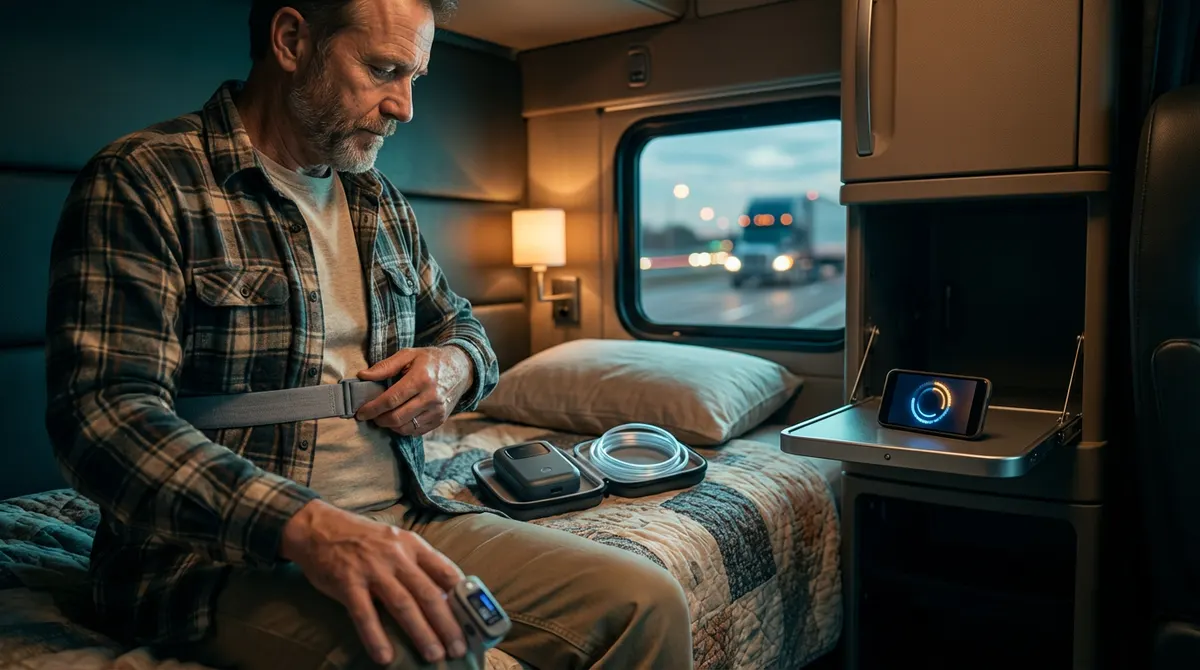
Home sleep apnea testing gives many truck drivers a faster and more practical path to evaluation than a traditional overnight sleep lab. For the transportation industry, that matters because convenience often determines whether drivers get tested early or delay care.
A home sleep test is a portable overnight study that measures breathing-related signals while you sleep at home. According to the American Academy of Sleep Medicine, home sleep apnea testing should be ordered after a medical history and examination and should not be interpreted by automated scoring alone. A qualified Sleep Medicine clinician must review the results and connect them to symptoms, risk factors, and next steps.
Already diagnosed and need CPAP support?
Dumbo Health helps patients start CPAP without the usual confusion, paperwork, or upfront cost. Equipment, setup, supplies, and ongoing support are all handled in one place.
Traditional polysomnography in a sleep lab is more comprehensive, but it is also more disruptive for many drivers. A sleep lab usually requires overnight scheduling, travel, and more time away from work. Home sleep apnea testing can often be completed with less interruption to your route, family schedule, or income. That practical difference is one reason the transportation industry increasingly supports remote evaluation pathways.
The testing equipment is simpler than what a sleep clinic or sleep lab uses, but it still captures key data. Depending on the device, the testing equipment may record airflow, breathing effort, heart rate, oxygen saturation, and body position. Some providers use a reusable home sleep apnea test kit, while others use a disposable home sleep test kit. Both models can work when the case is appropriate and the data is reviewed properly.
Many drivers looking for providers in your area prefer a remote-first option because it reduces wait time and avoids spending a full night away from home or the road. If you want a convenient starting point, Dumbo Health’s at-home sleep test can help you begin the process from home.
TIP: The best home sleep test is not the most convenient device. The best home sleep test is the one ordered and interpreted by a qualified provider.
KEY TAKEAWAY: Home sleep apnea testing improves access, speed, and convenience for truck drivers who need evaluation without the full burden of an overnight sleep lab.
To see where home testing fits best, it helps to compare it directly with in-lab testing and telehealth-led options.
Traditional Sleep Labs vs. Home Sleep Tests for Truck Drivers
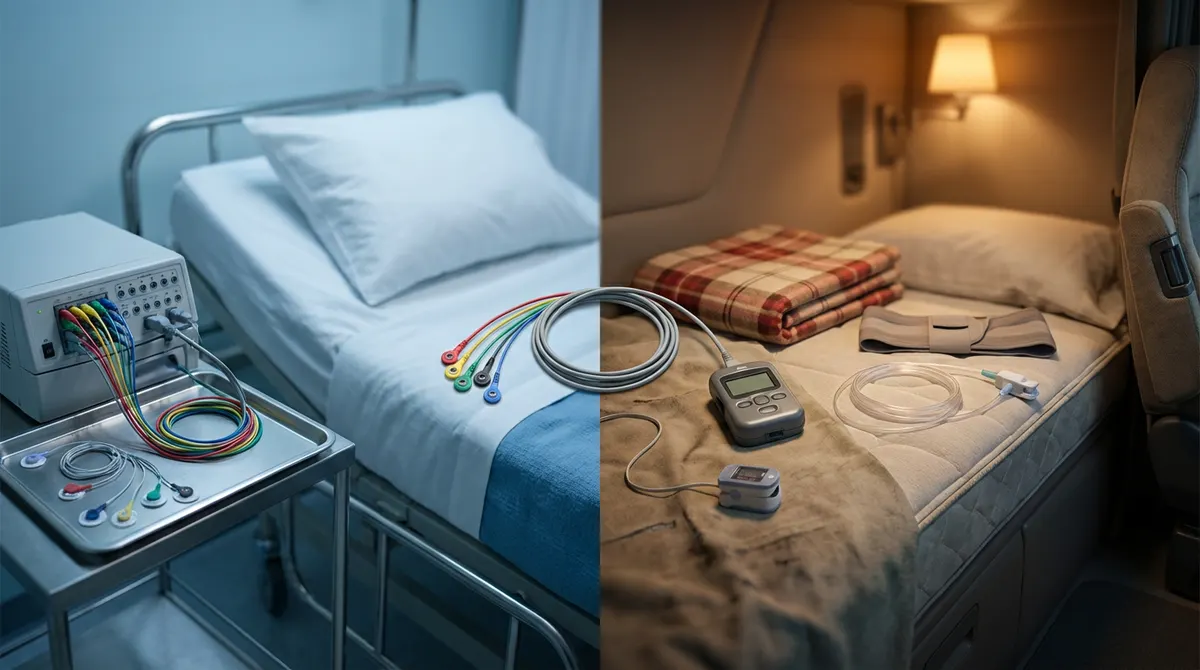
The key difference between a sleep lab and a home sleep test is depth versus convenience. A sleep lab captures more complex data, while home sleep apnea testing is often the better fit for straightforward obstructive sleep apnea screening.
A sleep lab is an overnight clinical setting where sleep lab technicians monitor a wider range of signals, including brain activity, eye movement, muscle activity, breathing, oxygen levels, and heart rhythm. A home sleep test focuses more narrowly on breathing-related measures. According to the AASM, if a single home sleep test is negative, inconclusive, or technically inadequate in a patient with ongoing suspicion, polysomnography should be performed instead.
For many truck drivers, that tradeoff is worth understanding early. If symptoms strongly suggest uncomplicated obstructive sleep apnea, home sleep apnea testing is usually more efficient. If symptoms suggest narcolepsy, central events, significant lung disease, neurologic disease, or another complex issue, a sleep clinic may move directly to in-lab testing.
| Option | Best for | Convenience | Turnaround time | Accuracy context | Recommended when |
|---|---|---|---|---|---|
| Home sleep test | Suspected uncomplicated obstructive sleep apnea | High | Often faster | Strong for selected adult patients | You need a practical first step |
| Sleep lab polysomnography | Complex symptoms or unclear diagnosis | Lower | Often slower to schedule | More comprehensive | You have other sleep or medical concerns |
| Telehealth plus home test | Drivers needing remote coordination | High | Often fast if available | Depends on clinical fit and follow-up | You want care close to you without a clinic visit |
For the most common truck-driver use case, a home sleep test is often the best first move. For complex cases, a sleep lab remains the better diagnostic tool. That is why a proper intake matters before any device is shipped.
KEY TAKEAWAY: A home sleep test is often the best first-line option for straightforward suspected obstructive sleep apnea, while a sleep lab is better for complex or uncertain cases.
Once you know which pathway fits, the next step is understanding exactly how the process works from start to finish.
Your Step-by-Step Guide to At-Home Sleep Testing
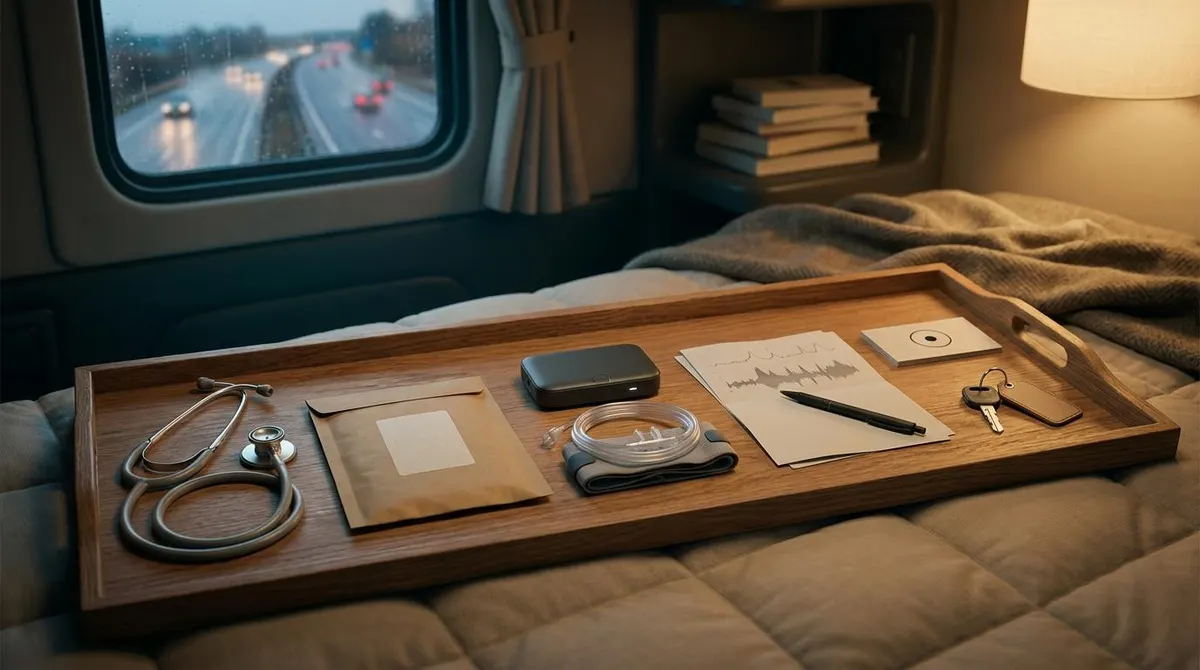
At-home sleep testing usually follows a simple sequence: clinical screening, kit delivery, one night of testing, result review, and next-step planning. For truck drivers, that structure matters because a sleep apnea diagnosis needs proper documentation before it can support medical clearance.
The process usually starts with an intake visit with a provider trained in Sleep Medicine. That visit may happen by telehealth, through a sleep care online service, or through a local sleep clinic. The provider asks about snoring, witnessed breathing pauses, sleepiness, blood pressure, prior history, and work schedule. A medical examiner may also refer you for this evaluation if your DOT physical raises concern.
Next, you receive your home sleep apnea test kit. A typical home sleep apnea test kit includes sensors for airflow, chest movement, and oxygen levels. Some programs use mobile sleep apnea tests that connect to an app, while others mail a small recorder with instructions. You may also see newer mobile sleep apnea tests marketed for convenience, but clinical oversight still matters more than the device style itself.
Then you complete the test at home for one night, sometimes more if the provider wants additional data. People who undergo this exam often find that the setup is easier than expected. A home sleep test does not usually require needles, a hospital room, or a full overnight stay. After the recording, you return the kit and wait for physician review.
Finally, the provider explains the results, confirms whether the data supports a sleep apnea diagnosis, and recommends next steps. That interpretation is critical because a sleep study should guide treatment and documentation, not create confusion. If you want to understand the DOT side in more detail, can you pass a DOT physical with sleep apnea is a useful next read.
KEY TAKEAWAY: A home sleep test works best when it is part of a complete clinical process that includes screening, physician interpretation, and documentation for follow-up care.
Once results are in, the focus shifts from testing to diagnosis, treatment, and keeping your CDL on track.
Navigating Your Sleep Apnea Diagnosis and Treatment

A sleep apnea diagnosis does not automatically stop a truck driving career. What matters most is whether sleep apnea treatment is started, tolerated, and documented well enough to support safe driving and ongoing medical clearance.
A sleep apnea diagnosis usually includes an estimate of severity based on how often breathing disruptions occur during sleep. The provider then connects that severity to symptoms, oxygen changes, and your daytime functioning. For truck drivers, that interpretation matters because the Department of Transportation is focused on driving fitness. A medical examiner wants to know whether the condition is controlled well enough to reduce safety risk.
The most common first-line sleep apnea treatment for obstructive sleep apnea is CPAP, which uses breathing equipment to keep the airway open during sleep. According to Mayo Clinic, CPAP is highly effective at preventing airway collapse in obstructive sleep apnea. Other options may include oral appliances, weight management, positional strategies, and selected surgical approaches, but CPAP remains the most established therapy for many working drivers.
Adherence matters because treatment only supports CDL exam medical clearance when it is actually being used and symptoms improve. Many patients report that better sleep quality, fewer morning headaches, and clearer daytime focus appear gradually over days to weeks rather than overnight. In real-world use, successful treatment often improves both health confidence and work performance. That is why the transportation industry increasingly treats sleep therapy as a safety tool, not just a medical chore.
IMPORTANT: Sleep apnea treatment is about controlling risk. A medical card is more likely to be supported when treatment is documented and effective.
KEY TAKEAWAY: The most important question after diagnosis is not whether sleep apnea exists but whether treatment is working well enough to protect health and driving safety.
That makes provider choice especially important, because not every testing pathway offers the same level of support for truck drivers.
Choosing the Right At-Home Sleep Test Provider
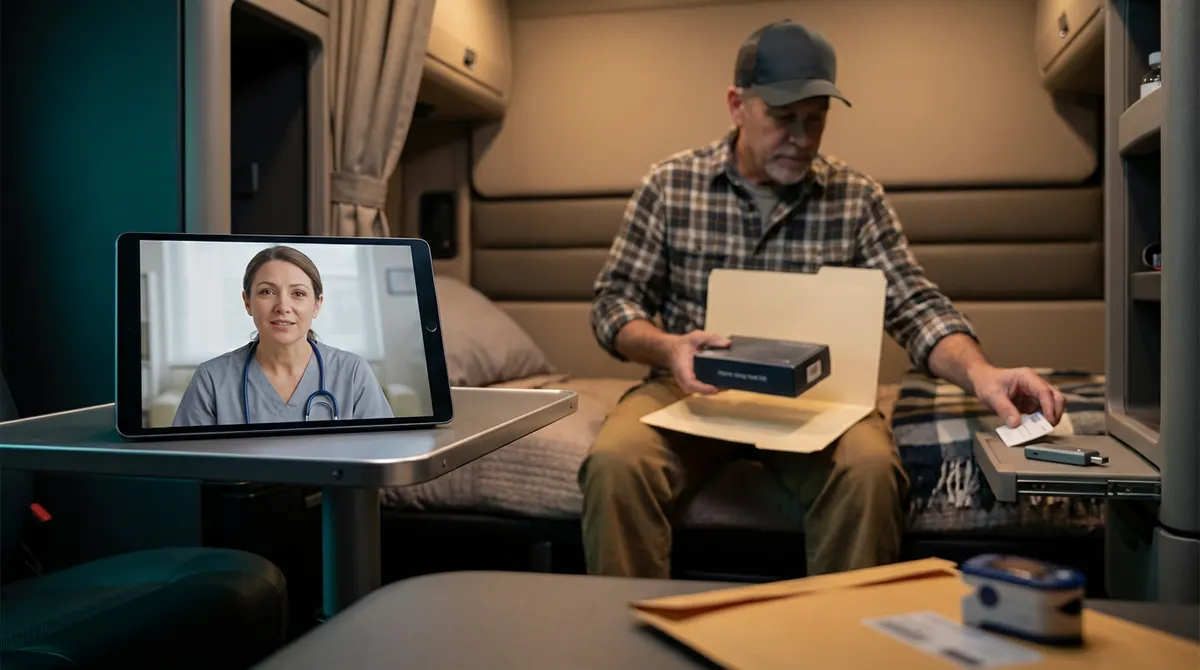
The right provider combines diagnostic accuracy, clear support, and a workflow that fits the transportation industry. For truck drivers, the best provider is one that helps move from screening to treatment and documentation without unnecessary delay.
Start with clinical credibility. The provider should use physician review, explain whether home sleep apnea testing is appropriate, and have a process for cases that need escalation to a sleep lab. The provider should also explain the difference between obstructive sleep apnea and Central Sleep Apnea, because home testing is not the right answer for every pattern of symptoms.
Next, look at logistics. Some services offer reusable devices, while others use a disposable home sleep test kit. Some are built around telehealth, while others combine remote shipping with in-person support. Convenience matters, but so does continuity. A provider that offers follow-up, treatment coordination, and documentation can save time if the medical examiner requests evidence of evaluation or adherence.
You may also see industry-specific programs such as WorkSTEPS Sleep, Cardinal Sleep, and Sleep Solutions 4 Drivers. These names are relevant because they reflect how the transportation industry has built dedicated pathways for screening and management. The right choice depends less on branding and more on whether the program offers qualified review, practical scheduling, and support for treatment follow-through.
If you are comparing options, ask whether the provider can help you find a provider near you for follow-up, whether they support telehealth in your area, and how quickly results are reviewed. If you want a consumer-friendly option built around remote access, Dumbo Health’s at-home sleep test is a helpful place to start.
KEY TAKEAWAY: The best at-home testing provider for truck drivers is the one that combines proper clinical oversight with a practical, driver-friendly path to follow-up and documentation.
Once the right testing pathway is in place, it becomes easier to understand why treatment offers benefits far beyond compliance alone.
Beyond Compliance: The Broader Benefits of Treating Sleep Apnea

Treating sleep apnea can improve more than DOT compliance. Effective treatment can support sleep quality, daytime alertness, cardiovascular health, and long-term quality of life.
Sleep apnea works by repeatedly disrupting normal breathing and sleep structure. That means even a full night in bed may not feel restorative. When treatment works, sleep quality often improves because the airway stays open more consistently and the brain is not forced into repeated micro-awakenings. Many patients report fewer headaches, less irritability, and more stable energy.
The benefits also extend to performance on the road. Better sleep can support reaction time, attention, and decision-making, which are essential in commercial driving. According to the CDC, fatigue management starts with adequate sleep, but fatigue that continues despite enough sleep should be medically evaluated. For truck drivers, this makes treatment both a health decision and a professional one.
There is also a long-term health angle. sleep apnea is associated with blood pressure and cardiovascular strain, which means untreated disease can create a larger burden over time. A driver who starts treatment early is not just protecting a medical card. That driver is making a proactive choice for long-term function, family life, and career stability in the transportation industry.
DID YOU KNOW: According to the National Heart, Lung, and Blood Institute, sleep apnea can affect oxygen levels and contribute to daytime sleepiness and broader health consequences if left untreated.
KEY TAKEAWAY: Treating sleep apnea can improve daily function, road safety, and long-term health, making it a career-protective decision rather than a regulatory burden.
Before wrapping up, it helps to address a few common myths that often delay testing and treatment.
Common Myths About Sleep Apnea Debunked

Many myths about sleep apnea make truck drivers delay testing, resist treatment, or assume a diagnosis ends their career. The reality is that most of these fears are based on misunderstanding rather than current clinical or DOT guidance.
MYTH: If you have sleep apnea, you automatically lose your CDL.
FACT: The FMCSA does not say that every driver with sleep apnea is disqualified. The FMCSA says a driver cannot be medically qualified when a condition is likely to interfere with safe driving. That means evaluation, symptom control, and treatment adherence matter more than the diagnosis alone.
MYTH: A home sleep test is not valid for truck drivers.
FACT: According to the American Academy of Sleep Medicine, home sleep apnea testing is an accepted alternative to polysomnography for uncomplicated adults with suspected moderate to severe obstructive sleep apnea. A home sleep test is valid when it is clinically appropriate, physician-reviewed, and followed by the right next steps.
MYTH: Only people who snore loudly need a sleep study.
FACT: Snoring is common, but sleep apnea risk is broader than snoring alone. Morning headaches, witnessed pauses in breathing, daytime sleepiness, high blood pressure, and nonrestorative sleep can all matter. A DOT medical examiner may consider several clues together, not just one symptom.
MYTH: Losing 20 pounds always cures sleep apnea.
FACT: Weight loss can improve obstructive sleep apnea in some people, but it does not guarantee a cure. Mayo Clinic notes that sleep apnea risk can improve when excess weight is reduced, yet many patients still need formal reassessment before treatment is stopped.
KEY TAKEAWAY: Most driver fears about sleep apnea come from myths, while the real deciding factors are proper diagnosis, effective treatment, and evidence of safe function.
With those misconceptions cleared up, the most common practical questions become much easier to answer.
Frequently Asked Questions
How to pass a home sleep study test?
You should not try to game or “pass” a home sleep study by changing the results. A home sleep test is designed to measure your usual breathing during sleep so a qualified provider can decide whether sleep apnea is present and whether treatment is needed. The most effective way to prepare is to follow the instructions closely, use the testing equipment correctly, sleep as normally as possible, and avoid removing sensors during the night. Accurate results help you get the right diagnosis, the right documentation, and the safest path to medical clearance.
Can you fail a DOT physical for sleep apnea?
Yes, you can have problems with a DOT physical if sleep apnea is untreated, uncontrolled, or severe enough to interfere with safe driving. The FMCSA explains that a driver is not medically qualified when a condition is likely to affect safe operation of a commercial motor vehicle. That does not mean every driver with sleep apnea fails. A driver with documented evaluation, effective sleep apnea treatment, improved symptoms, and appropriate follow-up may still qualify for a medical card, depending on the medical examiner’s decision.
Can I be a CDL driver if I have sleep apnea?
Yes, many people remain CDL drivers after a sleep apnea diagnosis. The key issue is whether the condition is managed well enough to support alert, safe driving. A DOT medical examiner may ask for evidence of diagnosis, treatment, and adherence, especially if symptoms were significant. Many truck drivers continue working once they begin treatment and show that sleepiness is controlled. If you want more detail on the certification side, what blood pressure do you need to pass a DOT physical and what are the requirements to pass a DOT physical can help you understand the broader medical context.
Does a DOT medical examiner have to order a sleep study?
A DOT medical examiner does not have to order a sleep study in every case, but a DOT medical examiner can request further evaluation if symptoms or risk factors suggest a safety concern. The Department of Transportation framework focuses on whether a medical condition may interfere with safe driving. That is why some drivers are referred for a sleep study after reporting fatigue, snoring, witnessed apneas, or related concerns. If you disagree with a recommendation, you may still need another qualified evaluation rather than simply ignoring the issue.
Can losing weight cure sleep apnea for truck drivers?
Weight loss can reduce obstructive sleep apnea severity for some drivers, but it does not automatically cure the condition or replace retesting. Mayo Clinic explains that reducing excess weight may help lower airway obstruction, yet many patients still need formal reassessment before treatment changes are made. For truck drivers, the practical point is simple: you should not assume that symptoms are gone just because weight changed. If a provider diagnosed sleep apnea, you usually need updated clinical evidence before a treatment plan or medical clearance decision changes.
Is a home sleep test enough, or do I still need a sleep lab?
A home sleep test is often enough when you are an uncomplicated adult with suspected obstructive sleep apnea and a provider determines that home sleep apnea testing is appropriate. A sleep lab is still important if symptoms are complex, if the results are negative but suspicion remains high, or if another sleep disorder may be involved. The American Academy of Sleep Medicine specifically recommends polysomnography when a single home sleep test is negative, inconclusive, or technically inadequate. If you are trying to find a provider near you, ask whether they can escalate to a sleep lab when needed.
What happens after a positive home sleep test?
After a positive home sleep test, a qualified provider reviews the data, confirms the sleep apnea diagnosis, and recommends treatment based on severity and symptoms. That treatment often starts with CPAP, though some patients may discuss oral appliances or other options. For truck drivers, the next important step is documentation. If a medical examiner asked for evaluation, you may need records showing diagnosis, treatment, and follow-up. If your concerns extend beyond sleep apnea alone, navigating your DOT physical with common medical conditions can help you plan more broadly.
Can I use telehealth or mobile sleep apnea tests if I am on the road?
Yes, many drivers use telehealth and mobile sleep apnea tests because they fit irregular schedules better than a traditional overnight appointment. Mobile sleep apnea tests can make evaluation easier when you travel often or want support close to you without visiting a clinic in person. The important point is that convenience should still include proper physician review, clear instructions, and follow-up planning. A remote pathway can be very effective, but only when the provider uses a clinically appropriate process rather than treating the device as a standalone answer.
Conclusion

An at home sleep test for truck drivers can be a safe, practical, and clinically appropriate way to evaluate sleep apnea before it creates bigger problems for your health, alertness, or CDL status. The most important points are simple: untreated sleep apnea can affect safe driving, home sleep apnea testing can work well for the right patients, and effective treatment often supports both better well-being and continued medical clearance. If you are ready to take the next step, start with Dumbo Health’s at-home sleep test to begin a more convenient path toward diagnosis, treatment, and a safer future on the road.
Related DOT Physical Topics
- Home Sleep Apnea Test for Commercial Drivers The CDL Holder's Complete Guide
- Does a DOT Physical Test for Weed or THC The Complete Guide for Commercial Drivers
- Sleep Apnea Test for CDL Drivers
- What are the current DOT requirements for sleep apnea testing for commercial drivers
- What drugs do they test for in a DOT drug test
- Why DOT Sleep Tests at Home Matter for Your Career and Health
- Are there legal requirements for drivers with sleep apnea
- DOT sleep apnea test at home
- What are the current FMCSA guidelines on sleep apnea for commercial drivers
- What Happens If Your DOT Physical Expires Compliance Guide for Commercial Drivers
- How can drivers with sleep apnea qualify again after a failed DOT physical
- Remote DOT Physical The Complete Guide for Commercial Drivers
- Essential 171 DOT Definitions for Commercial Drivers
- Navigating the Florida DOT Physical Your Essential Guide for CDL Drivers
- The Ultimate DOT Physical Guide for Commercial Drivers (2025–2026)
- Is a drug test required for a DOT physical
- DOT Physical Forms & Paperwork The Complete Guide for Commercial Drivers
- Online DOT Physical Without Insurance A Complete Guide for Commercial Drivers
- What Precautions Should Drivers With Sleep Apnea Take
- What Is the Urine Test for in a DOT Physical
- DOT physical self pay guide for commercial drivers paying out of pocket
- Online DOT Physical Self-Pay The Complete Guide for CDL Drivers and Owner-Operators
- Can You Get a Second Opinion on Your DOT Physical A Complete Guide for Commercial Drivers
- Best Treatments for Sleep Apnea to Improve Driving Safety
- Online DOT Physical The Complete Guide for Commercial Drivers and Medical Examiners
- DOT Medical Exam Self-Pay A Complete Guide for Commercial Drivers
- The Comprehensive Guide to Suboxone, Sleep Apnea, and FMCSA Compliance for Commercial Motor Vehicle Operators
- What Happens During the DOT Physical Exam The Complete Guide for Drivers
- BMI for DOT Physical What Commercial Drivers Need to Know
- DOT Physical & Drug Test What Drivers Need to Know
- Medical Examination Report (MER) – Form MCSA-5875 The Complete Guide for Commercial Drivers
- DOT Physical Requirements A Complete Guide for CDL Drivers
- Is a Sleep Study Required for a DOT Physical
- Does a DOT physical include a drug test
- DOT Physical Out of Pocket What Commercial Drivers Actually Pay
- Are There New DOT Rules or Laws on Sleep Apnea Testing
- When Can Sleep Apnea Affect a DOT Physical
- What Does DOT Stand for in a DOT Physical
- How Sleep Apnea Affects Overall Driving Safety
- DOT Physical Cost Breakdown What Drivers Pay & Why
- What Forms Do You Need for a DOT Physical
- DOT Physical ICD-10 & Billing Codes The Complete Guide for Accurate Compliance and Reimbursement
- Can You Fail a DOT Physical for Being Overweight
- Do They Check for Hernia During a DOT Physical
- Online DOT Exam What Drivers and Medical Examiners Need to Know
- DOT Physical Blood Pressure Requirements What Drivers Need to Know
- How Does Sleep Apnea Affect Driving Ability
- New DOT Physical Requirements What Drivers MUST Know About New Updates
- Can You Fail a DOT Physical for High Blood Pressure
- Can you fail a DOT physical because of sleep apnea
- DOT Physical at Urgent Care What Commercial Drivers Need to Know
- DOT Physical Insurance or Self Pay How to Choose the Right Payment Option for Your Exam
- Can you pass a DOT physical with sleep apnea
- What happens if you fail a DOT physical due to sleep apnea
- What eye chart is used for a DOT physical
- The DOT Physical Exam Ensuring You're Fit for the Road
- DOT Physical Online Cost
- DOT Physical Vision & Eye Requirements
- What Can Disqualify You From a DOT Physical
- Online CDL Physical
- Can You Pass a DOT Physical with Epilepsy
- DOT Physical Self Pay Cost
- Navigating Your DOT Physical with Common Medical Conditions
- 2026 DOT Inspection Dates
- Walk In DOT Physical Self Pay
- Can You Pass a DOT Physical With One Eye
- How Do You Submit Your DOT Physical to the DMV
- Can You Get a DOT Physical Online
- Can You Pass a DOT Physical With a Pacemaker
- What Should You Bring to a DOT Physical
- Telehealth Dot Physical
- DOT Physical Exam Basics
- DOT Physical & Alcohol Requirements
- What Are the Requirements to Pass a DOT Physical
- DOT Physical Duration and Validity How Long Your Medical Card Lasts
- DOT Physical Insurance & Recertification The Complete Driver's Guide
- Why do they measure your neck during a DOT physical
- Your Complete Guide What's Included in a DOT Physical Exam
- Cheap DOT Physical Online
- Can You Pass a DOT Physical With a Hernia
- What blood pressure do you need to pass a DOT physical
- CDL PHYSICAL SELF PAY
- DOT Physical Cash Pay
- Same Day DOT Physical
- Virtual DOT Physical
- Who needs a DOT physical
- How to Pass a DOT Physical The Complete Commercial Driver's Guide
- Do They Check Your Private Parts During a DOT Physical
- DOT Physical Chiropractor Your Complete Guide to CDL Exams
- Is a DOT physical the same as a regular physical
- What should I expect at a DOT physical
- What Does a DOT Physical Consist Of
- Can You Pass a DOT Physical with Diabetes
- Can You Pass a DOT Physical with High Blood Pressure
- Navigating Your CDL Health Requirements
- Non-DOT Physical A Comprehensive Guide to Workforce Health and Safety
- DOT Physical Texas The Essential Guide to Your Exam, Medical Card, and CDL Compliance
- What Is the Difference Between a DOT and Non-DOT Physical
- Guide to Obtaining and Managing Your DOT Medical Card Online
- Do You Have to Pee During a DOT Physical
Take the next step before your DOT physical
Start with the free quiz if you are unsure about your risk, or order an at-home sleep test if you have already been flagged for possible sleep apnea.
AI summary
A home sleep apnea test (HSAT) is a portable overnight study used to evaluate suspected obstructive sleep apnea in an uncomplicated adult, often as an alternative to in-lab polysomnography. For commercial drivers, sleep apnea matters because untreated disease can reduce oxygen levels, fragment sleep, and cause excessive daytime sleepiness, which can impair alertness and reaction time. Key points: - FMCSA guidance: a driver may be medically unqualified if a condition is likely to interfere with safe operation of a commercial motor vehicle. - HSAT measures breathing-related signals such as airflow, breathing effort, heart rate, oxygen saturation, and sometimes body position. - HSAT should be ordered after a clinical history and exam and interpreted by a qualified Sleep Medicine clinician, not by automated scoring alone. - If an HSAT is negative, inconclusive, or technically inadequate and suspicion remains, polysomnography is recommended. - After diagnosis, treatment (commonly CPAP) and documented adherence can support DOT medical clearance and ongoing medical card qualification.

Nicolas Nemeth
Co-Founder
Nico is the co-founder of Dumbo Health, a digital sleep clinic that brings the entire obstructive sleep apnea journey home. Patients skip the sleep lab and the long wait to see a specialist. Dumbo Health ships an at home test, connects patients with licensed sleep clinicians by video, and delivers CPAP or a custom oral appliance with ongoing coaching and automatic resupply in one clear subscription.
Keep reading

How Long Does a DOT Physical Take? A Complete Guide for Commercial Drivers

What Happens If You Fail a DOT Drug Test? The Complete Guide for Commercial Drivers


