Are there legal requirements for drivers with sleep apnea?
This article explains the federal legal requirements that apply to commercial drivers with obstructive sleep apnea and how these rules affect CDL medical certification. It outlines how the FMCSA and DOT physical process identify risk and when a certified medical examiner can require sleep testing. Key screening triggers include high BMI, large neck circumference, and tools like the Epworth Sleepiness Scale and STOP questionnaire. It covers diagnosis via sleep study and the apnea-hypopnea index, including that AHI over 15 indicates moderate sleep apnea. It details treatment options such as CPAP and oral appliance therapy and the compliance standard of at least 4 hours per night on 70 percent of nights. It also summarizes consequences of non-compliance, documentation needs for recertification, and a driver’s rights to choose testing and appeal denials.
Struggling with sleep?
Find out if sleep apnea is the reason.
FDA-cleared. $149 flat. Physician-reviewed results in 48 hours.

Are there legal requirements for drivers with sleep apnea?
Legal requirements for drivers with sleep apnea are federal mandates that determine if a commercial operator is medically fit to drive. According to the FMCSA, untreated respiratory conditions in commercial drivers significantly increase the risk of occupational accidents. Understanding DOT physical criteria, sleep testing protocols, and compliance data tracking is essential for maintaining your medical certification. Navigating these federal rules ensures truck drivers meet CDL requirements while protecting public safety on the road. Read on to explore how a sleep apnea diagnosis impacts your driving privileges and career.
The Short Answer: Yes, and Here's Why It Matters Legally
Yes, legal requirements mandate that commercial drivers diagnosed with moderate to severe obstructive sleep apnea must demonstrate treatment compliance to maintain their medical certification and CDL license. Ignoring these federal guidelines can result in immediate disqualification from driving a commercial motor vehicle.
sleep apnea is a serious respiratory disorder characterized by repeated interruptions in breathing during sleep. Unmanaged airway obstruction severely impairs sleep quality and daytime alertness.
The Department of Transportation views driver fitness as a matter of public safety. Chronic sleep deprivation reduces reaction times and degrades overall driving performance. When a truck driver spends long hours behind the wheel, undiagnosed sleep disorders elevate the crash risk dramatically. Drivers must adhere to specific DOT regulations to prove their medical condition is managed.
KEY TAKEAWAY: Commercial drivers must legally prove their condition is actively treated to retain their driving privileges and medical certification.
Not sure if sleep apnea applies to you?
Take our 2-minute sleep risk quiz to see whether sleep apnea could affect your DOT physical. No account required.
This strict regulatory approach relies on specific agencies to establish the baseline rules.
Understanding the Regulatory Framework: FMCSA and DOT

The regulatory framework consists of Federal Motor Carrier Safety Administration guidelines that dictate how a certified medical examiner evaluates a truck driver for sleep disorders. Failing to meet these regulatory compliance standards directly impacts your ability to hold a DOT physical card.
The DOT physical is the primary checkpoint for identifying potential health risks in commercial drivers. During this medical examination, providers assess your medical history and physical markers to determine if a sleep apnea diagnosis is likely. Medical providers follow guidance from the American Academy of Sleep Medicine to evaluate these risks.
IMPORTANT: According to the American Academy of Sleep Medicine, untreated severe obstructive sleep apnea can increase the risk of motor vehicle accidents by more than twofold.
If a medical practitioner suspects a problem, they will mandate further sleep testing before granting full certification. Navigating this framework requires coordination with a qualified sleep specialist.
KEY TAKEAWAY: The DOT and FMCSA work together to enforce medical standards that prevent fatigued drivers from operating heavy machinery.
Partnering with a sleep specialist ensures you understand these specific federal agency mandates.
The Federal Motor Carrier Safety Administration (FMCSA) Mandate

The Federal Motor Carrier Safety Administration mandate explicitly requires that any commercial driver with a medical condition interfering with safe driving must seek appropriate treatment. This mandate specifically targets obstructive sleep apnea due to its profound impact on driving ability.
While the FMCSA does not currently have a standalone rule exclusively for sleep apnea testing, it enforces general medical guidelines. A certified medical examiner has the authority to disqualify a truck driver based on observed symptoms or risk factors. This regulatory oversight exists because sleep disordered breathing compromises alertness and judgment.
DID YOU KNOW: The FMCSA notes that an estimated 28 percent of commercial truck drivers suffer from mild to severe sleep apnea.
Drivers often face questions about specific regulatory thresholds during their medical examination. Understanding how examiners apply these guidelines is the first step toward compliance.
KEY TAKEAWAY: The FMCSA requires medical examiners to evaluate and potentially disqualify drivers who exhibit significant risk factors for untreated sleep disorders.
Already diagnosed and need CPAP support?
Dumbo Health helps patients start CPAP without the usual confusion, paperwork, or upfront cost. Equipment, setup, supplies, and ongoing support are all handled in one place.
These evaluations primarily take place during routine health screenings.
The Role of the DOT Physical and Medical Certification

The DOT physical serves as the legally mandated health screening where a certified medical examiner determines if you are physically qualified to drive a commercial motor vehicle. Earning your medical certification depends heavily on passing this rigorous assessment.
During the exam, the examiner reviews your medical history, checks for high blood pressure, and assesses your neck circumference. These factors are strong indicators of a narrow airway and potential sleep issues. If you show multiple risk factors, the examiner will likely require a formal sleep study.
You cannot bypass the medical practitioner if they flag you for a potential respiratory disorder. The DOT physical acts as the gatekeeper for your CDL license. Preparing for this exam involves understanding what the examiner looks for.
KEY TAKEAWAY: The DOT physical is a strict legal requirement where medical examiners actively screen for health issues that compromise road safety.
When an examiner flags an issue, it rapidly transitions into a serious compliance matter.
How Sleep Apnea Becomes a Legal Concern for Commercial Drivers

Sleep apnea becomes a legal concern for commercial drivers because untreated daytime sleepiness directly violates the federal requirement to remain alert and capable behind the wheel. Operating a commercial motor vehicle while impaired by severe fatigue is a liability for the driver and the employer.
When reaction time decreases due to poor sleep quality, a truck driver becomes a hazard on the highway. Drowsy driving contributes to thousands of motor vehicle accidents annually. Legal exposure increases if an accident occurs and the driver has an undocumented or untreated medical condition.
The focus on reaction times and cognitive function makes occupational health a priority. Ignoring these risks is not an option for anyone in the transportation industry.
KEY TAKEAWAY: Untreated sleep disorders transform from a personal health issue into a severe legal liability when they impair your driving performance.
The severity of this liability is why the condition can permanently halt your career.
Why Sleep Apnea is a Disqualifying Medical Condition (If Untreated)

Obstructive sleep apnea is considered a disqualifying medical condition if left untreated because it causes severe oxygen deprivation that impairs cognitive function. A truck driver with untreated moderate to severe sleep apnea cannot legally hold a medical certification.
The constant cycle of airway obstruction and waking up prevents restorative sleep. Over time, this leads to secondary health issues such as heart disease and high blood pressure. According to the CDC, adults generally need adequate sleep to maintain neurological health, and chronic disruptions severely degrade a driver's focus during long hours.
If a sleep specialist confirms the condition is unmanaged, the certified medical examiner must revoke or deny the certification. Securing the right medical intervention is the only way to reverse this disqualification.
KEY TAKEAWAY: A lack of treatment for moderate to severe sleep apnea automatically disqualifies commercial drivers due to the extreme safety risks associated with daytime fatigue.
The journey to resolving this disqualification begins with the initial assessment.
The Medical Examination Process: Triggering Sleep Apnea Evaluation

The medical examination process triggers a sleep apnea evaluation when a driver exhibits a high BMI, a large neck circumference, or scores poorly on standardized screening tools. A certified medical examiner uses these indicators to justify the legal requirement for comprehensive sleep apnea testing.
Examiners frequently utilize the Epworth Sleepiness Scale or the STOP questionnaire to quantify a driver's risk. They may also assess your oral cavity to check for a narrow airway. If your BMI is over 35 or your neck size exceeds 17 inches for men, a sleep study is almost always mandated.
Refusing the evaluation process means an immediate denial of your medical certification. Finding a testing solution in your area is the immediate next step. You can often start this process by ordering an at-home sleep test to meet your diagnostic needs quickly.
KEY TAKEAWAY: Medical examiners rely on specific physical measurements and standardized questionnaires to mandate further sleep diagnostics.
Completing these diagnostics fulfills the first phase of regulatory compliance.
Legal Requirements for Diagnosis and Treatment Compliance
Legal requirements for diagnosis and treatment compliance dictate that a commercial driver must undergo a formal sleep study and provide verifiable compliance data. Without this documentation, maintaining a DOT medical card is legally impossible.
Once a sleep specialist diagnoses obstructive sleep apnea, the driver must initiate a treatment plan. This typically involves using positive airway pressure or exploring oral appliance therapy. You must demonstrate that your therapy resolves the airway obstruction effectively.
The medical examiner will request a compliance report directly from your device or your sleep specialist. Understanding the difference between testing methods can help expedite your diagnosis.
KEY TAKEAWAY: Drivers must legally secure a formal diagnosis and provide objective data proving their continuous adherence to a prescribed treatment plan.
To meet these diagnostic mandates quickly, drivers must choose the most efficient testing method.
To help drivers understand their diagnostic choices, the following table compares the most common sleep apnea testing facilities available today.
| Testing Method | Cost | Who It Is Best For | Turnaround Time | Convenience | Accuracy | Recommended When |
|---|---|---|---|---|---|---|
| In-Lab Sleep Study | High | Drivers with complex medical history | 2 to 4 weeks | Low | Very High | A medical examiner requires extensive neurological monitoring |
| Home Sleep Test | Low | Most commercial drivers needing rapid results | 3 to 7 days | High | High | You need a fast assessment to satisfy DOT requirements |
| Telemedicine Screening | Medium | Drivers seeking initial occupational health advice | 1 to 3 days | Very High | Moderate | You need a fast referral to a sleep specialist |
For the majority of commercial drivers facing a tight certification deadline, a home sleep test provides the best balance of speed, affordability, and acceptable accuracy for DOT compliance. For those requiring a rapid diagnostic turnaround, this method ensures you avoid lengthy clinic wait times.
The Requirement for a Formal Diagnosis: Sleep Study and AHI
The requirement for a formal diagnosis centers on completing a sleep study that measures your apnea-hypopnea index to determine the severity of your condition. A certified medical examiner requires this precise metric to establish your driver fitness.
A sleep study tracks your breathing patterns, blood oxygen levels, and heart rate. A home sleep test and portable sleep studies have become the standard for drivers because they are fast and legally accepted by the FMCSA. Your apnea-hypopnea index must be below a specific threshold to prove the condition is mild or effectively treated.
According to the American Academy of Sleep Medicine, an AHI over 15 indicates moderate sleep apnea, which immediately triggers the need for a treatment plan. Moving from diagnosis to active therapy is the most critical phase.
KEY TAKEAWAY: The apnea-hypopnea index obtained from a formal sleep study is the definitive legal metric used to diagnose and regulate drivers with sleep disorders.
Once diagnosed, the focus shifts entirely to resolving the symptoms.
Legally Mandated Treatment and Compliance
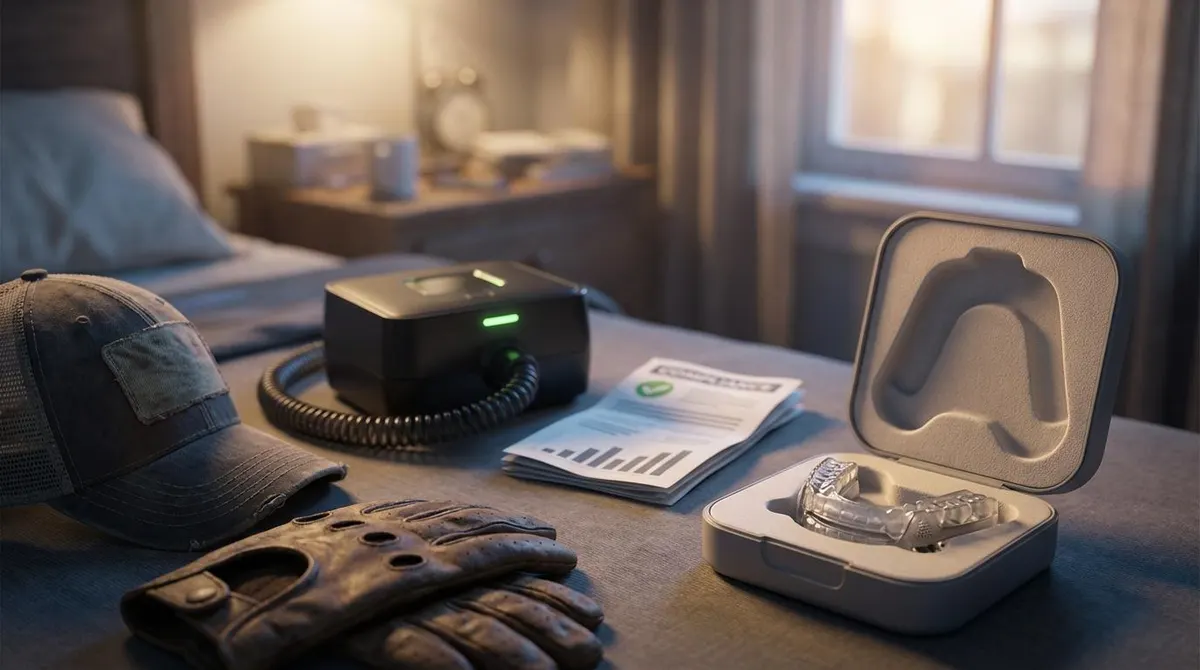
Legally mandated treatment requires drivers to utilize an approved intervention, such as CPAP therapy or a custom-fitted oral appliance, to resolve their sleep disordered breathing. Compliance means using the treatment consistently enough to satisfy DOT regulations.
Continuous positive airway pressure is the gold standard for resolving airway obstruction. A CPAP machine delivers steady air pressure to keep the airway open. Alternatively, oral appliances provide jaw repositioning to achieve similar results for mild to moderate cases. You must use your positive airway pressure devices or oral appliance therapy for a minimum of 4 hours per night on 70 percent of nights.
Consulting a sleep specialist ensures your therapy is optimized for comfort and legal compliance. To understand your positive airway pressure device options, read about the differences between CPAP, APAP, and BiPAP. Tracking your usage is the next vital requirement.
KEY TAKEAWAY: Drivers must actively treat their condition using a CPAP machine or an oral appliance, adhering to strict usage minimums to remain legally compliant.
Proving this adherence requires submitting specific electronic data.
Demonstrating Compliance for Recertification
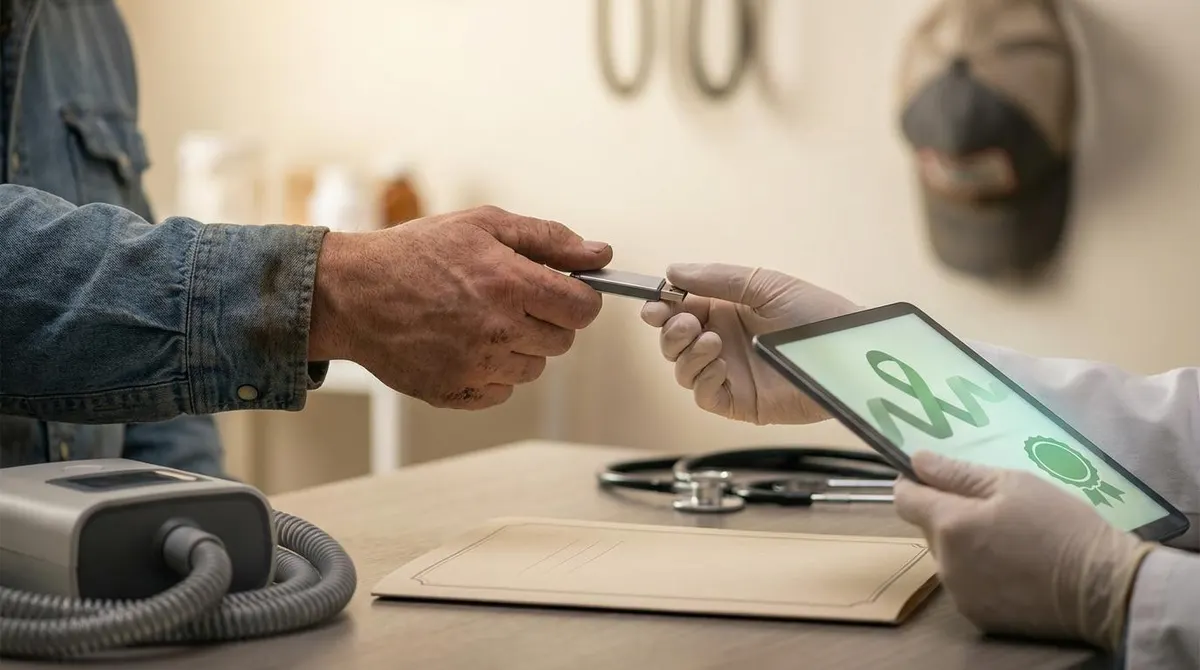
Demonstrating compliance for recertification requires you to submit a digital compliance report from your CPAP machine to prove you are following your treatment plan. A certified medical examiner reviews this compliance data before renewing your CDL license.
Modern devices record every hour of usage and measure treatment efficacy. Your sleep specialist will generate a compliance verification document that details your adherence over the past 30 to 90 days. The examiner relies on this chain of custody to ensure the data is authentic and accurate.
If your compliance data falls below the 70 percent threshold, your DOT medical card will be denied or issued for a very short duration. Failing to produce this report carries serious consequences.
KEY TAKEAWAY: You must present objective, machine-generated data proving your adherence to CPAP therapy to successfully renew your DOT medical certification.
Failing to meet these benchmarks triggers immediate legal and professional repercussions.
Legal Ramifications of Non-Compliance and Undiagnosed Sleep Apnea

The legal ramifications of non-compliance include the immediate suspension of your medical certification, increased civil liability, and potential termination by your employer. A truck driver who ignores sleep apnea testing mandates operates outside the law.
When a driver fails to produce a compliance report or refuses a required sleep study, the certified medical examiner is legally obligated to disqualify them. The FMCSA maintains strict oversight, and attempting to hide a medical condition constitutes fraud. Falsifying a medical examination report can lead to severe fines and permanent CDL revocation.
Protecting yourself requires complete transparency with your sleep specialist. The consequences of losing your license are professionally devastating.
KEY TAKEAWAY: Non-compliance with sleep apnea regulations results in swift legal penalties, including the loss of driving privileges and severe professional repercussions.
The most immediate penalty is the suspension of your livelihood.
Loss of Medical Certification and CDL License

The loss of medical certification and your CDL license occurs automatically when you fail to treat a disqualifying medical condition like severe obstructive sleep apnea. Without valid occupational health clearance, you cannot legally drive a commercial motor vehicle.
Medical examiners typically issue a temporary certification, sometimes as short as 30 days, to allow you time to begin CPAP therapy. If you fail to demonstrate treatment compliance within that window, your certification expires. Reinstating your CDL license after a medical disqualification requires a completely new DOT physical and extensive documentation from a sleep specialist.
This administrative burden disrupts your income and career progression. Understanding your liability is equally important.
KEY TAKEAWAY: Failing to manage sleep apnea leads directly to the loss of your commercial driver's license and your ability to earn a living in the transportation industry.
Beyond personal career loss, there are significant legal liabilities involved.
Increased Legal Liability in Accidents

Increased legal liability in accidents arises when a commercial driver causes a crash and investigators discover an untreated or undocumented medical condition. Operating a vehicle with known but untreated daytime sleepiness exposes the driver to severe civil and criminal penalties.
Following motor vehicle accidents, lawyers routinely subpoena medical history and DOT physical results. If a driver failed to disclose symptoms or ignored a mandated sleep study, they can be held personally liable for damages. Traffic safety organizations actively investigate the role of sleep deprivation in fatal crashes.
Protecting yourself legally means maintaining a pristine medical record. Employers also face significant scrutiny in these scenarios.
KEY TAKEAWAY: Driving with untreated sleep apnea dramatically increases your personal legal liability and exposure to lawsuits in the event of a highway accident.
This shared risk places a heavy burden on employers to monitor their fleets.
Employer and Carrier Responsibilities and Legal Exposure

Employer and carrier responsibilities require companies to ensure their drivers possess valid medical certification and comply with all FMCSA health regulations. Carriers face massive legal exposure if they knowingly allow a medically disqualified truck driver to operate a commercial motor vehicle.
Under federal regulations, transportation companies must implement rigorous occupational health standards. This includes verifying the compliance report of any driver using an oral appliance or CPAP machine. If a carrier ignores red flags or fails to maintain compliance verification files, they share the liability in the event of a crash.
Many fleets partner with a sleep specialist to streamline testing and monitoring. Knowing your rights as a driver is the final piece of the puzzle.
KEY TAKEAWAY: Transportation companies carry a legal burden to monitor driver fitness and enforce medical compliance to protect themselves from catastrophic liability.
Navigating this system effectively requires drivers to understand their options.
Driver's Rights and Next Steps: Navigating the Legal Requirements

Navigating the legal requirements requires drivers to understand their rights to a fair medical evaluation, an accurate sleep apnea diagnosis, and access to approved treatment options. A commercial driver has the right to consult a qualified sleep specialist to manage their condition effectively.
You are not required to use the testing facilities recommended by your employer. You have the right to seek out independent medical providers or use a home sleep test if it meets DOT standards. Understanding these CDL requirements empowers you to take control of your health.
If you suspect you have a respiratory disorder, taking action immediately is vital. Exploring your next steps ensures you stay ahead of certification deadlines.
KEY TAKEAWAY: Drivers possess specific rights regarding their medical care and testing choices, allowing them to manage their sleep health on their own terms.
Taking immediate action is the best way to leverage these rights.
What to Do if You Suspect Sleep Apnea or are Diagnosed
If you suspect sleep apnea or receive a diagnosis, you must immediately schedule a consultation with a sleep specialist to initiate a compliant treatment plan. Addressing the issue before your next DOT physical is the smartest approach for a commercial driver.
Start by searching for sleep medicine professionals or testing providers in your area who understand DOT regulations. A local sleep specialist can guide you through the process of obtaining a home sleep test and setting up CPAP therapy. Do not wait until your medical certification is about to expire.
You can find a provider near you to expedite your sleep study and get the compliance data you need. Sometimes, a medical examiner may still deny certification despite your efforts.
KEY TAKEAWAY: Proactively seeking a diagnosis and starting treatment before your DOT physical prevents certification delays and protects your commercial driving status.
If you face an unfair denial, you have the right to challenge the decision.
Appealing a Medical Certification Denial

Appealing a medical certification denial involves submitting comprehensive documentation from a sleep specialist proving that your sleep disorders are effectively managed and do not impair your driving performance. A commercial driver can request a second opinion if a certified medical examiner unfairly revokes their DOT medical card.
To succeed in an appeal, you must provide a detailed compliance report showing consistent use of your CPAP therapy or oral appliance therapy. You will also need a formal letter from your sleep specialist confirming that your daytime sleepiness is resolved. The FMCSA provides mechanisms for resolving disputes between medical professionals regarding driver fitness.
Gathering this evidence quickly is essential to getting back on the road. Maintaining continuous records is the best way to prevent denials altogether.
KEY TAKEAWAY: Drivers have the legal right to appeal a medical disqualification by presenting robust clinical evidence and compliance data from a certified sleep specialist.
The foundation of a successful appeal, and a successful career, is ongoing documentation.
Proactive Compliance and Documentation
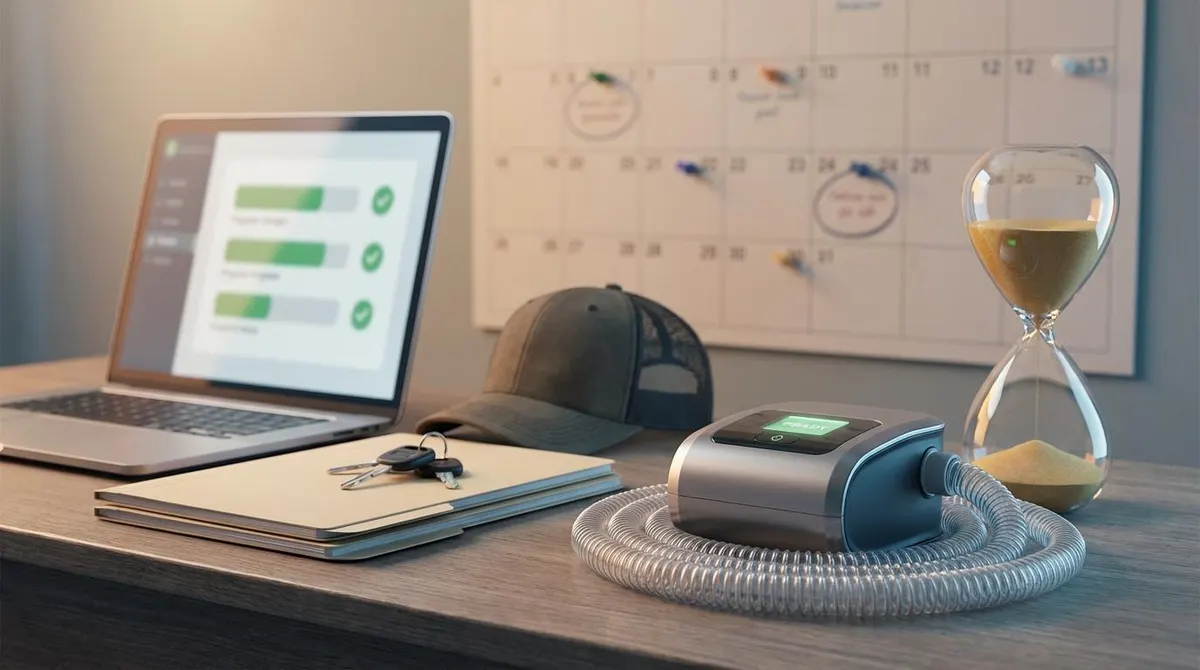
Proactive compliance and documentation require you to continuously monitor your CPAP machine data, maintain a clean medical history, and complete your sleep testing well in advance of your recertification date. A prepared truck driver never experiences a lapse in their medical certification.
Make it a habit to review your compliance data monthly to ensure your positive airway pressure device is functioning correctly. Participate in employer-sponsored sleep health initiatives to stay informed about changing FMCSA regulations. By keeping meticulous records, you eliminate the stress of the DOT physical.
If you need a reliable machine to maintain your treatment compliance, you can explore the CPAP machine options available to commercial drivers. Staying organized is the ultimate strategy for success.
KEY TAKEAWAY: Consistently tracking your treatment data and organizing your medical records guarantees a stress-free DOT recertification process.
Separating fact from fiction helps drivers embrace this proactive approach.
Common Myths About Sleep Apnea Debunked
Common myths about sleep apnea debunked involve clarifying misconceptions about the condition that prevent drivers from seeking necessary treatment. Understanding the facts about oral appliances and continuous positive airway pressure ensures you make informed medical decisions.
MYTH: A sleep apnea diagnosis automatically and permanently disqualifies you from holding a CDL license.
FACT: A diagnosis only disqualifies you if you refuse to treat it. The FMCSA allows drivers to maintain their medical certification as long as they can prove they are successfully using CPAP therapy or an oral appliance to manage the condition.
MYTH: I have to spend a night in a hospital to get a legally valid sleep study.
FACT: The DOT and FMCSA widely accept home sleep apnea testing as a valid diagnostic tool. According to the Sleep Foundation, home tests are highly effective and convenient for diagnosing obstructive sleep apnea in commercial drivers.
MYTH: Using an oral appliance is never accepted by the DOT for medical certification.
FACT: While a CPAP machine is the most common treatment, a certified medical examiner can accept oral appliance therapy for mild to moderate cases if a sleep specialist verifies its effectiveness. You still must prove treatment compliance through regular medical follow-ups.
KEY TAKEAWAY: Understanding the factual guidelines surrounding sleep testing and DOT regulations prevents unnecessary panic and helps drivers make informed healthcare decisions.
With these facts clear, you can focus on fulfilling your legal obligations.
Conclusion

Maintaining your medical certification as a commercial driver requires strict adherence to FMCSA health guidelines regarding respiratory disorders. You must successfully navigate the DOT physical, secure a formal sleep apnea diagnosis if requested, and provide ongoing compliance data to prove your treatment plan is effective. Whether you utilize a CPAP machine or an oral appliance, demonstrating consistent usage is legally mandated to protect both your CDL license and public safety. For a streamlined approach to fulfilling your testing requirements, you can easily get started with compliant diagnostic solutions today.
Frequently Asked Questions
Can I lose my CDL over sleep apnea?
Yes, you can lose your CDL if you are diagnosed with moderate to severe obstructive sleep apnea and refuse to follow a prescribed treatment plan. The FMCSA mandates that a certified medical examiner must disqualify any commercial driver who fails to demonstrate treatment compliance and control over their daytime sleepiness.
What is the 3% rule for sleep apnea?
The 3% rule refers to the diagnostic criteria used during a sleep study to measure the severity of a respiratory disorder. It tracks when a driver's blood oxygen level drops by at least 3 percent during a breathing pause, which helps the sleep specialist calculate the apnea-hypopnea index required for a formal sleep apnea diagnosis.
Do I need to tell my car insurance if I have sleep apnea?
Private motorists generally do not need to inform their car insurance about a sleep condition unless a medical practitioner has explicitly revoked their driving privileges. However, a commercial driver must report their condition during the DOT physical to maintain legal medical certification and avoid personal liability.
Can I drive a truck if I have sleep apnea?
Yes, you can absolutely drive a truck if you have this medical condition, provided it is properly treated. You must use approved positive airway pressure devices or oral appliances and provide a continuous compliance report to your medical examiner to retain your DOT medical card.
When was Maines sleep apnea drivers license law passed?
While specific state laws vary and update over time, commercial drivers in Maine and all other states are primarily bound by the federal FMCSA regulations regarding occupational health and sleep diagnostics. You should always consult local DOT guidelines or a sleep specialist near you for state-specific licensing nuances.
Sleep apnea & driving? UK reporting to DVLA?
In the UK, drivers are legally required to report moderate to severe obstructive sleep apnea to the DVLA if it causes excessive daytime sleepiness. Similar to US DOT requirements, failing to report the condition can result in a suspended license and increased legal liability.
Risk losing driver's license in Ontario by consulting with a sleep clinic?
In Ontario, physicians are legally required to report patients who have medical conditions that make it dangerous to drive, including severe, untreated sleep disorders. However, consulting a clinic to begin CPAP therapy actually protects your license by proving you are actively managing the risk.
Dot sleep apnea test?
A DOT sleep apnea test is a mandated evaluation, usually a home sleep test or in-lab sleep study, required by a medical examiner if a truck driver shows risk factors during a physical. The results determine if the driver meets the health CDL requirements to operate a commercial motor vehicle safely.
If you're diagnosed with SA will it affect your driving licence?
A diagnosis will only negatively affect your driving license if you ignore the medical advice and refuse to treat the respiratory disorder. As long as you maintain treatment compliance and your sleep physician clears your driving performance, your license remains fully valid.
Sleep apnea machine required?
A sleep apnea machine, such as a CPAP device, is legally required for commercial drivers diagnosed with a moderate to severe form of the condition. You must provide ongoing compliance data from the machine to renew your medical certification, but many drivers often wonder is CPAP covered by insurance to help manage these required costs.
Related DOT Physical Topics
- What are the current DOT requirements for sleep apnea testing for commercial drivers
- What are the current FMCSA guidelines on sleep apnea for commercial drivers
- Are There New DOT Rules or Laws on Sleep Apnea Testing
- Home Sleep Apnea Test for Commercial Drivers The CDL Holder's Complete Guide
- Sleep Apnea Test for CDL Drivers
- What Precautions Should Drivers With Sleep Apnea Take
- How can drivers with sleep apnea qualify again after a failed DOT physical
- Does a DOT Physical Test for Weed or THC The Complete Guide for Commercial Drivers
- Best Treatments for Sleep Apnea to Improve Driving Safety
- The Comprehensive Guide to Suboxone, Sleep Apnea, and FMCSA Compliance for Commercial Motor Vehicle Operators
- Can you pass a DOT physical with sleep apnea
- At Home Sleep Test for Truck Drivers
- DOT Physical Requirements A Complete Guide for CDL Drivers
- Can You Get a DOT Physical in Any State The Complete Guide for Commercial Drivers
- Can You Get a DOT Physical Online The Complete Guide for Commercial Drivers
- Medical Examiner's Certificate (Form MCSA-5876) The Complete Guide for Commercial Drivers
- Remote DOT Physical The Complete Guide for Commercial Drivers
- Essential 171 DOT Definitions for Commercial Drivers
- Navigating the Florida DOT Physical Your Essential Guide for CDL Drivers
- When Can Sleep Apnea Affect a DOT Physical
- How Sleep Apnea Affects Overall Driving Safety
- DOT Hypertension Guidelines The Complete Blood Pressure Guide for Commercial Drivers
- DOT Physical Forms & Paperwork The Complete Guide for Commercial Drivers
- Online DOT Physical Without Insurance A Complete Guide for Commercial Drivers
- Why DOT Sleep Tests at Home Matter for Your Career and Health
- Online DOT Physical Self-Pay The Complete Guide for CDL Drivers and Owner-Operators
- DOT physical self pay guide for commercial drivers paying out of pocket
- New DOT Physical Requirements What Drivers MUST Know About New Updates
- Can you fail a DOT physical because of sleep apnea
- DOT Medical Exam Self-Pay A Complete Guide for Commercial Drivers
- DOT Physical Blood Pressure Requirements What Drivers Need to Know
- What happens if you fail a DOT physical due to sleep apnea
- BMI for DOT Physical What Commercial Drivers Need to Know
- What Happens During the DOT Physical Exam The Complete Guide for Drivers
- How Does Sleep Apnea Affect Driving Ability
- What Happens If Your DOT Physical Expires Compliance Guide for Commercial Drivers
- Medical Examination Report (MER) – Form MCSA-5875 The Complete Guide for Commercial Drivers
- The Ultimate DOT Physical Guide for Commercial Drivers (2025–2026)
- Is a Sleep Study Required for a DOT Physical
- DOT sleep apnea test at home
- What Are the Requirements to Pass a DOT Physical
- Can You Get a Second Opinion on Your DOT Physical A Complete Guide for Commercial Drivers
- Online DOT Physical The Complete Guide for Commercial Drivers and Medical Examiners
- What drugs do they test for in a DOT drug test
- Can You Pass a DOT Physical with Epilepsy
- DOT Physical Out of Pocket What Commercial Drivers Actually Pay
- DOT Physical ICD-10 & Billing Codes The Complete Guide for Accurate Compliance and Reimbursement
- What Is the Urine Test for in a DOT Physical
- Can You Pass a DOT Physical With a Hernia
- Is a drug test required for a DOT physical
- DOT Physical Cost Breakdown What Drivers Pay & Why
- Can You Pass a DOT Physical With a Pacemaker
- Can You Pass a DOT Physical With One Eye
- What Forms Do You Need for a DOT Physical
- DOT Physical & Alcohol Requirements
- DOT Physical Vision & Eye Requirements
- Can You Fail a DOT Physical for Being Overweight
- Navigating Your DOT Physical with Common Medical Conditions
- Online DOT Exam What Drivers and Medical Examiners Need to Know
- DOT Physical Insurance or Self Pay How to Choose the Right Payment Option for Your Exam
- Can You Fail a DOT Physical for High Blood Pressure
- DOT Physical at Urgent Care What Commercial Drivers Need to Know
- Can You Pass a DOT Physical with Diabetes
- Can You Pass a DOT Physical with High Blood Pressure
- Navigating Your CDL Health Requirements
- DOT Physical & Drug Test What Drivers Need to Know
- What Does DOT Stand for in a DOT Physical
- Do They Check for Hernia During a DOT Physical
- What eye chart is used for a DOT physical
- The DOT Physical Exam Ensuring You're Fit for the Road
- How Do You Submit Your DOT Physical to the DMV
- What Can Disqualify You From a DOT Physical
- Does a DOT physical include a drug test
- DOT Physical Self Pay Cost
- DOT Physical Exam Basics
- 2026 DOT Inspection Dates
- What Should You Bring to a DOT Physical
- Telehealth Dot Physical
- Who needs a DOT physical
- DOT Physical Online Cost
- Why do they measure your neck during a DOT physical
- Your Complete Guide What's Included in a DOT Physical Exam
- Walk In DOT Physical Self Pay
- Can You Get a DOT Physical Online
- CDL PHYSICAL SELF PAY
- DOT Physical Insurance & Recertification The Complete Driver's Guide
- DOT Physical Cash Pay
- Same Day DOT Physical
- Virtual DOT Physical
- What blood pressure do you need to pass a DOT physical
- Do They Check Your Private Parts During a DOT Physical
- DOT Physical Chiropractor Your Complete Guide to CDL Exams
- Is a DOT physical the same as a regular physical
- How to Pass a DOT Physical The Complete Commercial Driver's Guide
- What should I expect at a DOT physical
- What Does a DOT Physical Consist Of
- Does insurance cover a DOT physical
- Online CDL Physical
- DOT Physical Duration and Validity How Long Your Medical Card Lasts
- Non-DOT Physical A Comprehensive Guide to Workforce Health and Safety
Take the next step before your DOT physical
Start with the free quiz if you are unsure about your risk, or order an at-home sleep test if you have already been flagged for possible sleep apnea.
AI summary
Legal requirements for commercial drivers with sleep apnea are enforced through FMCSA medical standards and the DOT physical (medical certification) process. A certified medical examiner can require sleep apnea evaluation when risk factors are present, including high BMI, large neck circumference, and results from screening tools such as the Epworth Sleepiness Scale and the STOP questionnaire. Diagnosis is confirmed with a formal sleep study that calculates the apnea-hypopnea index (AHI); the article notes that AHI over 15 indicates moderate obstructive sleep apnea and requires a treatment plan. To keep or renew a DOT medical card and CDL eligibility, drivers with moderate to severe obstructive sleep apnea must show objective treatment compliance. Common treatments include CPAP (positive airway pressure) and, in some mild to moderate cases, oral appliance therapy verified by a sleep specialist. The compliance benchmark described is at least 4 hours per night on 70 percent of nights, supported by machine-generated compliance reports (often covering 30 to 90 days). Non-compliance can lead to disqualification, short-term certification, increased accident liability, and potential fraud penalties if medical information is falsified. Drivers may seek independent testing and can appeal a denial with clinical documentation and compliance data.

Nicolas Nemeth
Co-Founder
Nico is the co-founder of Dumbo Health, a digital sleep clinic that brings the entire obstructive sleep apnea journey home. Patients skip the sleep lab and the long wait to see a specialist. Dumbo Health ships an at home test, connects patients with licensed sleep clinicians by video, and delivers CPAP or a custom oral appliance with ongoing coaching and automatic resupply in one clear subscription.
Keep reading

How Long Does a DOT Physical Take? A Complete Guide for Commercial Drivers

What Happens If You Fail a DOT Drug Test? The Complete Guide for Commercial Drivers


