DOT sleep apnea test at home
This guide explains how some commercial drivers can complete obstructive sleep apnea testing at home as part of DOT certification follow-up. It clarifies why untreated moderate to severe sleep apnea matters for alertness and driving safety, and why a referral does not automatically end certification. You will learn when a medical examiner may request evaluation, what makes a home sleep apnea test acceptable, and why provider ordering and physician interpretation are essential. It compares home testing (Type III HSAT, WatchPAT ONE) with in-lab polysomnography and outlines the step-by-step process from intake to a DOT-usable report. It also covers common outcomes, next steps after diagnosis, CPAP compliance expectations, re-certification documentation, and cost and insurance questions.
Struggling with sleep?
Find out if sleep apnea is the reason.
FDA-cleared. $149 flat. Physician-reviewed results in 48 hours.

DOT Sleep Apnea Test at Home
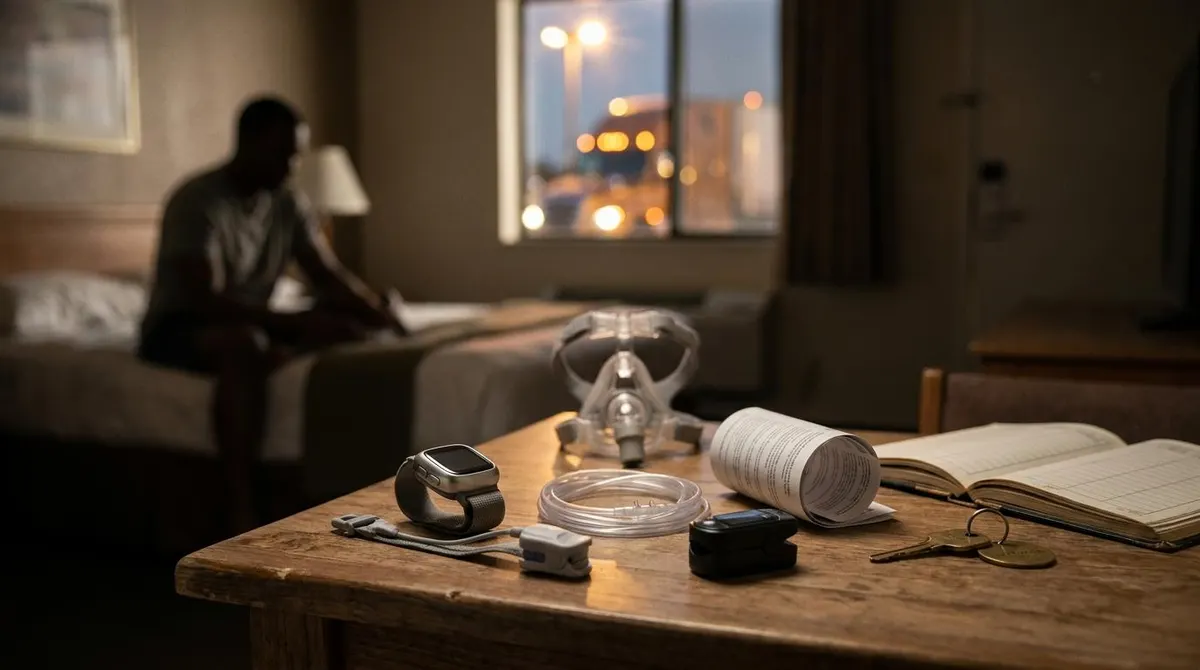
DOT sleep apnea test at home is a medically guided way for some commercial drivers to complete sleep apnea screening and follow-up testing without spending a night in a sleep center. According to the FMCSA, untreated moderate to severe obstructive sleep apnea can impair alertness and safe driving, which is why it matters during DOT certification. This guide explains how a home Sleep Study works, when a medical examiner may ask for one, what makes a home test acceptable, how results affect medical clearance, and what treatment and re-certification look like. It also covers cost, insurance, CPAP expectations, and the questions drivers ask most. Keep reading so you can handle the process with confidence and protect your CDL.
The Critical Link: Why DOT Drivers Need to Address Sleep Apnea

sleep apnea matters in DOT certification because untreated sleep apnea can reduce alertness and increase safety risk for a commercial motor vehicle driver. Sleep apnea is not just about snoring. Sleep apnea is a sleep disorder that can affect reaction time, concentration, and daytime performance.
Obstructive sleep apnea is the most common form of sleep apnea. Obstructive sleep apnea happens when the upper airway repeatedly narrows or collapses during sleep, which disrupts breathing and fragments normal sleep patterns. According to MedlinePlus, doctors diagnose sleep apnea using medical history, physical examination, and sleep study results.
The Department of Transportation focuses on functional safety. A DOT physical is meant to determine whether you can safely operate a commercial motor vehicle, not whether you fit a single stereotype. According to the FMCSA Medical Examiner’s Handbook, untreated moderate to severe obstructive sleep apnea may contribute to fatigue, deficits in attention, and unintended sleep episodes.
sleep apnea is a repeated breathing disorder during sleep. Sleep apnea matters for drivers because repeated breathing interruptions can worsen sleep quality, reduce restorative sleep, and increase daytime sleepiness when you need steady focus on the road.
Not sure if sleep apnea applies to you?
Take our 2-minute sleep risk quiz to see whether sleep apnea could affect your DOT physical. No account required.
IMPORTANT: A sleep apnea concern does not automatically end certification. FMCSA states that moderate to severe obstructive sleep apnea that is effectively treated does not, by itself, preclude certification.
KEY TAKEAWAY: DOT drivers need to address sleep apnea because untreated symptoms can affect both health and transportation safety.
That safety link explains why examiners look closely at symptoms, risk factors, and prior testing.
Understanding Sleep Apnea: More Than Just Snoring
sleep apnea is more than loud snoring because sleep apnea involves repeated breathing disturbances that can lower oxygen levels and disrupt sleep architecture. Snoring can be one warning sign, but snoring alone does not equal obstructive sleep apnea.
A sleep disorder is a condition that interferes with normal sleep quantity, timing, or quality. Obstructive sleep apnea is a sleep disorder with repeated airway blockage, while other sleep disorders may involve insomnia, narcolepsy, circadian rhythm problems, or movement disorders. According to MedlinePlus, a home sleep study is used to help diagnose sleep apnea but does not diagnose every sleep disorder.
Many patients report that they did not realize how tired they were until treatment began. Clinicians frequently observe that drivers normalize symptoms such as waking unrefreshed, morning headaches, dry mouth, irritability, and daytime fatigue because the symptoms build gradually over time. That is one reason a careful medical history matters during a DOT physical.
Sleep patterns are the repeated cycles and timing of your sleep across the night. Sleep patterns matter because fragmented sleep patterns can lower sleep quality even when you think you slept long enough. Heart Rate changes during sleep, oxygen changes, snoring, and breathing pauses can all help reveal whether a sleep apnea Test is needed.
If you are also trying to understand how sleep apnea affects certification decisions, Dumbo Health has a helpful guide on can you pass a DOT physical with sleep apnea.
KEY TAKEAWAY: sleep apnea is a medically significant breathing disorder, not just a snoring problem, and the effect on sleep quality and daytime function is what matters most.
Once you know what sleep apnea really is, the next question is why DOT examiners focus on it so much.
The Department of Transportation (DOT) and Sleep Apnea: Why It's Mandated
The Department of Transportation does not mandate one universal sleep test for every driver. The Department of Transportation does expect a medical examiner to identify conditions that could make commercial driving unsafe.
According to the FMCSA Medical Examiner’s Handbook, the regulations do not create mandatory screening rules for obstructive sleep apnea and do not specify one preferred diagnostic testing method. Instead, the medical examiner evaluates your symptoms, medical history, physical findings, and risk profile. That means a driver is not automatically sent for a Sleep Study because of one number alone.
Already diagnosed and need CPAP support?
Dumbo Health helps patients start CPAP without the usual confusion, paperwork, or upfront cost. Equipment, setup, supplies, and ongoing support are all handled in one place.
A medical examiner may look at loud snoring, witnessed breathing pauses, excessive daytime sleepiness, obesity, neck size, high blood pressure, diabetes, cardiovascular disease, and prior diagnosis or treatment history. The medical examiner then decides whether more evaluation is needed before issuing full medical clearance. In real-world practice, drivers often receive a time-limited certificate or a short follow-up window to complete a sleep test.
DOT physical sleep apnea review is the part of the DOT physical process where a medical examiner considers whether obstructive sleep apnea could affect safe driving. DOT physical sleep apnea review often leads to either proof of existing treatment, a Home Sleep Study, or referral to a sleep center.
DID YOU KNOW: FMCSA specifically notes that treated moderate to severe obstructive sleep apnea may allow certification, which is why early diagnosis often protects a career better than avoiding testing.
KEY TAKEAWAY: DOT does not force every driver into a sleep study, but a medical examiner may require evaluation when untreated sleep apnea could affect road safety.
That makes it important to understand what kind of home test is actually acceptable.
Navigating DOT Compliance: What Makes a Home Sleep Test Acceptable?
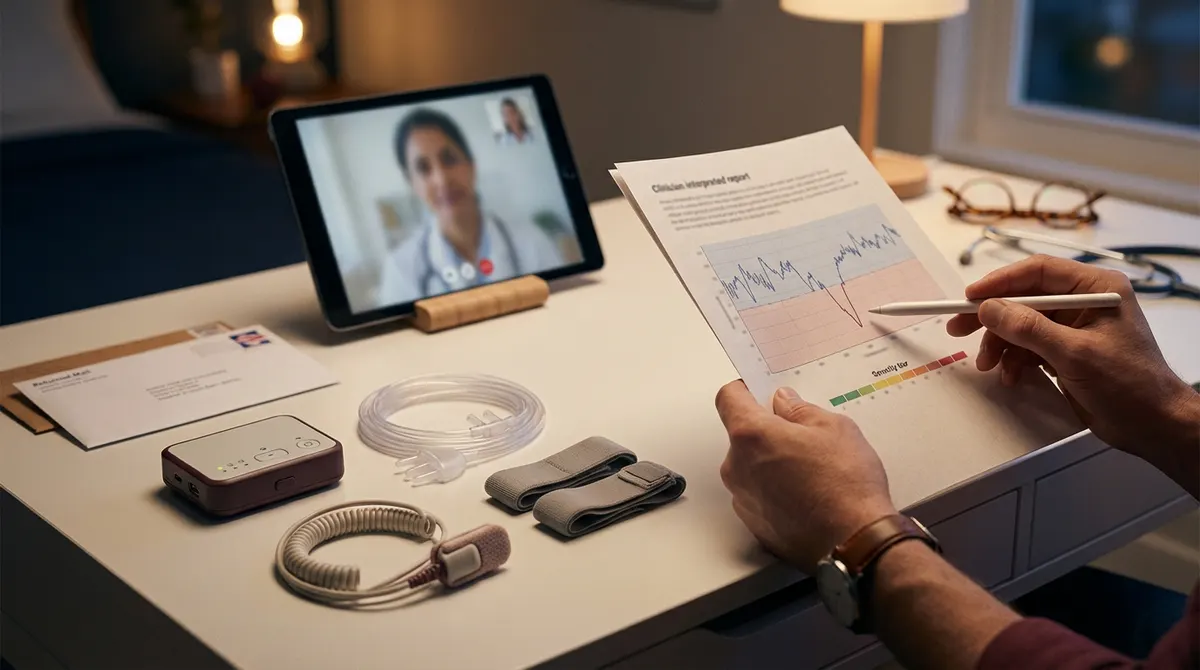
A home sleep test is acceptable for DOT follow-up when the test is clinically appropriate, properly ordered, and interpreted in a way the medical examiner can rely on. Convenience alone is not enough. The result has to support a safe certification decision.
A Sleep Apnea Test is a diagnostic assessment that measures breathing-related signals during sleep to help determine whether obstructive sleep apnea is present. According to the AASM, a home sleep apnea test is an alternative to polysomnography in uncomplicated adults with signs and symptoms suggesting moderate to severe obstructive sleep apnea. The AASM also states that diagnosis and treatment decisions should not be based on automatically scored data alone.
That means the strongest DOT workflow usually includes these steps:
medical history review
sleep health screening
provider order for a sleep test
technically adequate data collection
physician interpretation
report provided to the medical examiner
A Type III home sleep test is one of the most common home-based diagnostic pathways for obstructive sleep apnea. A Type III home sleep test generally records several channels, such as airflow, respiratory effort, oxygen saturation, and heart rate sensors, without the full brain wave monitoring used in a lab Sleep Study. A Type III home sleep test can be useful when the clinical picture is clear and the goal is to confirm obstructive sleep apnea efficiently.
A tele-health consultation or virtual consultation may be part of the intake process. The AASM states that the face-to-face evaluation may occur in person or by telemedicine, which is why many modern programs now use tele-health consultation before shipping a home sleep test unit.
KEY TAKEAWAY: An acceptable DOT home test is one that is medically appropriate, provider-led, and supported by interpretable clinical data.
The next piece is how home testing became a realistic option for working drivers.
The Evolution of Sleep Testing for DOT Drivers: From Lab to Home
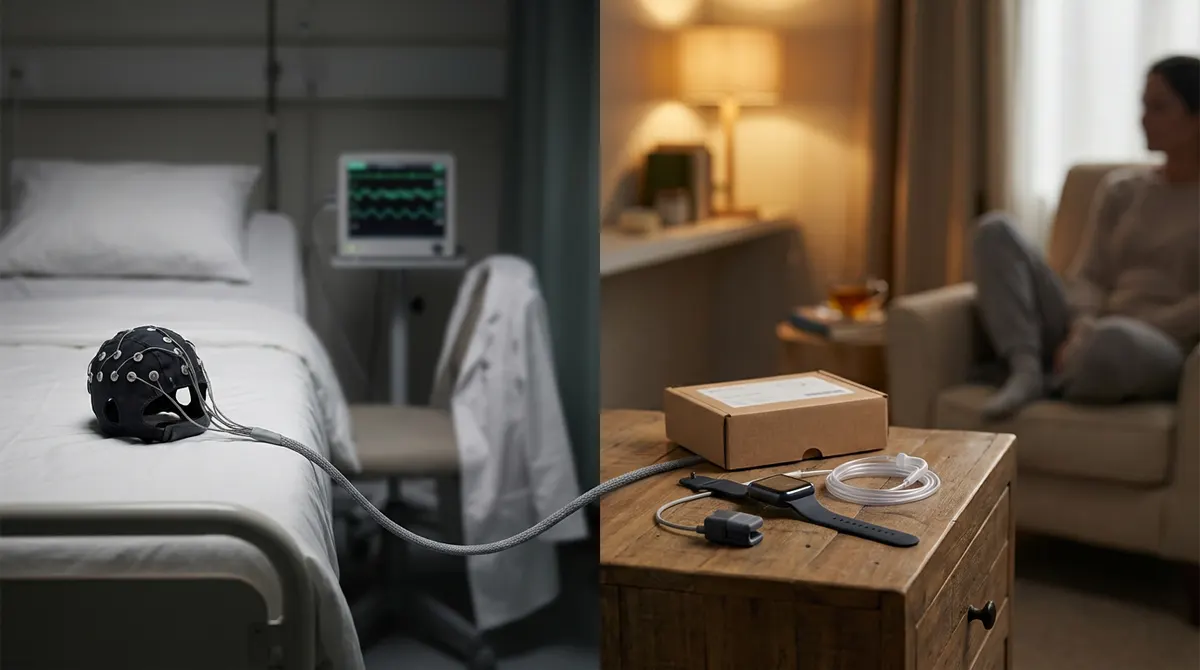
Sleep testing for drivers has evolved from mostly lab-based evaluation to a model that often includes home-based options for appropriate cases. The biggest reason is practicality. Drivers need accurate answers, but drivers also need a path that fits route schedules and certification deadlines.
Traditional polysomnography in a sleep center remains the most comprehensive Sleep Study. It records more signals and can diagnose a wider range of sleep disorders. According to MedlinePlus, in-clinic sleep studies can track brain waves, eye movement, heart rhythm, breathing, oxygen, and body movements, while a home sleep study uses fewer sensors and focuses mainly on sleep apnea.
Portable sleep monitors made home-based screening much more realistic. Portable sleep monitors can collect enough information for many uncomplicated obstructive sleep apnea cases without requiring an overnight stay in a sleep center. That shift matters for drivers who need a solution near you or close to you without taking unnecessary time off the road.
The key difference between lab testing and home testing is scope. A full lab Sleep Study looks broadly at many sleep disorders. A Home Sleep Study is usually narrower and more convenient, which is why it often works well when the main question is obstructive sleep apnea and the patient does not have a more complicated sleep disorder picture.
| Option | Best For | Convenience | Diagnostic Scope | Typical Use Case |
|---|---|---|---|---|
| In-lab polysomnography | Complex symptoms or suspected multiple sleep disorders | Lowest | Broadest | Inconclusive home test or complex case |
| Type III home sleep test | High suspicion of obstructive sleep apnea | High | Focused | Fast DOT follow-up in uncomplicated adults |
| WatchPAT ONE | Selected home-based evaluation pathways | Very high | Focused with device-specific metrics | Mail-out home testing workflow |
For most drivers with a straightforward referral, home testing is often the best fit for speed and practicality. For drivers with complicated symptoms, a sleep center remains the safer and more complete next step.
KEY TAKEAWAY: Home testing expanded because it offers a practical path for many drivers, while lab testing still matters when the case is more complex.
That brings us to the specific rules and expectations DOT drivers should keep in mind.
Specific DOT Requirements for Sleep Apnea Testing

DOT requirements for sleep apnea testing are based on clinical judgment, documentation, and fitness-for-duty decisions. DOT requirements are not a single pass-fail rule published for every driver.
The medical examiner reviews symptoms, risk factors, and supporting records. The medical examiner may ask about daytime sleepiness, observed apneas, prior diagnosis, current treatment, CPAP machines, medication use, and driving history. The examiner may also review blood pressure, BMI, neck circumference, and the rest of your medical history during the DOT physical.
Medical clearance is the decision that you are medically fit to operate a commercial motor vehicle under the applicable standards. Medical clearance may be granted for up to 24 months in some cases, but shorter certification periods may be used when closer monitoring is needed, according to the FMCSA handbook. That shorter window is common when sleep apnea is suspected, newly diagnosed, or recently treated.
Diagnostic criteria matter because the medical examiner needs a trustworthy diagnosis, not just a consumer gadget summary. A medical examiner typically wants a formal report that states whether obstructive sleep apnea was found, how severe it appears, and what the next step is. If you already use a CPAP device, the examiner may also want treatment documentation before continuing certification.
If you are preparing for the broader exam, you may also want Dumbo Health’s guide on what can disqualify you from a DOT physical.
KEY TAKEAWAY: DOT compliance depends on credible documentation and examiner judgment, not on a one-size-fits-all federal sleep study rule.
To get that documentation, you need to understand which home testing pathways are commonly used.
Types of Home Sleep Tests (HSTs) Approved for DOT Screening
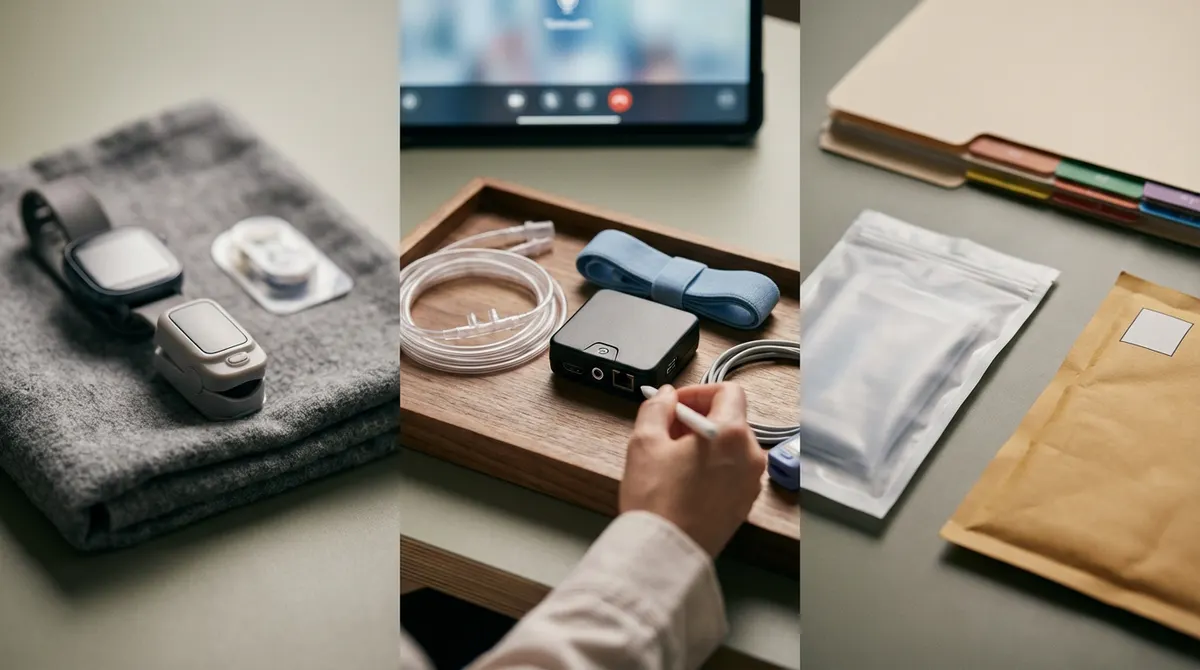
Home sleep tests used for DOT screening are usually focused devices designed to detect obstructive sleep apnea, not every possible sleep disorder. The best option depends on your symptoms, provider workflow, and the report your medical examiner needs.
A Home Sleep Study may use different sensor setups. Some programs use a wrist device with a finger probe and app-based setup. Some programs use portable sleep monitors with nasal cannulas, chest straps, pulse oximetry, and heart rate sensors. Some programs coordinate testing through a sleep center with remote support from a sleep technician or clinical supervisor.
WatchPAT ONE is one example of a home sleep test pathway that some providers use. WatchPAT ONE is an FDA Approved disposable home care device cleared for use in patients suspected of sleep related breathing disorders, according to FDA clearance documents. WatchPAT ONE uses a wrist device and finger probe design, and the FDA documents list outputs such as snoring level, body position, heart rate, and other parameters relevant to sleep related breathing assessment.
Itamar Medical developed the WatchPAT platform. Itamar Medical is the company name historically associated with WatchPAT technology. Itamar Medical appears in FDA clearance documents for WatchPAT ONE. Itamar Medical also appears in discussions about mail-out home testing pathways. Itamar Medical technology is often mentioned when drivers search for WatchPAT ONE or WatchPAT ONE™ at home testing. Itamar Medical therefore comes up often in DOT sleep apnea conversations even though the clinical decision still depends on the ordering provider and the medical examiner.
A Type III home sleep test often uses nasal cannulas, chest straps, pulse oximetry, and heart rate sensors to estimate breathing events through the night. Type III home sleep test systems may also track Body Position, Chest Motion, and Snoring Intensity, depending on the unit. A sleep technician may help with setup instructions, and a sleep technician or interpreting clinician may review technical adequacy before final analysis.
KEY TAKEAWAY: The most common acceptable home test options are provider-directed HSAT pathways such as Type III home sleep test systems and selected device-based platforms like WatchPAT ONE.
Once the device is chosen, drivers want to know exactly what the process looks like.
Your At-Home Sleep Apnea Test: A Step-by-Step Guide for Drivers

An at-home sleep apnea Test is usually a short, structured process that starts with intake and ends with an interpreted report for your examiner. Most drivers find the process simpler than expected once they understand the steps.
The usual workflow includes provider screening, shipping or pickup, one night of testing, device return or digital upload, interpretation, and follow-up. A home sleep test unit is the physical kit you receive for overnight data collection. A home sleep test unit may arrive through a Mail-out partnership, an In-Office partnership, a Referral partnership, Primary Health, urgent care, or a local sleep center depending on how the program is set up.
Many modern programs use sleep coaches for onboarding and sleep coaching for basic logistics, though diagnosis still depends on licensed clinical review. When a program advertises HIPAA Compliant data handling, that refers to privacy standards for protected health information. HIPAA Compliant systems matter because your results, medical history, and identity information should move securely between you, the clinician, and the medical examiner.
People who undergo this exam often find that preparation matters more than complexity. Follow instructions closely, keep your usual sleep schedule as much as possible, and avoid guessing your way through the setup. If you need a provider in your area, ask whether the workflow includes physician interpretation, result turnaround time, and a report suitable for DOT documentation.
For a direct at-home option from Dumbo Health, you can explore the DOT-related at-home sleep test pathway.
KEY TAKEAWAY: The home testing process is usually straightforward when the program includes clear setup, secure data handling, and physician interpretation.
The first operational step is getting the unit ordered correctly.
Ordering Your Home Sleep Test Unit
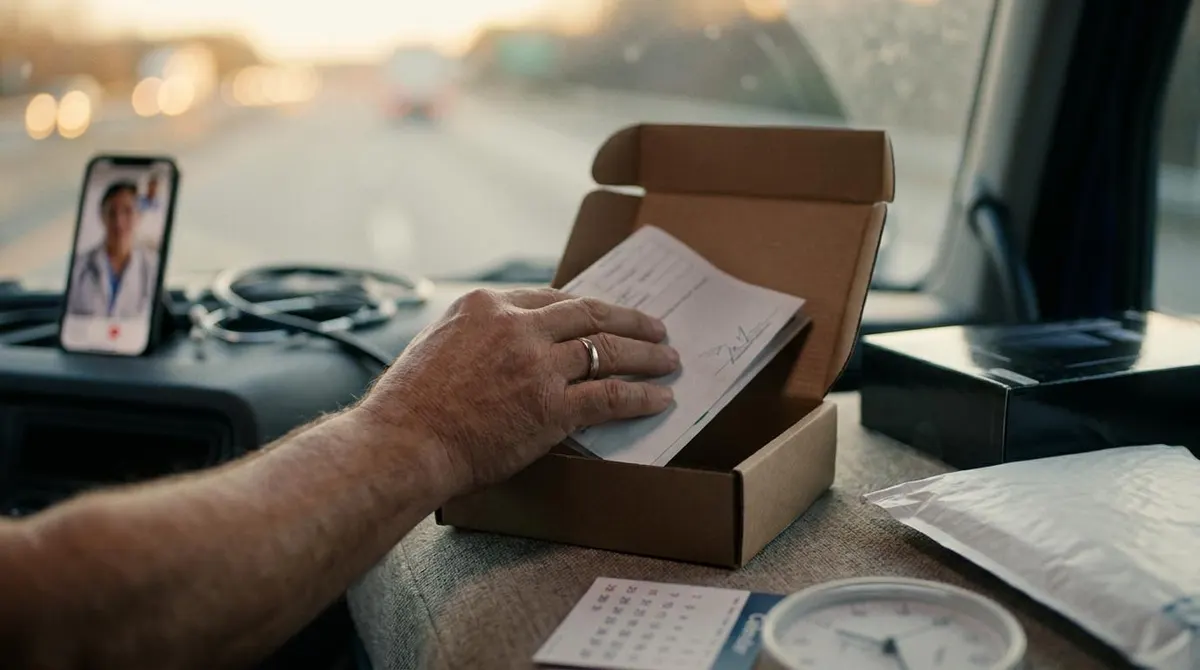
Ordering the test correctly matters because the ordering pathway affects whether the final report is usable for DOT follow-up. The fastest route is not always the most useful route if the report cannot support medical clearance.
Many programs begin with a tele-health consultation or brief virtual consultation to review symptoms and determine whether a Home Sleep Study is appropriate. That provider evaluation matters because the AASM recommends HSAT only for uncomplicated adults with a high likelihood of obstructive sleep apnea. A consumer gadget without proper clinical review is not the same as a valid Sleep Study.
Drivers generally receive a home sleep test unit by mail, pickup, or referral. Some organizations offer a partner program with clinics, Urgent Care, or Primary Health locations. Others use a Mail-out partnership with app-based guidance and remote support. In either case, confirm that the program includes physician interpretation, not just a raw dashboard.
If cost is a concern, ask whether the provider accepts FSA/ HSA cards, whether Medicare insurance plans are accepted in non-DOT contexts, and whether out-of-pocket pricing includes follow-up. DOT-related testing is often paid differently from routine insurance-based care, so clarity up front prevents delays.
KEY TAKEAWAY: Order through a provider-led pathway that includes clinical review and DOT-usable reporting, not just hardware shipment.
After the unit arrives, setup quality becomes the next make-or-break factor.
Setting Up and Using Your Portable Sleep Monitor
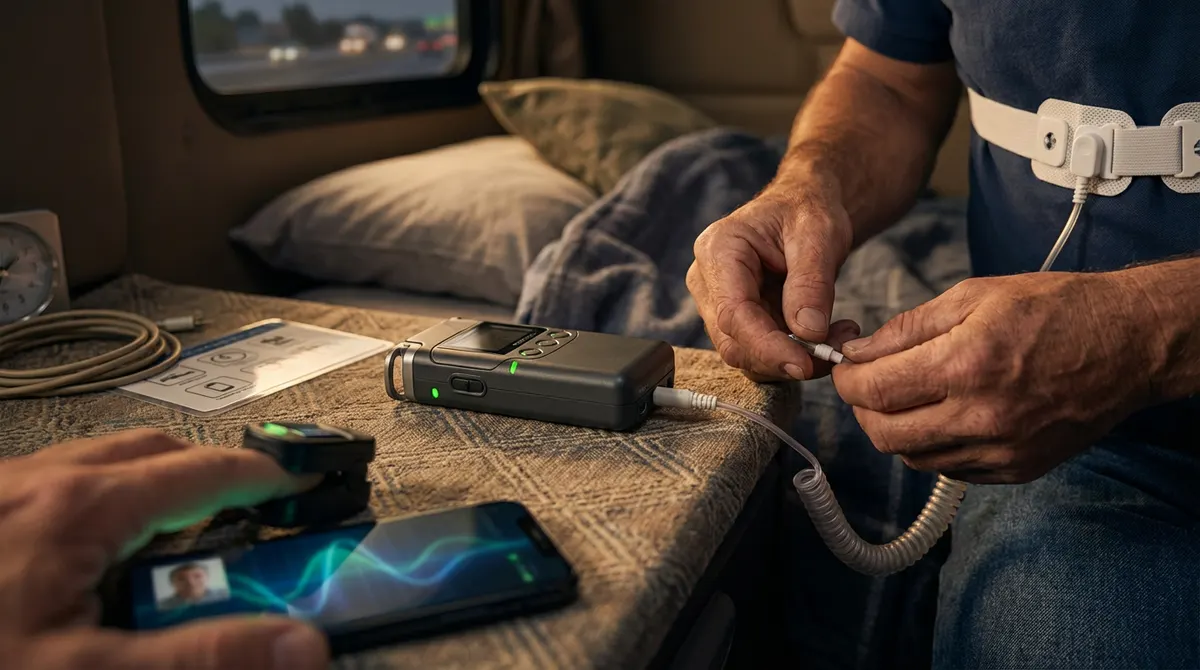
Correct setup matters because technically poor data can delay diagnosis and force repeat testing. A portable sleep monitor only helps if the signals are captured accurately through the night.
Depending on the system, setup may include a wrist device, finger probe, chest straps, nasal cannulas, or adhesive sensors. WatchPAT ONE typically uses a wrist device and finger probe format, while many Type III home sleep test systems use nasal cannulas, chest straps, pulse oximetry, and heart rate sensors. The device may measure Heart Rate, oxygen trends, Chest Motion, Body Position, and Snoring Intensity while you sleep.
Read every instruction before bedtime. If the program offers live support from a sleep technician, use it. A sleep technician can often help prevent common setup mistakes such as loose chest straps, poorly placed nasal cannulas, or a disconnected finger probe.
Try to sleep as normally as possible. Your usual sleep patterns are often more useful than a forced perfect night. In real-world use, one imperfect night can still be adequate if the data collection is technically strong enough for interpretation.
KEY TAKEAWAY: Accurate setup is essential because clean overnight data is what turns a home test into a usable diagnostic record.
Once the night is complete, the focus shifts from data collection to review.
After the Test: Returning the Unit and Data Analysis
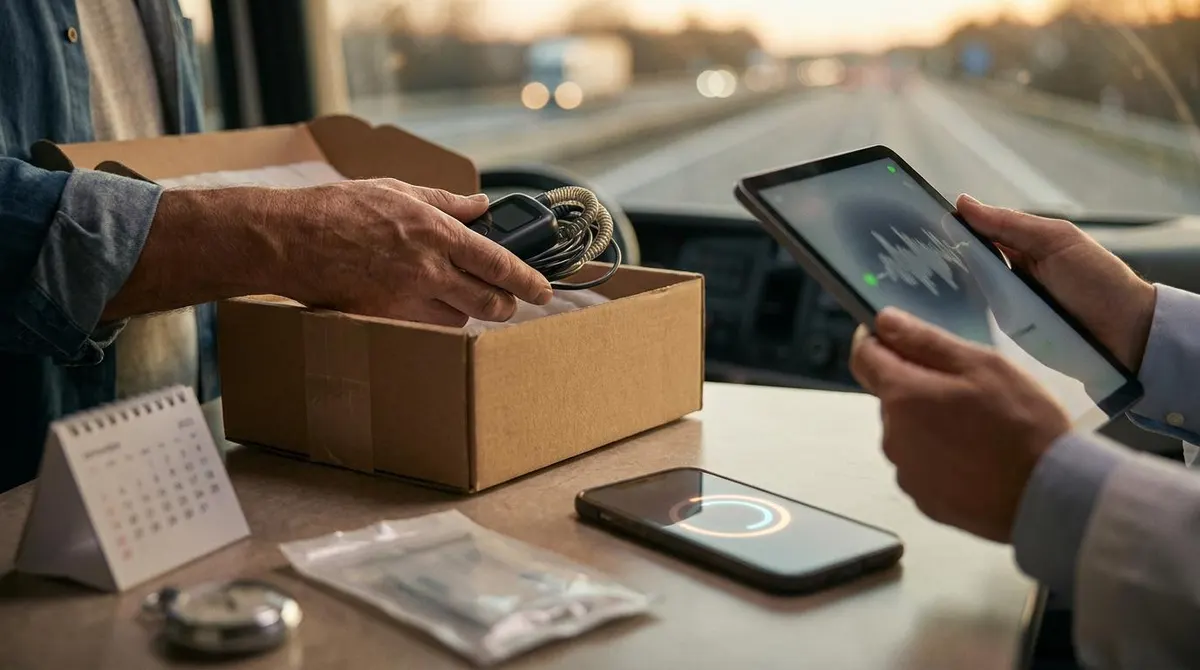
After the test, you either return the device, upload the data, or discard a single-use system depending on the program. The important part is that the data reaches the clinical team quickly and intact.
Some programs use disposable systems. Some require you to send back the home sleep test unit for analysis. A reusable system may go back to a sleep center, while a disposable model may upload data through an app-linked workflow. The timeline matters because many drivers are working under a short window from the medical examiner.
A sleep technician or technical reviewer may first check for data quality. If the recording is incomplete, the study may need to be repeated. According to the AASM, diagnosis and treatment should not rely on automatically scored data alone, which is why technical adequacy and clinician review matter so much.
The output should lead to a formal report, not just a consumer summary. That report typically includes event indices, oxygen patterns, sleep-related respiratory findings, and a clinical impression that can support the next step. If a provider near you offers a 24 to 72 hour turnaround, verify whether that timeline includes interpretation and report release.
KEY TAKEAWAY: Returning the device is only one step. The real goal is a complete, reviewed report that your examiner can use without delay.
With that report in hand, the next concern is what the result actually means for certification.
Interpreting Your Results and Securing Your Medical Clearance
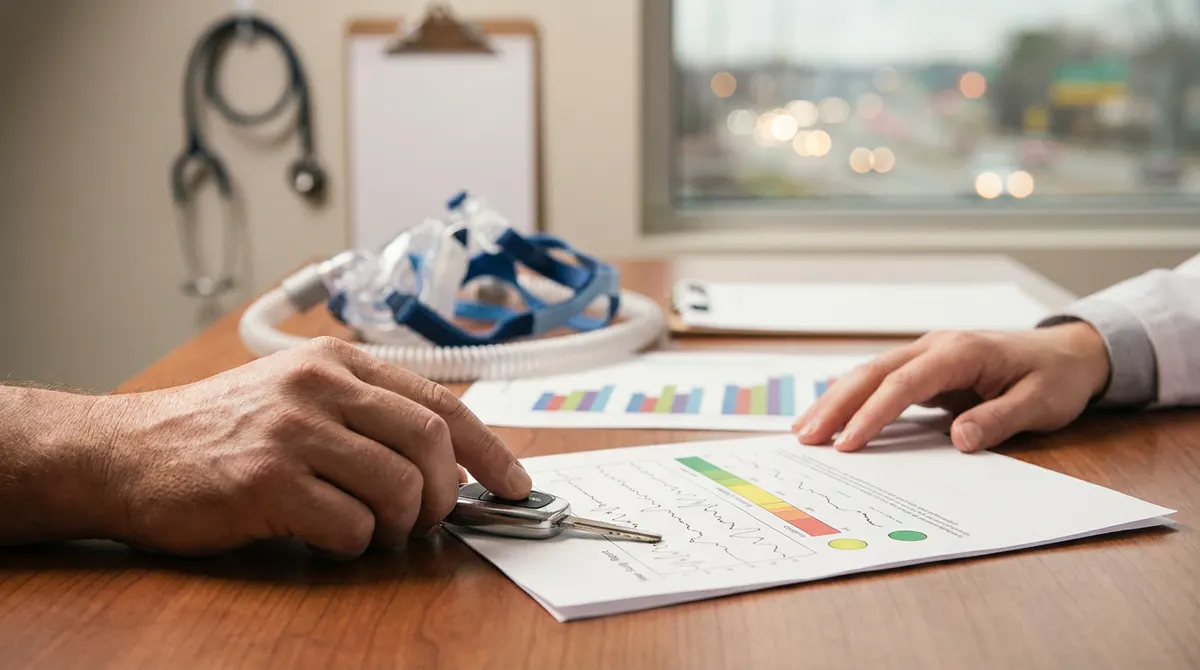
Results matter only when they are translated into a certification decision. A diagnosis by itself is not the end of the story. The practical question is whether the result supports safe driving now, after treatment, or after more evaluation.
A sleep study result usually estimates whether obstructive sleep apnea is absent, mild, moderate, or severe. A negative or technically inadequate result may not settle the issue if symptoms remain strong. According to AASM clinical guidance, if a single home sleep apnea test is negative, inconclusive, or technically inadequate, polysomnography may be needed next.
Medical clearance depends on both diagnosis and management. If the report shows no meaningful obstructive sleep apnea and the examiner is satisfied, certification may move forward. If the report shows obstructive sleep apnea, the examiner may issue a short certificate, request proof of treatment, or require follow-up before full certification.
This is a good point to review Dumbo Health’s guide on failing a DOT physical because many drivers assume any abnormal finding means an automatic failure. That is usually too simplistic.
Medical clearance is a documented determination that you are fit to drive under the applicable rules and monitoring requirements. Medical clearance often becomes easier once the condition is documented and the treatment plan is in motion.
KEY TAKEAWAY: The result becomes useful only when it is turned into a clear treatment or certification path that your examiner can act on.
That path starts with the actual diagnosis.
Receiving Your Sleep Apnea Diagnosis

Receiving a diagnosis means you finally have an evidence-based answer to why your sleep may feel poor or why the examiner had concerns. Receiving a diagnosis does not automatically mean losing your CDL.
Obstructive sleep apnea diagnosis is usually based on reported symptoms, medical history, physical findings, and Sleep Study results. The final report may also comment on oxygen desaturation, Heart Rate trends, sleep quality indicators, and the overall likelihood and severity of obstructive sleep apnea. Diagnostic criteria should be clear enough for the next clinician to understand the result quickly.
Many patients report mixed emotions at this stage. Relief is common because the uncertainty ends. Worry is also common because drivers often fear that any sleep disorder diagnosis means permanent job loss. FMCSA guidance points in a more practical direction: the issue is untreated risk, not the diagnosis alone.
Sleep apnea diagnosis is often the step that makes treatment possible. Sleep apnea diagnosis can also make future DOT interactions easier because a documented condition with documented treatment is usually easier to manage than an unresolved concern.
KEY TAKEAWAY: A diagnosis gives you a documented starting point for treatment and certification planning, not an automatic disqualification.
The next decision-maker in the process is still the examiner.
The Medical Examiner's Role in Your Certification
The medical examiner decides how your sleep apnea information affects certification. The medical examiner is not the same as the testing company, device maker, or sleep center.
The examiner reviews your DOT physical findings, medical history, sleep study documentation, symptoms, and treatment status. The examiner may issue full certification, short-term certification, or require additional information before approving you. FMCSA gives the medical examiner discretion to evaluate the whole safety picture rather than rely on one metric alone.
A medical examiner also decides whether your documentation is credible and current. That is why the report format matters. A raw app screen or consumer PDF may not satisfy the examiner if it does not clearly state diagnosis, severity, and treatment recommendations. A report interpreted by a qualified clinician carries more weight.
If the examiner says a follow-up Sleep Study is needed, ask what exact documentation is required for return. Drivers who clarify the requested paperwork early usually move faster through the process than drivers who bring incomplete records back to the office.
KEY TAKEAWAY: The medical examiner is the final certification gatekeeper, so every step of testing should be designed to produce examiner-ready documentation.
If the diagnosis is confirmed, the question becomes what happens next.
Next Steps if Diagnosed with Obstructive Sleep Apnea
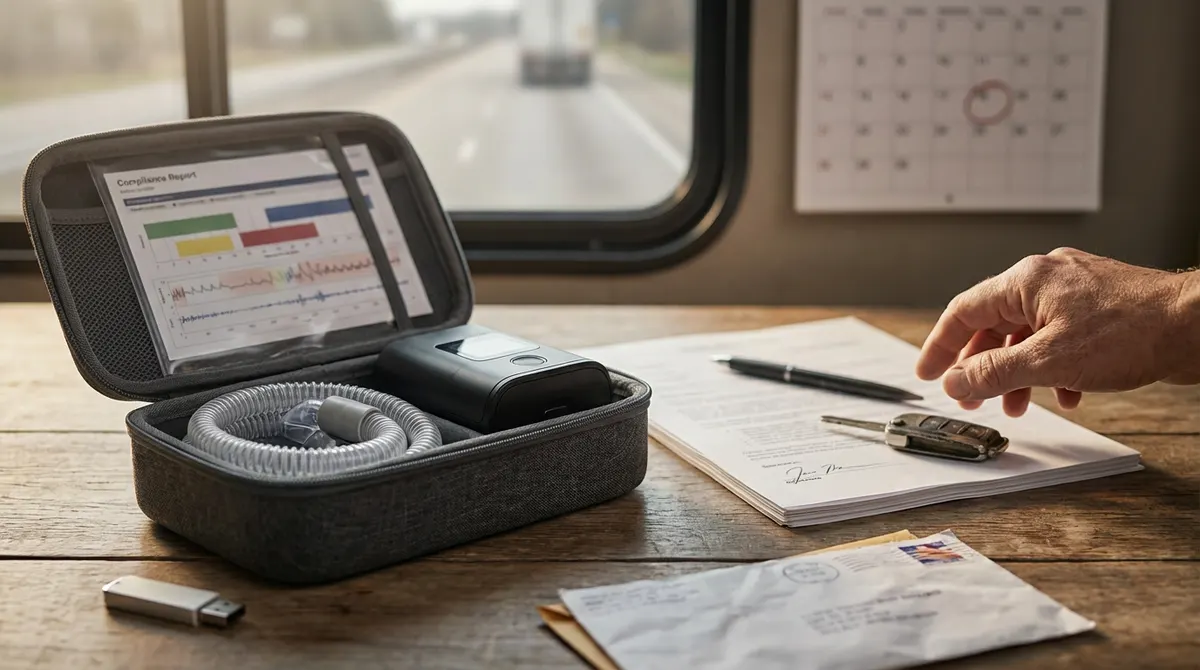
If you are diagnosed with obstructive sleep apnea, the next step is usually treatment plus documentation, not automatic loss of your CDL. The goal is to reduce safety risk and show that the condition is being managed.
The most common next steps are:
review the diagnostic report
discuss treatment options
obtain a CPAP prescription if indicated
begin therapy promptly
collect compliance documentation
return to the medical examiner with the required records
Obstructive sleep apnea treatment is the medical management used to reduce airway obstruction during sleep and improve symptoms and safety. The right plan depends on severity, symptoms, anatomy, and how quickly you need to satisfy DOT follow-up.
Many drivers ask how to pass dot physical with sleep apnea. The practical answer is usually the same: get a valid diagnosis, start effective treatment, and bring objective documentation back to the medical examiner. Dumbo Health also covers the issue in can you pass a DOT physical with sleep apnea.
KEY TAKEAWAY: A confirmed diagnosis usually leads to a treatment-and-documentation pathway that keeps you moving toward certification.
For most drivers, that treatment conversation starts with CPAP.
Treatment and Long-Term Compliance: Maintaining Your DOT-Compliant Status
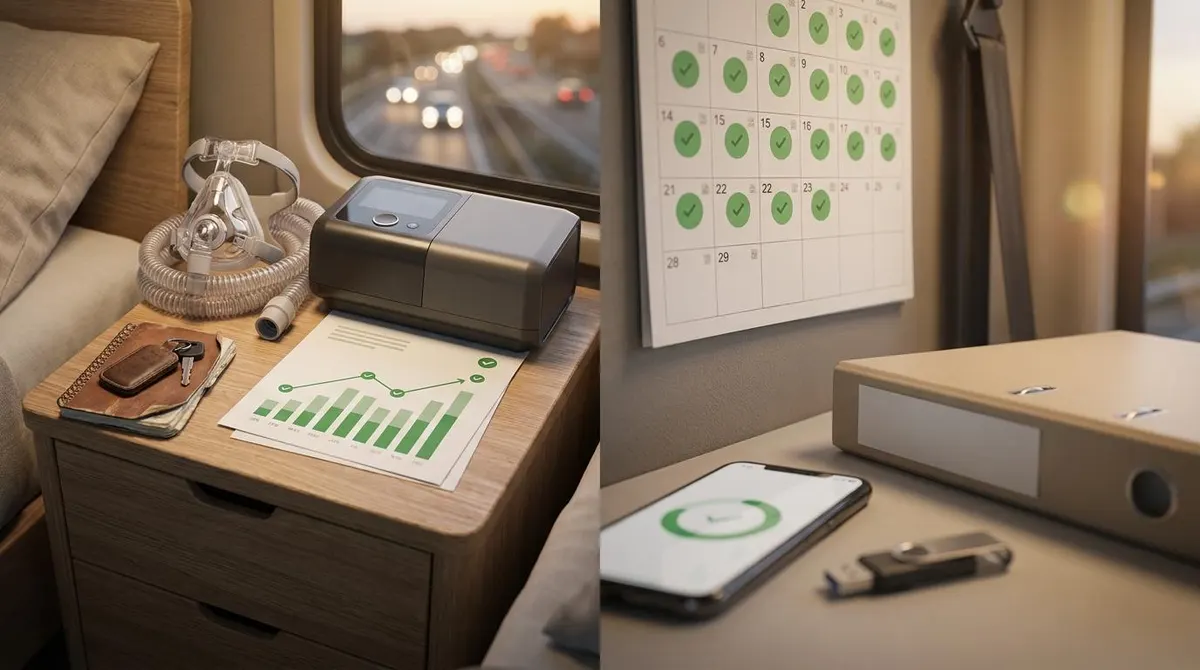
DOT compliance after diagnosis depends on consistent treatment and objective follow-up. DOT compliance is usually easier to maintain than to rebuild after months of untreated symptoms.
Long-term management matters because sleep apnea does not disappear just because the first certificate was issued. If your condition is untreated or poorly controlled, the same concerns about daytime sleepiness and safe driving can return. That is why recertification often depends on proof that treatment is working.
People who undergo treatment often find that fatigue, morning headaches, and poor sleep quality improve when therapy is used regularly. Clinicians frequently observe that drivers who treat obstructive sleep apnea consistently are in a stronger position during recertification than drivers who avoid follow-up. The treatment discussion also opens the door to lifestyle changes that support better sleep patterns over time.
KEY TAKEAWAY: Long-term DOT compliance depends on showing that sleep apnea is being managed, not merely diagnosed once.
The first-line option is usually CPAP therapy.
Continuous Positive Airway Pressure (CPAP) Therapy: The Gold Standard
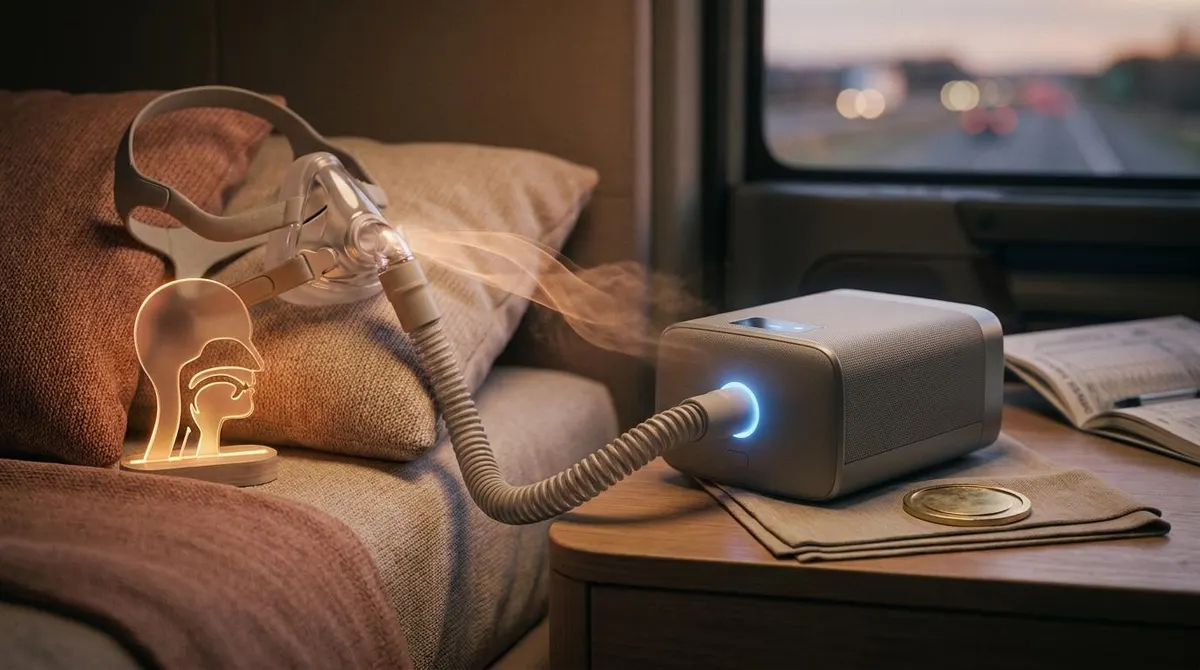
Continuous positive airway pressure is the most established treatment for moderate to severe obstructive sleep apnea. Continuous positive airway pressure works by delivering pressurized air that helps keep the airway open during sleep.
CPAP machines are devices that provide this therapy through a mask connected to a CPAP device. CPAP machines matter because they offer measurable, objective treatment data that the medical examiner may use during recertification. A CPAP prescription is usually required before treatment begins, and the prescribing clinician may also help with mask fit and troubleshooting.
Drivers often ask about the 70 rule for CPAP. In practice, that phrase usually refers to adherence thresholds commonly discussed in sleep medicine and insurance workflows, such as using therapy for at least 4 hours on 70 percent of nights. The exact documentation your medical examiner wants may vary, so always confirm the current requirement with the examiner handling your case.
The most effective way to keep certification moving after diagnosis is to start therapy early and keep your records organized. Bring device usage reports, treatment notes, and any requested follow-up letter to the examiner rather than assuming the office already has them.
KEY TAKEAWAY: CPAP remains the standard treatment because it treats the condition and generates the objective records many examiners want to see.
Not every driver tolerates CPAP immediately, so alternatives matter too.
Beyond CPAP: Other Treatment Options for Sleep Apnea
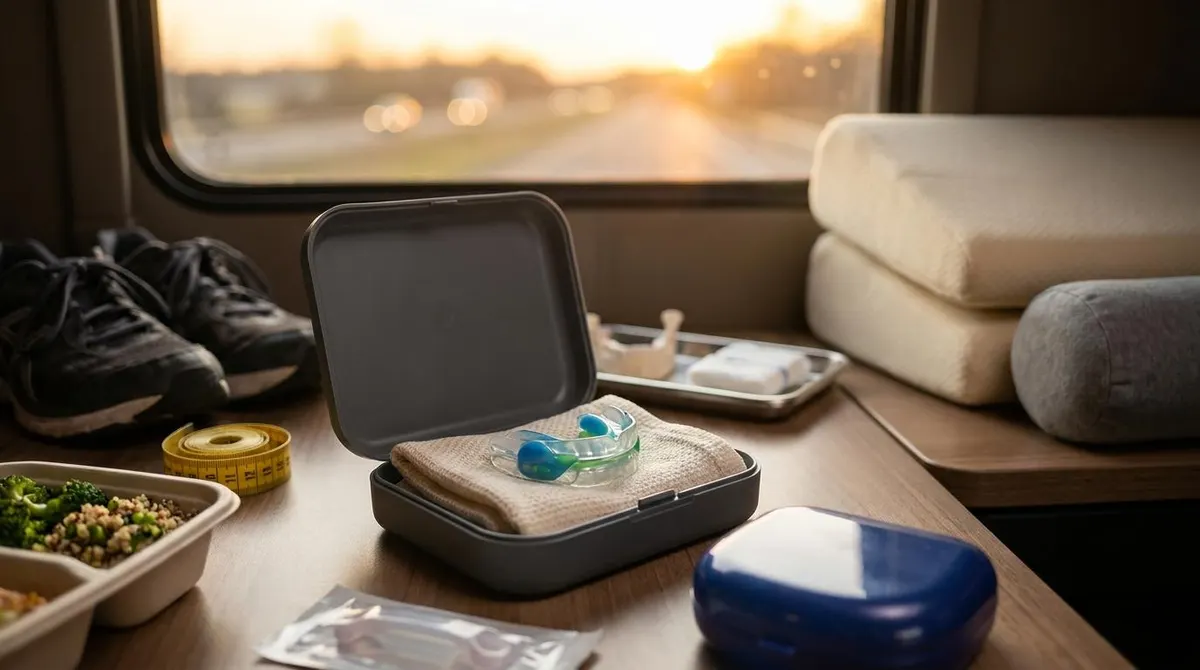
Beyond CPAP, some drivers may use other treatment options depending on severity, anatomy, and clinician advice. Alternatives exist, but alternatives are not equal in speed, evidence, or DOT documentation value.
Possible options may include oral appliance therapy, weight reduction, positional therapy, upper airway procedures, or more specialized approaches. The right option depends on whether the condition is mild or more significant and whether the treatment can be documented in a way that satisfies the medical examiner. Some options improve symptoms but do not provide the same easy compliance reports as CPAP device data.
This is where drivers need nuance. A treatment can help your health but still create a slower DOT paperwork path if the examiner wants stronger objective evidence. That is why many drivers begin with CPAP machines even if another therapy may later become part of the long-term plan.
If you cannot tolerate CPAP machines at first, ask the prescribing clinician for mask adjustments, humidity changes, pressure review, and coaching before giving up. Many people do better after a few practical adjustments than they expected on the first night.
KEY TAKEAWAY: Alternatives to CPAP exist, but the best DOT option is usually the treatment that both works medically and produces clear documentation.
After treatment starts, ongoing monitoring becomes part of staying certified.
Ongoing Monitoring and DOT Re-certification
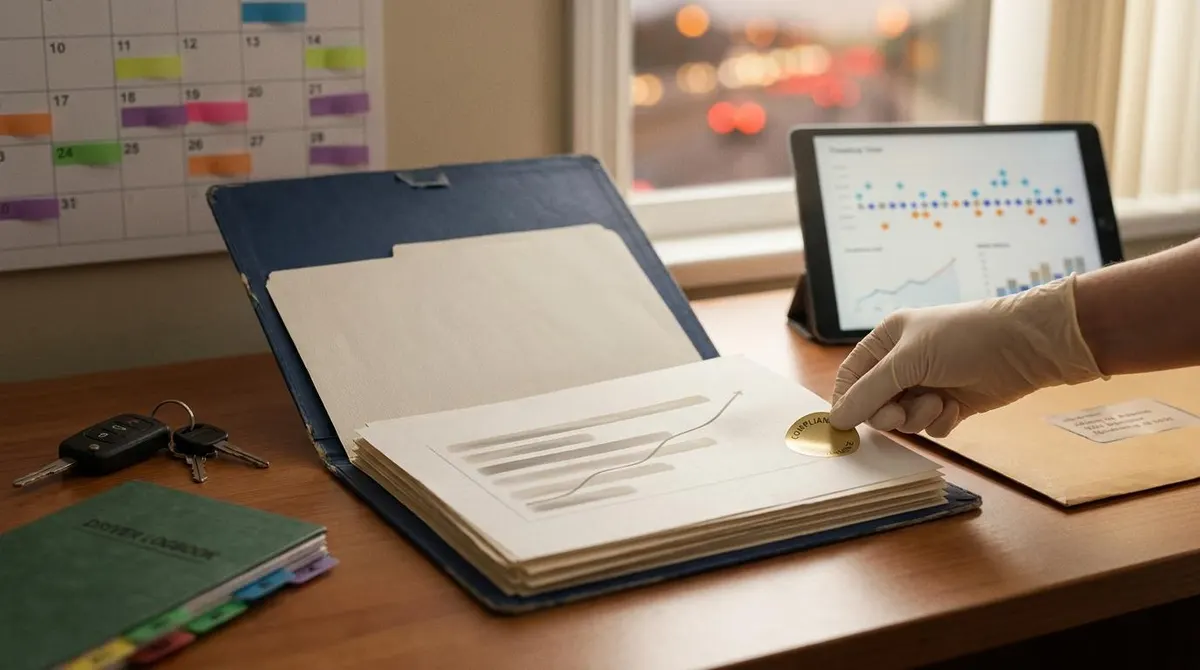
Re-certification depends on showing that treatment remains effective and that symptoms are controlled. Re-certification is not just a repeat of the original diagnosis process.
The examiner may request recent compliance reports, updated notes, or confirmation that daytime sleepiness is controlled. Shorter certification periods are common when a condition requires closer follow-up. That means staying organized between exams is part of protecting your CDL.
A sleep center, prescribing clinician, or equipment provider may generate the records you need. A sleep center can help with follow-up reports, but some remote programs also provide structured documentation. Keep copies of Sleep Study reports, CPAP prescription records, usage summaries, and any treatment letters in one place.
Sleep health screening should not stop after the first certificate. Sleep health screening is part of ongoing safe driving because symptoms can change with weight, work schedules, alcohol use, medication changes, or inconsistent treatment.
KEY TAKEAWAY: DOT re-certification is easier when you maintain ongoing records and address problems before the next physical.
Money is often the next concern, so cost deserves a clear breakdown.
Financial Considerations: Affording Your DOT Sleep Apnea Test and Treatment

Cost matters because testing delays often happen when drivers do not know the full financial picture up front. Cost also matters because the cheapest path is not always the fastest path to medical clearance.
A home sleep test may cost less than a full in-lab Sleep Study, but pricing varies by program, clinician review, and follow-up services. Drivers should ask whether the quoted price includes the device, interpretation, follow-up consultation, and documentation for the medical examiner. A cheap test without usable reporting can become expensive if it leads to a repeat study.
Insurance coverage varies. Some plans cover sleep testing and treatment in standard clinical settings, but DOT-related workflows may have separate rules depending on employer arrangements and network structure. Ask whether FSA/ HSA cards are accepted and whether any part of treatment, such as CPAP device setup, is billed separately.
Early diagnosis has practical value. Untreated sleep apnea can delay certification, worsen fatigue, and increase the risk of more costly disruption later. For many drivers, the best return on investment is getting a valid answer quickly and starting the right treatment instead of waiting until the certificate deadline becomes urgent.
KEY TAKEAWAY: The best financial decision is usually the option that combines clear pricing, valid reporting, and a fast path back to certification.
Beyond cost, daily habits can make treatment easier and sleep better.
Holistic Sleep Health for the Road Warrior: Beyond the Test

Long-term sleep health requires more than one test result. Long-term sleep health for drivers depends on routines, recovery, and treatment consistency.
Sleep environment is the physical setting that supports healthy sleep. Sleep environment matters because noise, light, temperature, and schedule disruption can worsen sleep quality even when sleep apnea is being treated. If you sleep on the road often, focus on blackout support, cooling, noise control, and consistent pre-sleep habits when possible.
Lifestyle adjustments also matter. Better sleep patterns often begin with regular sleep timing, reduced alcohol near bedtime, weight management when appropriate, and careful review of sedating medications with a clinician. Even small changes can make CPAP device use more tolerable and reduce symptom burden.
Resources can help. Some programs provide sleep coaches, sleep coaching, and follow-up support for equipment adaptation and habit building. If you need to find a provider near you, prioritize programs that combine clinical review, clear reporting, and practical treatment support.
KEY TAKEAWAY: Better sleep health comes from combining treatment with daily habits that protect recovery, consistency, and alertness on the road.
Drivers also hear many myths, and some of them cause unnecessary fear.
Common Myths About DOT Sleep Apnea Tests at Home Debunked
Many DOT sleep apnea myths are based on fear, half-true forum advice, or confusion about FMCSA policy. Many DOT sleep apnea myths fall apart once you separate diagnosis from disqualification.
MYTH: A home sleep test is never valid for DOT.
FACT: A home sleep test can be valid when it is clinically appropriate, provider-directed, and properly interpreted. The AASM states that home sleep apnea testing can be used in uncomplicated adults with signs and symptoms suggesting moderate to severe obstructive sleep apnea, and FMCSA does not require one specific testing method.
MYTH: If you fail a sleep test, you lose your CDL immediately.
FACT: A diagnosis does not automatically end certification. FMCSA guidance focuses on untreated moderate to severe obstructive sleep apnea and whether the condition is effectively managed. Many drivers continue working through documented treatment and follow-up.
MYTH: A large neck or high BMI alone means DOT requires a sleep study.
FACT: FMCSA does not publish a blanket rule based on one body measurement alone. Examiners consider the whole clinical picture, including symptoms, medical history, blood pressure, daytime sleepiness, and related risk factors.
MYTH: At-home testing is always less accurate than any lab study.
FACT: A lab Sleep Study remains broader and more comprehensive, but a home test can still be appropriate and clinically useful in selected uncomplicated adults. The right comparison is not convenience versus science. The right comparison is whether the chosen test matches the clinical question.
KEY TAKEAWAY: Most driver fears come from misunderstanding the difference between suspected sleep apnea, confirmed diagnosis, and treated fitness for duty.
With the myths addressed, the article can close by summarizing what to do next.
Frequently Asked Questions
How to pass dot physical with sleep apnea?
The most practical way to pass a DOT physical with sleep apnea is to document the condition properly, begin effective treatment, and return to the medical examiner with objective records. A diagnosis alone does not usually disqualify you. The examiner is trying to confirm that obstructive sleep apnea is controlled well enough for safe driving. In most cases, that means completing a valid Sleep Study, following the recommended treatment plan, and bringing current documentation such as a provider note, CPAP prescription, and device usage report when requested.
How much does WatchPAT cost?
WatchPAT cost varies because the total price depends on the provider, whether interpretation is included, and whether follow-up consultation is bundled with the test. Some drivers pay one all-in price for the device pathway, clinical review, and report, while others pay separately for consultation and treatment follow-up. WatchPAT ONE is one example of a home testing workflow, not a universal national price point. Before ordering, ask whether the quote includes physician interpretation, a DOT-usable report, shipping, and any repeat-test charges if the first recording is technically inadequate.
What is the 4% rule for sleep apnea?
The 4% rule for sleep apnea usually refers to a scoring approach in which breathing events are counted based on oxygen desaturation of 4 percent or more, depending on the report format and payer or clinical context. Drivers sometimes hear this phrase online and assume it is a DOT-specific rule, but that is not usually the case. The more important issue for DOT follow-up is whether your report clearly states the diagnosis, severity, and treatment recommendation in a form the medical examiner can use. Ask the interpreting clinician how the study was scored if the wording seems unclear.
What is the 70 rule for CPAP?
The 70 rule for CPAP usually refers to a common adherence benchmark of using CPAP therapy for at least 4 hours on 70 percent of nights over a monitoring period. Drivers hear this number because it appears often in sleep medicine compliance discussions and insurance workflows. Your medical examiner may ask for objective CPAP device data that shows consistent use, but the exact records requested can vary by examiner and timing. The safest approach is to use therapy regularly and bring your most recent compliance report to the DOT follow-up visit.
What if I fail my DOT sleep apnea test at home?
If an at-home DOT sleep apnea test shows obstructive sleep apnea, the usual next step is treatment and documentation, not automatic loss of your CDL. The medical examiner may issue a short certification period, ask for treatment follow-up, or request additional evaluation depending on the severity and your symptoms. In some cases, a technically poor or inconclusive home test leads to a lab Sleep Study instead of a treatment decision. The most effective response is to move quickly, follow the prescribed plan, and keep all records ready for the return visit.
How quickly can I get results and get back on the road?
Results timing depends on the provider workflow, the device used, and whether the study data is technically complete the first night. Some home programs can deliver interpreted results in a few days, while other programs take longer if the unit must be returned physically or the data needs repeat collection. The fastest overall route is usually the one that includes intake, testing, interpretation, and examiner-ready paperwork in one coordinated pathway. If time is tight, ask the provider near you or providers in your area for the full turnaround from order to final report, not just the shipping time.
Can my employer require me to get a sleep apnea test?
An employer may require you to follow a safety or occupational health process, but the DOT certification decision itself still depends on the medical examiner’s judgment and documentation. In practice, employers often act when a driver has a pending DOT issue, a safety concern, or an examiner referral for follow-up. The key distinction is that employer policy and certification rules are not identical. If you are being asked to test, confirm what exact documentation is needed, who is paying, and whether you may choose a provider close to you that can deliver a valid DOT-ready report.
Is a home sleep study as accurate as a sleep lab study for DOT?
A home sleep study can be accurate enough for DOT follow-up in selected uncomplicated adults with suspected obstructive sleep apnea, but it is not as comprehensive as a full in-lab Sleep Study. A lab study remains the broader test because it can capture more signals and evaluate a wider range of sleep disorders. A home study is usually the better fit when the main question is straightforward sleep apnea and speed matters. If symptoms are complex or the first test is inconclusive, the next step may be a sleep center evaluation instead.
Conclusion: Take Control of Your Sleep, Protect Your Career

A DOT sleep apnea test at home can be a practical and medically credible option when the concern is straightforward obstructive sleep apnea and the process includes proper clinical oversight. The goal is not to avoid the issue. The goal is to get a valid diagnosis, secure medical clearance, start effective treatment if needed, and stay compliant over time. If you want a faster next step, explore Dumbo Health’s at-home sleep test option for DOT-related sleep apnea concerns. Taking action early gives you more control, fewer delays, and a stronger path back to confident driving.
Related DOT Physical Topics
- Home Sleep Apnea Test for Commercial Drivers The CDL Holder's Complete Guide
- What drugs do they test for in a DOT drug test
- Are There New DOT Rules or Laws on Sleep Apnea Testing
- When Can Sleep Apnea Affect a DOT Physical
- Sleep Apnea Test for CDL Drivers
- Why DOT Sleep Tests at Home Matter for Your Career and Health
- How can drivers with sleep apnea qualify again after a failed DOT physical
- Can you fail a DOT physical because of sleep apnea
- Can you pass a DOT physical with sleep apnea
- What happens if you fail a DOT physical due to sleep apnea
- At Home Sleep Test for Truck Drivers
- What are the current DOT requirements for sleep apnea testing for commercial drivers
- Does a DOT Physical Test for Weed or THC The Complete Guide for Commercial Drivers
- Does a DOT physical include a drug test
- What Does DOT Stand for in a DOT Physical
- How Sleep Apnea Affects Overall Driving Safety
- Is a drug test required for a DOT physical
- Best Treatments for Sleep Apnea to Improve Driving Safety
- What Precautions Should Drivers With Sleep Apnea Take
- What Is the Urine Test for in a DOT Physical
- Are there legal requirements for drivers with sleep apnea
- How Does Sleep Apnea Affect Driving Ability
- The Comprehensive Guide to Suboxone, Sleep Apnea, and FMCSA Compliance for Commercial Motor Vehicle Operators
- What are the current FMCSA guidelines on sleep apnea for commercial drivers
- DOT Physical & Drug Test What Drivers Need to Know
- Is a Sleep Study Required for a DOT Physical
- What Is the Difference Between a DOT and Non-DOT Physical
- What Happens If Your DOT Physical Expires Compliance Guide for Commercial Drivers
- What Can Disqualify You From a DOT Physical
- The Ultimate DOT Physical Guide for Commercial Drivers (2025–2026)
- Can You Pass a DOT Physical with Epilepsy
- DOT Physical Self Pay Cost
- Remote DOT Physical The Complete Guide for Commercial Drivers
- DOT Physical Out of Pocket What Commercial Drivers Actually Pay
- Essential 171 DOT Definitions for Commercial Drivers
- Navigating the Florida DOT Physical Your Essential Guide for CDL Drivers
- 2026 DOT Inspection Dates
- DOT Physical Cost Breakdown What Drivers Pay & Why
- Can You Pass a DOT Physical With One Eye
- Can You Pass a DOT Physical With a Pacemaker
- What Should You Bring to a DOT Physical
- Telehealth Dot Physical
- DOT Physical Forms & Paperwork The Complete Guide for Commercial Drivers
- Who needs a DOT physical
- What Forms Do You Need for a DOT Physical
- Does insurance cover a DOT physical
- DOT Physical & Alcohol Requirements
- DOT Physical Online Cost
- DOT Physical Duration and Validity How Long Your Medical Card Lasts
- DOT Physical ICD-10 & Billing Codes The Complete Guide for Accurate Compliance and Reimbursement
- DOT Physical Vision & Eye Requirements
- Online DOT Physical Without Insurance A Complete Guide for Commercial Drivers
- Why do they measure your neck during a DOT physical
- Navigating Your DOT Physical with Common Medical Conditions
- Can You Fail a DOT Physical for Being Overweight
- Your Complete Guide What's Included in a DOT Physical Exam
- Do They Check for Hernia During a DOT Physical
- Walk In DOT Physical Self Pay
- Online DOT Physical Self-Pay The Complete Guide for CDL Drivers and Owner-Operators
- DOT physical self pay guide for commercial drivers paying out of pocket
- Can You Get a DOT Physical Online
- How Do You Submit Your DOT Physical to the DMV
- What Are the Requirements to Pass a DOT Physical
- New DOT Physical Requirements What Drivers MUST Know About New Updates
- DOT Physical Exam Basics
- DOT Physical Insurance & Recertification The Complete Driver's Guide
- Can You Pass a DOT Physical With a Hernia
- Can You Get a Second Opinion on Your DOT Physical A Complete Guide for Commercial Drivers
- Cheap DOT Physical Online
- Same Day DOT Physical
- Virtual DOT Physical
- DOT Physical Cash Pay
- What blood pressure do you need to pass a DOT physical
- Online DOT Physical The Complete Guide for Commercial Drivers and Medical Examiners
- DOT Medical Exam Self-Pay A Complete Guide for Commercial Drivers
- Online DOT Exam What Drivers and Medical Examiners Need to Know
- Do They Check Your Private Parts During a DOT Physical
- DOT Physical Blood Pressure Requirements What Drivers Need to Know
- DOT Physical Insurance or Self Pay How to Choose the Right Payment Option for Your Exam
- DOT Physical Chiropractor Your Complete Guide to CDL Exams
- Is a DOT physical the same as a regular physical
- Can You Fail a DOT Physical for High Blood Pressure
- How to Pass a DOT Physical The Complete Commercial Driver's Guide
- What should I expect at a DOT physical
- What Does a DOT Physical Consist Of
- DOT Physical at Urgent Care What Commercial Drivers Need to Know
- Can You Get a DOT Physical in Any State The Complete Guide for Commercial Drivers
- Can You Pass a DOT Physical with Diabetes
- Can You Pass a DOT Physical with High Blood Pressure
- BMI for DOT Physical What Commercial Drivers Need to Know
- What Happens During the DOT Physical Exam The Complete Guide for Drivers
- Non-DOT Physical A Comprehensive Guide to Workforce Health and Safety
- DOT Physical Texas The Essential Guide to Your Exam, Medical Card, and CDL Compliance
- DOT Physical Requirements A Complete Guide for CDL Drivers
- Guide to Obtaining and Managing Your DOT Medical Card Online
- Do You Have to Pee During a DOT Physical
- What eye chart is used for a DOT physical
- What Do They Check During a DOT Physical
- The DOT Physical Exam Ensuring You're Fit for the Road
- Failing a DOT Physical What Every Commercial Driver Needs to Know
Take the next step before your DOT physical
Start with the free quiz if you are unsure about your risk, or order an at-home sleep test if you have already been flagged for possible sleep apnea.
AI summary
A DOT sleep apnea test at home is a provider-directed home sleep apnea test (HSAT) used to evaluate suspected obstructive sleep apnea (OSA) for commercial drivers without an overnight sleep center stay. FMCSA does not mandate one universal test; the medical examiner uses clinical judgment based on symptoms, medical history, and risk factors. Acceptable home testing requires a clinician order, technically adequate data, and physician interpretation; automatically scored consumer summaries may not be sufficient. Common DOT-usable options include Type III home sleep tests (airflow, respiratory effort, oxygen saturation, heart rate) and selected device pathways such as WatchPAT ONE (FDA cleared). Results typically categorize OSA as absent, mild, moderate, or severe. If a home test is negative, inconclusive, or technically inadequate and suspicion remains, in-lab polysomnography may be needed. Certification outcomes depend on documentation and treatment status; effectively treated moderate to severe OSA may allow certification. After diagnosis, drivers often start CPAP therapy and provide compliance reports for DOT follow-up and re-certification.

Nicolas Nemeth
Co-Founder
Nico is the co-founder of Dumbo Health, a digital sleep clinic that brings the entire obstructive sleep apnea journey home. Patients skip the sleep lab and the long wait to see a specialist. Dumbo Health ships an at home test, connects patients with licensed sleep clinicians by video, and delivers CPAP or a custom oral appliance with ongoing coaching and automatic resupply in one clear subscription.
Keep reading

How Long Does a DOT Physical Take? A Complete Guide for Commercial Drivers

What Happens If You Fail a DOT Drug Test? The Complete Guide for Commercial Drivers


