Can You Pass a DOT Physical With One Eye?
Commercial drivers with vision loss in one eye often cannot pass the standard DOT vision rule because it requires minimum acuity and visual fields in each eye. The article explains the baseline federal thresholds, including 20/40 vision in each eye, 70 degrees of field of vision per eye, and traffic-signal color recognition. It outlines the current interstate pathway for many monocular drivers: the FMCSA Alternative Vision Standard under 49 CFR 391.44. You will learn how Form MCSA-5871 (Vision Evaluation Report) and a certified Medical Examiner determine certification. It also covers what else can affect approval, such as blood pressure, medications, diabetes, and sleep apnea risk. Practical preparation tips and steps to take after a denial are included.
Struggling with sleep?
Find out if sleep apnea is the reason.
FDA-cleared. $149 flat. Physician-reviewed results in 48 hours.

Can You Pass a DOT Physical With One Eye?

A DOT physical with one eye is sometimes possible for commercial drivers, but most drivers do not qualify through the standard vision rule alone. According to the Federal Motor Carrier Safety Administration, interstate commercial drivers normally must meet specific visual acuity, field of vision, and color recognition standards, and FMCSA now allows some drivers with vision loss in one eye to qualify under the Alternative Vision Standard instead of the old federal exemption route. This guide explains the standard DOT vision requirements, why monocular vision usually fails the default rule, how the current certification pathway works, what a certified Medical Examiner reviews during the physical exam, and what changes for interstate commerce versus intrastate driving. It also covers common fears, denial scenarios, and the practical steps that can improve your odds of medical certification. Keep reading to see what the rule really says and what process actually applies today. (eCFR)
Understanding the Standard DOT Vision Requirements for CDL Certification
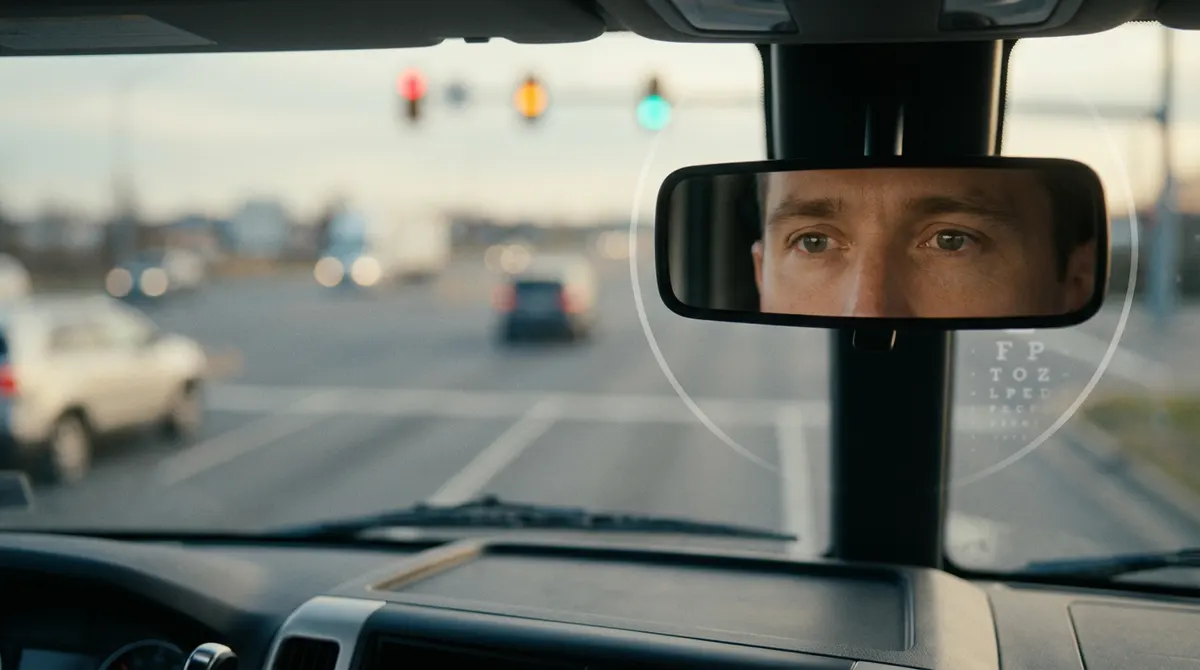
The standard DOT vision requirements are strict because safe operation of a commercial motor vehicle depends on seeing clearly, noticing hazards early, and recognizing traffic signals fast enough to react. For most commercial drivers, the vision test is not just about reading letters on a chart. It also measures whether your visual acuity, field of vision, and color recognition meet federal safety thresholds.
Visual acuity is the sharpness of sight measured during a vision test, usually with a Snellen eye chart. For a standard federal pass, you generally need at least 20/40 vision in each eye, with or without corrective lenses, plus at least 20/40 binocular acuity in both eyes together. According to the FMCSA rule in 49 CFR Part 391, each eye must also have at least 70 degrees in the horizontal meridian, which is why peripheral vision matters so much during a DOT physical exam. (eCFR)
Field of vision is the total area you can see while looking straight ahead. The standard rule does not use a 120-degree field of vision threshold overall. Instead, it requires at least 70 degrees in each eye under the default vision standard. Drivers must also recognize the colors of traffic signals and devices showing standard red, green, and amber. That is why a color test or color recognition screen may matter even if you read the chart well.
Corrective lenses are glasses or contact lenses used to improve vision to a safe level. Corrective lenses can help you meet the visual acuity standard, but corrective lenses cannot fully solve every visual condition. If you pass with glasses or contact lenses, the Medical Examiner may place a corrective lenses restriction on your Medical Examiner's Certificate so you must wear them while driving.
Not sure if sleep apnea applies to you?
Take our 2-minute sleep risk quiz to see whether sleep apnea could affect your DOT physical. No account required.
People often search for a simple DMV-style answer, but the Department of Transportation medical exam is broader than a basic license renewal screen. The DOT Exam also reviews hearing, blood pressure, blood sugar when relevant, overall physical examination findings, and other medical conditions that can affect reaction capability or safe driving.
DID YOU KNOW: The FMCSA physical qualification rule requires drivers to carry a current Medical Examiner's Certificate when medically certified to operate a commercial motor vehicle in covered operations. (eCFR)
KEY TAKEAWAY: Under the standard federal vision rule, a CDL driver usually needs 20/40 vision in each eye, adequate visual fields, and reliable color recognition to pass the DOT physical exam.
That standard sets up the core issue for monocular vision and why many drivers need the alternative pathway instead of the default rule.
Why Monocular Vision Usually Does Not Meet the Standard Rule

Monocular vision is vision that effectively relies on one functioning eye because of vision loss or major vision impairment in the other eye. Monocular vision matters in commercial driving because the standard DOT physical expects both eyes to meet minimum thresholds, not just the better eye.
Under the default federal rule, a driver is usually initially disqualified if one eye cannot meet the required visual acuity or field of vision standard. In practical terms, that means a driver with major vision problems in one eye usually cannot pass the standard vision test even if the better eye sees well. According to the FMCSA final rule and current regulation, the default standard still requires qualifying performance in each eye. (Federal Register)
The main safety concern is not simply one-eye status by itself. The deeper issue is whether the worse eye fails the default standard and whether the better eye and the driver as a whole can still operate safely. Binocular vision can support depth judgment, lane positioning, mirror use, and hazard detection. Clinicians frequently observe that people can adapt remarkably well to monocular vision over time, but adaptation is not assumed automatically. FMCSA expects documented medical evaluation instead of guesswork.
Peripheral vision is especially important here. A person may feel comfortable in daily driving yet still struggle with certain visual fields demands in a commercial vehicle, especially during backing, merging, or scanning crowded traffic. Vision loss in one eye can also change reaction capability in real-world traffic, particularly during fatigue, bad weather, or night driving.
This is also where confusion begins online. Many people still search for a vision waiver, vision exemptions, or the old vision exemption program. Those terms remain common in search behavior, but current interstate certification rules use a newer framework for many monocular vision cases.
IMPORTANT: Monocular vision does not always end a commercial driving career, but monocular vision usually does prevent a standard pass under the default rule unless you qualify under the current alternative standard. (eCFR)
KEY TAKEAWAY: Monocular vision usually fails the standard DOT vision rule because the federal standard measures each eye separately, not only the better eye.
The next step is understanding the current federal pathway that may still allow certification.
Already diagnosed and need CPAP support?
Dumbo Health helps patients start CPAP without the usual confusion, paperwork, or upfront cost. Equipment, setup, supplies, and ongoing support are all handled in one place.
The Current Federal Pathway: Alternative Vision Standard, Not the Old Waiver System

Passing a DOT physical with one eye is often achievable through the FMCSA Alternative Vision Standard, not through the older federal vision waiver model that many search results still mention. For interstate commerce, the Federal Motor Carrier Safety Administration replaced the prior vision exemption program for new cases with 49 CFR 391.44.
The Alternative Vision Standard is the current federal route for a driver who does not satisfy, with the worse eye, either the distant visual acuity rule, the field of vision standard, or both. According to FMCSA, the old federal vision exemption program was replaced as the main basis for qualification, and the current process centers on a vision specialist evaluation, Form MCSA-5871, and a certified medical examiner decision. (FMCSA)
Under this pathway, the better eye generally must still show at least 20/40 vision with or without corrective lenses, at least 70 degrees of field of vision in the horizontal meridian, and the ability to recognize traffic signal colors. The vision deficiency must also be stable and the driver must have had enough time to adapt to that vision loss. FMCSA also requires the medical exam to begin no more than 45 days after the ophthalmologist or optometrist signs the Vision Evaluation Report. (eCFR)
The key difference between the standard rule and the alternative rule is where the pass or fail decision happens. The standard rule focuses on whether both eyes meet the baseline thresholds. The alternative rule allows a Medical Examiner to certify a driver with one nonqualifying eye if the better eye, supporting documentation, and overall medical evaluation support safe operation.
A medical evaluation for monocular vision is not the same as a simple eye chart screening. A medical evaluation includes a specialist review, prior history, current stability, and formal findings that the examiner can use during the DOT Medical process.
If you are exploring whether at-home sleep testing may also matter for certification because of fatigue or sleep apnea concerns, Dumbo Health's at-home sleep test can help you understand symptoms before they become a bigger barrier to medical clearance.
KEY TAKEAWAY: For most new interstate cases involving one eye, the current federal route is the Alternative Vision Standard under 49 CFR Part 391.44, not the old federal exemption program.
Once you know the correct pathway, the practical question becomes how to complete it step by step.
The Step-by-Step Process for Getting Certified With One Eye

The process for a driver with one eye starts with specialist documentation and ends with a Medical Examiner's certification decision. The most effective way to move through the process is to treat it as a documentation-driven medical exam rather than a one-day surprise physical exam.
Step one is an eye exam by an ophthalmologist or optometrist. The specialist completes the Vision Evaluation Report, also called Form MCSA-5871. FMCSA states that the Vision Evaluation Report must be signed and dated by an ophthalmologist or optometrist and given to the Medical Examiner before each required qualification exam. The medical exam must begin within 45 days of that signature. (FMCSA)
Step two is the DOT physical exam with a certified medical examiner. The Medical Examiner reviews the Form MCSA-5871, checks the rest of your physical examination, and uses independent medical judgment to decide whether you meet the alternative standard and all other physical qualification standards. That means your vision is only one part of the DOT physical. Blood pressure, blood sugar, medication effects, cardiovascular history, neurologic conditions, and other medical conditions can still affect the outcome.
Step three is practical qualification. Under the current rule, a first-time driver certified under the alternative vision standard may need an employer-administered road test before operating in interstate commerce. Many people confuse this with the Skill Performance Evaluation or SPE process. The Skill Performance Evaluation is a separate concept that is often discussed online, but for one-eye qualification the current federal framework is the Alternative Vision Standard, not the older federal vision exemptions model. (Federal Register)
Step four is ongoing review. The examiner may issue medical certification for up to 12 months under the alternative vision standard, which is shorter than the maximum 24-month certificate many drivers think of under standard certification. That shorter cycle means keeping your eye health records and follow-up care organized matters.
The vision Evaluation Report is your eye health blueprint. The Medical Examiner's Certificate is the document that proves medical certification. The certified medical examiner is the gatekeeper who decides whether the full record supports safe commercial driving.
TIP: Bring prior eye exam records, diagnosis history, treatment notes, and a list of corrective lenses use to your DOT physical exam so the Medical Examiner can document stability clearly.
KEY TAKEAWAY: The certification pathway for one-eye drivers is built around Form MCSA-5871, a specialist eye exam, a DOT physical exam, and ongoing annual review when approved. (FMCSA)
That leads to the next issue many drivers underestimate, which is that the examiner reviews much more than vision alone.
What the Medical Examiner Reviews Beyond Vision

A driver with monocular vision can still fail the DOT physical if another medical issue creates safety risk. A DOT physical is a full health screening, not only a vision test.
The Medical Examiner evaluates overall physical health, including blood pressure, heart disease history, medication side effects, hearing, and signs of conditions that could impair alertness. If blood pressure is elevated, certification length may be shortened or delayed depending on the severity and supporting treatment plan. Blood sugar may also matter for drivers with diabetes or symptoms that raise concern during the physical exam. The core question is always fitness for duty in a commercial vehicle.
Sleep apnea is one of the most important examples. Sleep apnea is a disorder in which breathing repeatedly stops or becomes restricted during sleep, which can reduce sleep quality and increase daytime sleepiness. Mayo Clinic explains that obstructive sleep apnea is linked with excessive daytime drowsiness and high blood pressure, and FMCSA has warned that untreated sleep apnea raises the risk of fatigue-related crashes in truck drivers. That matters because a driver can pass a vision-related pathway and still have a DOT Medical issue if daytime sleepiness creates safety concerns. (Mayo Clinic)
Commercial drivers often focus on the eye issue and overlook how fatigue and cardiovascular risk can affect the same medical certification decision. According to FMCSA material, about 28 percent of commercial truck drivers in one cited study had mild to severe sleep apnea. Research highlighted by the American Academy of Sleep Medicine also reports that obstructive sleep apnea is associated with higher motor vehicle crash risk, and effective treatment reduces that risk. (FMCSA)
If snoring, daytime fatigue, headaches, or poor sleep are part of your history, it is smart to read about what sleep apnea is and the most common sleep apnea symptoms to look out for before your next medical exam.
sleep apnea increases DOT scrutiny because untreated sleep apnea can reduce alertness. Sleep apnea also overlaps with blood pressure risk, cardiovascular strain, and real-world driving safety. Sleep apnea is therefore both a medical issue and a certification issue for many truck drivers.
DID YOU KNOW: FMCSA educational material says almost one-third of commercial truck drivers in one sponsored study had mild to severe sleep apnea, which shows why fatigue screening can matter during a DOT physical. (FMCSA)
KEY TAKEAWAY: The Medical Examiner looks beyond one eye and reviews the full medical picture, including blood pressure, blood sugar, medications, and sleep apnea risk.
That broader review makes preparation more important than many drivers realize.
Proactive Strategies for Monocular Drivers Seeking Certification

Monocular drivers improve their odds when they prepare early, document stability, and address every medical concern that could complicate the DOT physical. The best strategy is to arrive with a complete record instead of hoping the office can fill in gaps.
Start with regular eye exam follow-up and treatment. Eye health is not a one-time checkbox. If you have a stable condition after cataract surgery, laser eye surgery, retinal injury, or another cause of vision loss, keep records showing stability over time. If you use progressive lenses, corrective lenses, or contact lenses, make sure the prescription is current and the specialist documentation is clear. If your better eye has any vision impairment or visual conditions under review, ask your specialist to explain functional impact in plain language.
Then prepare for the medical exam as a whole. Bring your medication list, blood pressure logs if you have hypertension, diabetes records if blood sugar control matters, and any specialty notes related to heart disease or past heart attack concerns. Some drivers also bring prior stress test or Exercise Tolerance Test results when a cardiovascular issue has already been evaluated. A medical evaluation that is complete and organized helps the examiner focus on what the regulation actually requires.
Many patients report that anxiety is one of the biggest barriers, especially after reading forum posts that mix old rules with new rules. In real-world use, the most helpful move is verifying the current federal standard before your appointment and working with a certified medical examiner who understands monocular vision cases.
You may also see online references to CNS Occupational Medicine, Johnson Chiropractic, DOT Center, 3D Spine, or Freight Waves when researching a DOT physical. Those names may appear in search results, but they are not the controlling regulatory authority. The controlling authority for interstate medical certification is the Federal Motor Carrier Safety Administration and the applicable regulation under 49 CFR Part 391.
IMPORTANT: Bring documentation that proves stability, adaptation, and follow-up care, because monocular vision cases are won or lost on medical detail and examiner confidence.
KEY TAKEAWAY: The strongest application combines stable eye health records, a current specialist report, and full preparation for the rest of the DOT medical exam.
The next distinction that can change the outcome is whether you drive interstate or only within your state.
Interstate vs. Intrastate Driving: Why the Rules Can Differ

Interstate commerce usually follows federal FMCSA standards, while intrastate driving may follow a state DMV or state-specific medical framework. That difference matters because some drivers who cannot qualify for interstate commerce may still have options for intrastate commerce.
Interstate commerce means operating a commercial motor vehicle in business that crosses state lines or affects cross-border trade. For interstate operations, the Federal Motor Carrier Safety Administration standards are the main focus, including the alternative vision standard in 49 CFR 391.44 and the broader physical qualification rules in 49 CFR 391.41. That is the pathway most readers mean when they ask whether they can keep a commercial driver's license or CDL license with one eye. (eCFR)
Intrastate commerce means operating only within one state under that state's rules. Intrastate driving can be different because a state DMV may adopt all, some, or modified versions of federal medical standards. Some states are more closely aligned with federal rules than others. That is why a driver may hear one answer from a federal source and a different answer from providers in your area who mostly handle intrastate cases.
Here is the simplest comparison:
| Category | Interstate commerce | Intrastate commerce |
|---|---|---|
| Main authority | FMCSA and federal regulation | state DMV or state agency |
| Core vision pathway | Standard vision rule or Alternative Vision Standard | Varies by state |
| Medical certification form | Federal DOT Medical forms | Often federal or state-adapted |
| Employer road test issue | May apply for first-time alternative vision standard cases | Varies by state |
| Best next step | See a certified medical examiner familiar with FMCSA rules | Verify state DMV rules and local provider requirements |
For the most common use case, a driver seeking interstate work should assume the federal pathway applies unless a qualified examiner confirms otherwise. A driver working only in-state should still verify local requirements rather than relying on general internet advice.
If you are trying to find a provider near you, ask whether the clinic handles monocular vision cases under the FMCSA alternative rule and whether the examiner regularly sees interstate commercial drivers.
KEY TAKEAWAY: Interstate cases usually follow FMCSA federal rules, while intrastate driving may depend on state DMV requirements and can differ in important ways.
With the legal framework clear, it helps to address the myths that create the most confusion and fear.
Common Myths About Passing a DOT Physical With One Eye Debunked

Many drivers assume one eye means automatic permanent disqualification. That is not accurate under the current federal framework, but some online advice is still stuck on outdated rules.
MYTH: You can never pass a DOT physical with one eye.
FACT: A driver with monocular vision may still qualify under the FMCSA Alternative Vision Standard if the better eye meets the required visual acuity, field of vision, and color recognition benchmarks and the rest of the medical exam supports safe operation. FMCSA replaced the older federal vision exemptions pathway for new cases with this newer standard. (FMCSA)
MYTH: If the better eye is 20/20, the rest of the process does not matter.
FACT: Better-eye sharpness helps, but it is not enough by itself. The examiner still reviews visual fields, traffic signal colors, adaptation to vision loss, blood pressure, medication effects, and other medical conditions that may affect reaction capability or safe driving.
MYTH: A vision waiver is the only way to keep a CDL.
FACT: Many people still use the term vision waiver, but current interstate federal qualification typically relies on the Alternative Vision Standard in 49 CFR 391.44 and Form MCSA-5871, not the older waiver or exemption terminology. Using the right process saves time and reduces avoidable denials. (FMCSA)
MYTH: Color blindness always means automatic failure.
FACT: The rule focuses on the ability to recognize traffic signal colors, meaning standard red, green, and amber. A person with some color vision deficiency is not judged by internet myths or self-diagnosis. A qualified examiner or eye specialist determines whether color recognition for traffic lights and traffic signal colors is adequate under the standard. (Federal Register)
MYTH: If your condition worsens later, nothing can be done.
FACT: A change in visual conditions or other health status can affect recertification, but it does not mean the process is over forever. Drivers may need updated eye exam records, a new medical evaluation, treatment, or in some cases a revised job plan depending on whether they drive interstate or intrastate.
KEY TAKEAWAY: The biggest barrier for one-eye drivers is usually misinformation, not the existence of a pathway, because current FMCSA rules can allow certification when the medical record supports safe driving.
The final body section focuses on what happens if your case changes or your first attempt does not succeed.
What Happens if Your Condition Changes, You Are Denied, or You Need Another Exam

A denial is not always the end of the road, but it does mean you need to identify the real reason for the decision. The most common next step is fixing documentation gaps, updating specialist findings, or addressing a separate medical issue that affected the physical exam.
If your vision condition changes or worsens, tell your eye specialist and Medical Examiner before the next certification cycle. Vision problems that are unstable are harder to certify than a long-standing stable condition. If the better eye drops below the required vision standard, if peripheral vision narrows, or if new medical conditions such as heart disease or poorly controlled blood pressure appear, the examiner may shorten certification, defer the case, or decline medical certification until more information is available.
Many drivers ask whether they can take more than one DOT physical. In practice, a driver can undergo another physical exam, but repeating appointments without solving the underlying issue rarely helps. A better approach is to ask exactly what documentation was missing and whether a new eye exam, updated Form MCSA-5871, or broader medical evaluation is needed. A second medical exam makes sense when the first exam was incomplete, outdated, or based on older misunderstanding about monocular vision.
Appeals are usually less about arguing and more about correcting the record. If the examiner did not have enough information, provide the missing information. If the case involves interstate commerce, make sure the examiner is applying the current FMCSA alternative standard rather than outdated exemption language. If the case is intrastate, verify what your state DMV requires.
People who are also dealing with fatigue often benefit from understanding how at-home sleep studies work, especially when sleep apnea symptoms are complicating a DOT Medical review.
TIP: If you are denied, request the specific reason in writing so your next eye exam or medical exam directly addresses the missing requirement instead of repeating the same problem.
KEY TAKEAWAY: A denial usually points to an unresolved medical or documentation issue, and the smartest next step is targeted correction rather than guesswork.
That brings the guide to the practical questions drivers most often ask before booking an exam.
Frequently Asked Questions
Can you pass a DOT physical with only one eye?
Yes, you may be able to pass a DOT physical with only one eye, but usually not under the default vision rule alone. For interstate commercial drivers, the current pathway is the FMCSA Alternative Vision Standard, which looks at whether the better eye meets the required thresholds and whether the rest of your medical exam supports safe operation. You typically need an eye exam from an ophthalmologist or optometrist, Form MCSA-5871, and a certified medical examiner review. If you drive only within one state, intrastate rules may differ, so providers in your area may give state-specific guidance.
What vision disqualifies you from a DOT physical?
Vision can disqualify you when you do not meet the required visual acuity, field of vision, or color recognition standards and you do not qualify under the alternative pathway. Under the standard federal rule, that usually means less than 20/40 vision in each eye, inadequate visual fields, or inability to recognize traffic signal colors. A driver may also be denied if the vision loss is unstable or if another medical issue, such as uncontrolled blood pressure or sleep apnea-related daytime sleepiness, makes the full DOT physical exam unsafe. The examiner reviews the full picture, not only the eye chart.
Can a truck driver drive with one eye?
A truck driver can sometimes drive with one eye if the driver is medically certified under the correct rule. For interstate commerce, FMCSA allows some drivers with monocular vision to qualify under the Alternative Vision Standard in 49 CFR 391.44. The better eye must generally meet the required standard, and the driver must pass the rest of the medical exam. A first-time driver qualifying under that pathway may also face additional practical requirements tied to employer road testing. For intrastate driving, state DMV rules may differ, so it is important to verify local requirements close to you.
Is a vision waiver still required for one-eye drivers?
Usually no for new interstate federal cases. Many people still search for a vision waiver or vision exemptions because older articles and forum threads use that language. FMCSA replaced the old federal vision exemption program for new cases with the Alternative Vision Standard, which relies on Form MCSA-5871 and a medical examiner's judgment. That means the better question today is not how to get an old waiver, but whether you meet the current alternative standard and have enough medical documentation to prove stability and safe function.
What does Form MCSA-5871 do?
Form MCSA-5871 is the Vision Evaluation Report used in cases where a driver does not meet the default federal vision standard in one eye. An ophthalmologist or optometrist completes the form and documents the better eye, the worse eye, visual acuity, visual fields, diagnosis, treatment history, and whether the condition appears stable. FMCSA requires the Medical Examiner to receive this form before the qualification exam, and the exam must begin within 45 days after the form is signed. The form does not guarantee approval, but it is a required foundation for the decision.
Can you wear glasses or contact lenses and still pass?
Yes, many drivers pass with corrective lenses, including glasses and contact lenses, as long as the corrected vision meets the required standard. If your corrected vision qualifies, the Medical Examiner may note that corrective lenses are required while driving. What matters is not whether you naturally have perfect vision, but whether the corrected visual acuity, field of vision, and color recognition are safe for commercial driving. If your better eye still cannot meet the threshold even with corrective lenses, the examiner will usually look at whether you may qualify under the alternative vision standard instead.
Will sleep apnea affect a DOT physical even if the main issue is vision?
Yes, sleep apnea can affect the DOT physical because the exam reviews overall fitness for duty, not only eye health. FMCSA has warned that untreated sleep apnea increases the risk of fatigue-related crashes, and Mayo Clinic notes that obstructive sleep apnea is linked with daytime drowsiness and high blood pressure. If you have loud snoring, witnessed pauses in breathing, morning headaches, or daytime sleepiness, the Medical Examiner may want more information. That is one reason many drivers also explore Dumbo Health's at-home sleep test when symptoms suggest a sleep disorder.
How often do you need to renew certification if you qualify with one eye?
Many drivers certified under the alternative vision standard should expect closer follow-up than a routine two-year certificate. In current FMCSA guidance, medical certification under the alternative standard may be issued for up to 12 months at a time, which means yearly re-evaluation is common. That shorter cycle makes regular eye exam follow-up, updated documentation, and stable health management especially important. If your condition changes, if new vision problems appear, or if another medical issue develops, the examiner may shorten the period further or request additional evaluation before renewing the Medical Examiner's Certificate.
Conclusion

Passing a DOT physical with one eye is possible for some drivers, but the path usually runs through the current FMCSA Alternative Vision Standard rather than the older waiver language still found online. The key issues are whether the better eye meets the required benchmarks, whether your vision loss is stable, and whether the rest of your physical examination supports safe commercial driving. Careful preparation, a current Vision Evaluation Report, and a knowledgeable Medical Examiner can make a major difference. If fatigue or sleep apnea symptoms may also affect your certification, start with Dumbo Health's at-home sleep test to take the next practical step.
Related DOT Physical Topics
- Can You Pass a DOT Physical with Epilepsy
- Can You Pass a DOT Physical With a Hernia
- Can You Pass a DOT Physical With a Pacemaker
- Can you pass a DOT physical with sleep apnea
- Can You Pass a DOT Physical with Diabetes
- Can You Pass a DOT Physical with High Blood Pressure
- Can You Get a DOT Physical in Any State The Complete Guide for Commercial Drivers
- Can You Get a DOT Physical Online The Complete Guide for Commercial Drivers
- What Can Disqualify You From a DOT Physical
- How can drivers with sleep apnea qualify again after a failed DOT physical
- Can You Get a DOT Physical Online
- Can You Fail a DOT Physical for Being Overweight
- Can you fail a DOT physical because of sleep apnea
- What blood pressure do you need to pass a DOT physical
- Can You Fail a DOT Physical for High Blood Pressure
- Can You Get a Second Opinion on Your DOT Physical A Complete Guide for Commercial Drivers
- Can You Fail a DOT Physical
- How Do You Submit Your DOT Physical to the DMV
- What Forms Do You Need for a DOT Physical
- Navigating Your DOT Physical with Common Medical Conditions
- What Should You Bring to a DOT Physical
- DOT Physical Vision & Eye Requirements
- When Can Sleep Apnea Affect a DOT Physical
- Is a DOT physical the same as a regular physical
- How to Pass a DOT Physical The Complete Commercial Driver's Guide
- What happens if you fail a DOT physical due to sleep apnea
- What Does DOT Stand for in a DOT Physical
- What Happens If You Fail a DOT Physical Twice The Complete Guide for Commercial Drivers
- What Is the Difference Between a DOT and Non-DOT Physical
- Do You Have to Pee During a DOT Physical
- What Are the Requirements to Pass a DOT Physical
- What eye chart is used for a DOT physical
- The DOT Physical Exam Ensuring You're Fit for the Road
- Does a DOT Physical Test for Weed or THC The Complete Guide for Commercial Drivers
- Does a DOT physical include a drug test
- DOT Physical Self Pay Cost
- Remote DOT Physical The Complete Guide for Commercial Drivers
- DOT Physical Exam Basics
- Is a drug test required for a DOT physical
- DOT Physical Cost Breakdown What Drivers Pay & Why
- DOT Physical ICD-10 & Billing Codes The Complete Guide for Accurate Compliance and Reimbursement
- Telehealth Dot Physical
- DOT Physical Forms & Paperwork The Complete Guide for Commercial Drivers
- Who needs a DOT physical
- Navigating DOT Stroke Guidelines for CMV Drivers What You Need To Know
- DOT Physical & Alcohol Requirements
- Online DOT Physical Without Insurance A Complete Guide for Commercial Drivers
- DOT Physical Out of Pocket What Commercial Drivers Actually Pay
- Why do they measure your neck during a DOT physical
- Navigating the Florida DOT Physical Your Essential Guide for CDL Drivers
- What Is the Urine Test for in a DOT Physical
- DOT Physical Online Cost
- Walk In DOT Physical Self Pay
- Online DOT Physical Self-Pay The Complete Guide for CDL Drivers and Owner-Operators
- DOT physical self pay guide for commercial drivers paying out of pocket
- Your Complete Guide What's Included in a DOT Physical Exam
- New DOT Physical Requirements What Drivers MUST Know About New Updates
- DOT Physical Insurance & Recertification The Complete Driver's Guide
- DOT Physical Cash Pay
- Same Day DOT Physical
- Virtual DOT Physical
- What Are the DOT Requirements for Drivers With Sleep Apnea
- Do They Check Your Private Parts During a DOT Physical
- DOT Physical Blood Pressure Requirements What Drivers Need to Know
- DOT Physical Insurance or Self Pay How to Choose the Right Payment Option for Your Exam
- DOT Physical Chiropractor Your Complete Guide to CDL Exams
- What should I expect at a DOT physical
- What Does a DOT Physical Consist Of
- DOT Physical at Urgent Care What Commercial Drivers Need to Know
- BMI for DOT Physical What Commercial Drivers Need to Know
- What Happens During the DOT Physical Exam The Complete Guide for Drivers
- What Happens If Your DOT Physical Expires Compliance Guide for Commercial Drivers
- Does insurance cover a DOT physical
- DOT Physical & Drug Test What Drivers Need to Know
- DOT Physical Duration and Validity How Long Your Medical Card Lasts
- The Ultimate DOT Physical Guide for Commercial Drivers (2025–2026)
- Non-DOT Physical A Comprehensive Guide to Workforce Health and Safety
- DOT Physical Texas The Essential Guide to Your Exam, Medical Card, and CDL Compliance
- DOT Physical Requirements A Complete Guide for CDL Drivers
- Is a Sleep Study Required for a DOT Physical
- Do They Check for Hernia During a DOT Physical
- What Happens If You Fail a DOT Drug Test The Complete Guide for Commercial Drivers
- How Long Does a DOT Physical Take A Complete Guide for Commercial Drivers
- What Do They Check During a DOT Physical
- Cheap DOT Physical Online
- Online DOT Physical The Complete Guide for Commercial Drivers and Medical Examiners
- Failing a DOT Physical What Every Commercial Driver Needs to Know
- What is DOT Physical
- What drugs do they test for in a DOT drug test
- Are There New DOT Rules or Laws on Sleep Apnea Testing
- Essential 171 DOT Definitions for Commercial Drivers
- 2026 DOT Inspection Dates
- Why DOT Sleep Tests at Home Matter for Your Career and Health
- What Precautions Should Drivers With Sleep Apnea Take
- Are there legal requirements for drivers with sleep apnea
- CDL PHYSICAL SELF PAY
- DOT Hypertension Guidelines The Complete Blood Pressure Guide for Commercial Drivers
- The Ultimate DOT Preparation Checklist for Motor Carriers and Commercial Drivers
- DOT Medical Exam Self-Pay A Complete Guide for Commercial Drivers
- Online DOT Exam What Drivers and Medical Examiners Need to Know
Take the next step before your DOT physical
Start with the free quiz if you are unsure about your risk, or order an at-home sleep test if you have already been flagged for possible sleep apnea.
AI summary
A DOT physical evaluates whether a commercial driver meets FMCSA medical qualification standards, including specific vision criteria. Monocular vision means relying on one functioning eye due to vision loss or impairment in the other eye. Under the standard vision rule in 49 CFR 391.41, drivers generally need at least 20/40 visual acuity in each eye (with or without corrective lenses), at least 70 degrees of horizontal field of vision in each eye, and the ability to recognize standard red, green, and amber traffic-signal colors. Because each eye is evaluated separately, monocular drivers often do not qualify under the default rule. For many new interstate cases, FMCSA allows qualification under the Alternative Vision Standard in 49 CFR 391.44. This pathway requires a vision specialist evaluation and Form MCSA-5871 (Vision Evaluation Report) completed by an ophthalmologist or optometrist. The DOT medical exam must begin within 45 days of the form’s signature. A certified Medical Examiner reviews the vision documentation and the full exam, including blood pressure, blood sugar, medications, and sleep apnea-related fatigue risk. Certification under the alternative standard is commonly issued for up to 12 months, with ongoing follow-up.

Nicolas Nemeth
Co-Founder
Nico is the co-founder of Dumbo Health, a digital sleep clinic that brings the entire obstructive sleep apnea journey home. Patients skip the sleep lab and the long wait to see a specialist. Dumbo Health ships an at home test, connects patients with licensed sleep clinicians by video, and delivers CPAP or a custom oral appliance with ongoing coaching and automatic resupply in one clear subscription.
Keep reading

How Long Does a DOT Physical Take? A Complete Guide for Commercial Drivers

What Happens If You Fail a DOT Drug Test? The Complete Guide for Commercial Drivers


