DOT Physical Forms & Paperwork: The Complete Guide for Commercial Drivers
DOT physical paperwork is the legal basis for FMCSA medical certification, and mistakes can delay or invalidate your ability to drive a CMV. This guide explains the two required core forms, MCSA-5875 (Medical Examination Report) and MCSA-5876 (Medical Examiner’s Certificate), including who completes them and how long records are kept. It also covers condition-specific documentation like MCSA-5870 for insulin-treated diabetes, MCSA-5871_508 for vision evaluation, and the optional MCSA-5895 medication form. You will learn CDL self-certification categories, common paperwork errors, and how certification length can vary. It outlines employer Driver Qualification File duties and practical planning tips, including digital document management and renewal timing.
Struggling with sleep?
Find out if sleep apnea is the reason.
FDA-cleared. $149 flat. Physician-reviewed results in 48 hours.

DOT Physical Forms & Paperwork: The Complete Guide for Commercial Drivers

A certified medical examiner reviews DOT physical documentation with a commercial driver before formal certification.
DOT physical forms are the official documents required by the Federal Motor Carrier Safety Administration (FMCSA) to certify that a commercial driver is medically qualified to operate a commercial motor vehicle (CMV). According to the FMCSA, every interstate commercial driver must maintain a current Medical Examiner's Certificate to drive legally. This guide covers every form you will encounter — from the core Medical Examination Report to specialized assessments for conditions such as insulin-treated diabetes and vision impairments. You will also learn about your responsibilities as a driver, what employers must do to stay compliant, and how to navigate common paperwork challenges. Whether you are preparing for your first exam or renewing your certification, this resource gives you everything you need to move through the process with confidence.
Why Understanding DOT Physical Paperwork Is Essential
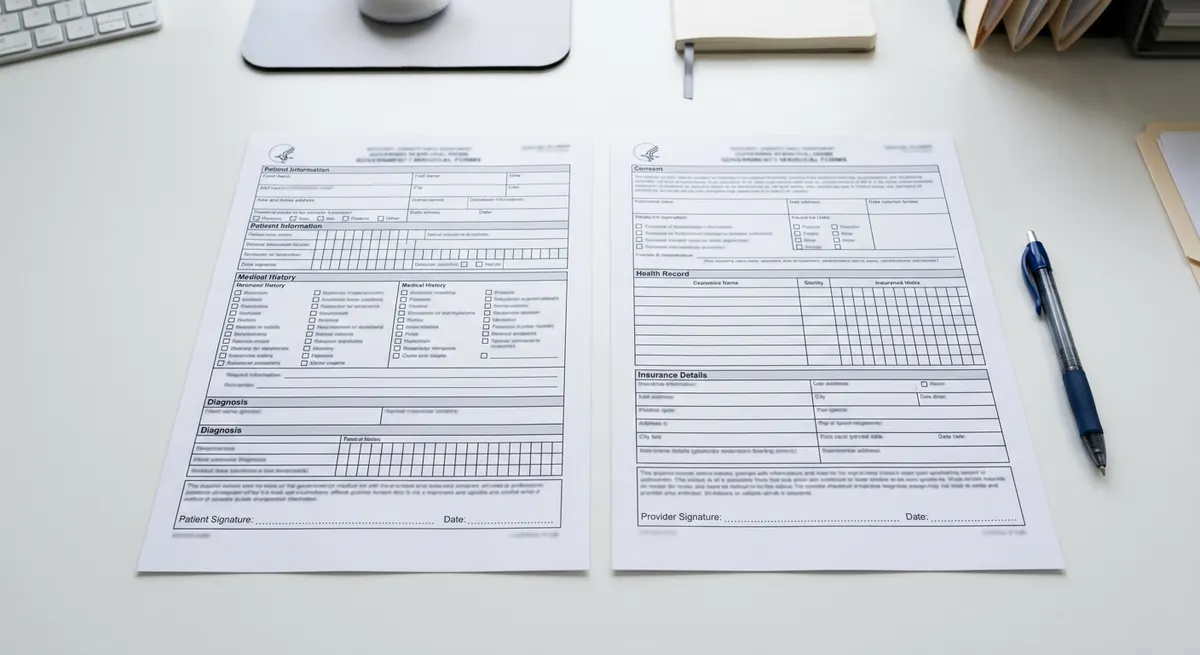
The MCSA-5875 and MCSA-5876 are the two core forms at the center of every commercial driver DOT physical.
DOT physical paperwork is the legal foundation of commercial driver medical certification, and errors or omissions in your documents can cost you your ability to drive. The Federal Motor Carrier Safety Administration mandates that every commercial motor vehicle driver operating in interstate commerce hold a valid Medical Examiner's Certificate, issued only after a successful physical examination by a certified examiner. Without the correct forms completed accurately, your certification is invalid, your employer faces regulatory penalties, and you cannot legally operate a CMV.
Many drivers treat the paperwork as an afterthought, focusing only on passing the physical tests. In practice, clinicians frequently observe that incomplete forms, missing specialist assessments, or improperly submitted self-certification documents are among the most common reasons for certification delays. Understanding which forms apply to your situation, when they must be submitted, and who is responsible for completing each one puts you in control of your compliance timeline.
Not sure if sleep apnea applies to you?
Take our 2-minute sleep risk quiz to see whether sleep apnea could affect your DOT physical. No account required.
Employers carry equal responsibility. The FMCSA requires motor carriers to maintain complete Driver Qualification Files for every driver, including copies of all medical certifications, exemptions, and related documentation. Errors in these files during an audit can result in civil penalties that impact an entire fleet operation.
DID YOU KNOW: As of May 21, 2014, all medical examiners who issue DOT medical certificates must be certified and listed on the FMCSA National Registry of Certified Medical Examiners.
KEY TAKEAWAY: Understanding DOT physical paperwork requirements protects your right to drive commercially and shields your employer from costly compliance violations.
Knowing the full paperwork picture starts with understanding what a DOT physical is and why the forms that support it carry so much legal weight.
The Foundation: What Is a DOT Physical and Why Forms Matter

A DOT physical examination evaluates multiple health dimensions and generates the official forms that determine a driver's certification status.
A DOT physical is a standardized medical examination required by the Federal Motor Carrier Safety Administration to confirm that commercial drivers are physically, mentally, and emotionally fit to operate a commercial motor vehicle safely. The exam is governed by 49 CFR Part 391 and applies to drivers operating CMVs in interstate commerce, including vehicles with a gross vehicle weight rating over 26,001 pounds, vehicles transporting 16 or more passengers including the driver, and vehicles hauling hazardous materials requiring placards.
The forms attached to the DOT physical are not administrative formalities. Each form captures clinical data, driver-certified health history, and examiner determinations that collectively determine whether a driver is legally qualified. According to the Cleveland Clinic, the exam evaluates vision, hearing, blood pressure, pulse, urinalysis, and a full physical examination. The completed forms become the official medical record of that evaluation and feed directly into the FMCSA's national compliance database.
The FMCSA shares examination results with its systems regardless of whether the driver passes or fails. This means every form you complete, every condition you disclose, and every specialist report you submit becomes part of a traceable regulatory record. Approaching this paperwork with accuracy and preparation is not optional — it is a professional and legal obligation.
KEY TAKEAWAY: A DOT physical is a federally mandated examination, and its associated forms create a legal medical record that determines your eligibility to drive commercially.
Once you understand the purpose of the DOT physical, the next step is knowing exactly which core forms you will complete at every exam appointment.
Core Forms Demystified: MCSA-5875 and MCSA-5876
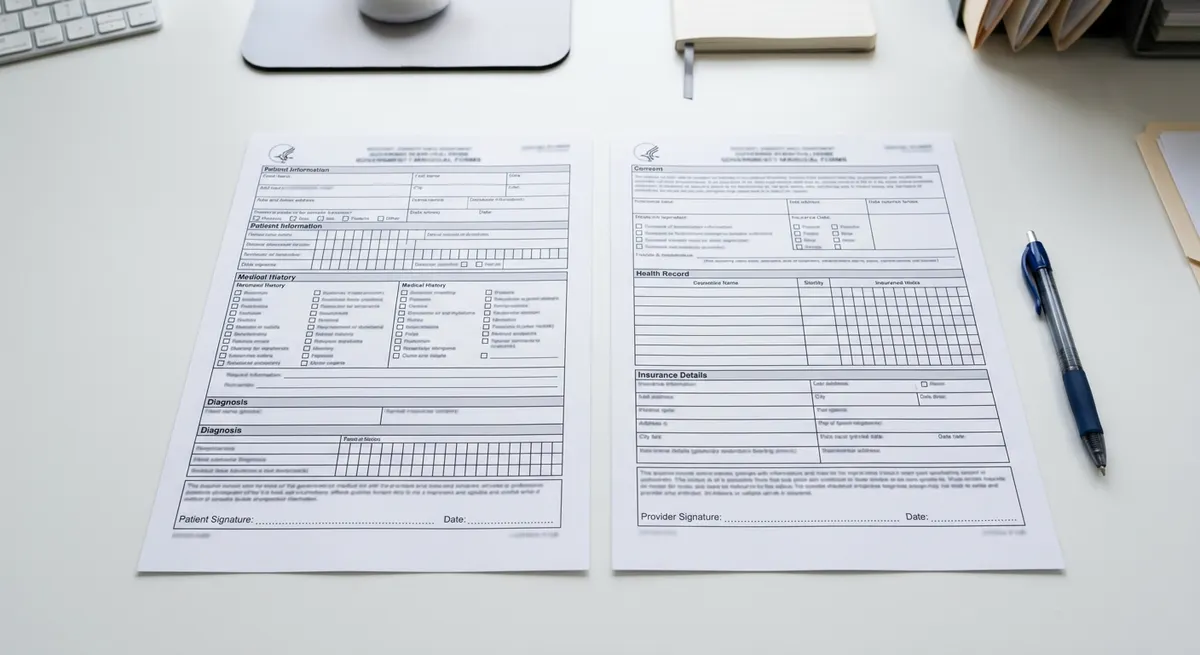
The MCSA-5875 and MCSA-5876 are the two mandatory forms completed at every DOT physical examination.
The MCSA-5875 and MCSA-5876 are the two primary forms at the center of every DOT physical examination, and together they constitute your complete medical certification package. The Medical Examination Report Form MCSA-5875 is the comprehensive health record completed during the exam, while the Medical Examiner's Certificate Form MCSA-5876 is the official med card that proves you are legally certified to drive.
Already diagnosed and need CPAP support?
Dumbo Health helps patients start CPAP without the usual confusion, paperwork, or upfront cost. Equipment, setup, supplies, and ongoing support are all handled in one place.
The Medical Examination Report Form MCSA-5875: Your Comprehensive Health Record
The Medical Examination Report Form MCSA-5875 is the document on which you, as the driver, complete your health history, and on which the certified medical examiner records the full results of your physical examination. The health history section asks you to answer 32 questions covering conditions such as heart disease, blood pressure disorders, sleep disorders, seizures, diabetes, and head or brain injuries, among others. You must answer each question truthfully, indicating yes, no, or not sure, and provide written explanations for any affirmative responses.
The FMCSA most recently updated the MCSA-5875 with an OMB expiration date of 03/31/2028, effective April 1, 2025. Medical examiners are required to use the current version of the form. The examiner uses the completed MCSA-5875 to document findings from every component of the physical: vision screening, hearing evaluation, blood pressure and pulse readings, urinalysis results, and the full physical examination of your body systems. This form remains in the examiner's records for a minimum of three years and is not given to the driver.
The MCSA-5875 is the backbone of your DOT exam record. Everything the examiner assesses — including conditions that may affect your certification period or require additional documentation — is recorded here. Drivers who complete this form accurately and bring supporting documentation for any disclosed conditions are far more likely to receive a full two-year certification without delays.
The Medical Examiner's Certificate Form MCSA-5876: Your Official Med Card
The Medical Examiner's Certificate Form MCSA-5876 is the wallet-sized card issued to you by the certified medical examiner if the examination confirms you meet all FMCSA physical qualification standards. This certificate is commonly called the med card in the trucking industry, and it is your legal proof of medical fitness to operate a commercial motor vehicle in interstate commerce.
The MCSA-5876 is valid for up to 24 months from the date of examination, though examiners may issue shorter certification periods for drivers with conditions requiring ongoing monitoring. For CDL holders, a copy is submitted to the State Driver's Licensing Agency so that your medical certification status is reflected on your driving record. You are also required to self-certify your driving type through your state DMV.
People who undergo this exam often find the med card process straightforward when they arrive prepared. Carry it with you while operating a CMV at all times, as federal regulations under 49 CFR 391.41 require drivers to have the original or a copy of their current medical examiner's certificate on their person when on duty.
| Feature | MCSA-5875 (MER Form) | MCSA-5876 (MEC / Med Card) |
|---|---|---|
| Who completes it | Driver (health history) + Examiner (exam findings) | Certified Medical Examiner only |
| Purpose | Comprehensive health record of the DOT exam | Official certification card proving medical fitness |
| Who keeps it | Medical examiner (minimum 3 years) | Driver carries original; examiner and state DMV retain copies |
| Validity period | Not applicable — record document | Up to 24 months (shorter if monitoring required) |
| Given to driver | No | Yes |
| Submitted to state DMV | No | Yes, for CDL holders |
KEY TAKEAWAY: The MCSA-5875 is your exam record while the MCSA-5876 is your legal credential. Both must be completed accurately by the correct party for your certification to be valid.
Beyond these two core forms, certain medical conditions require additional specialized documentation before your examination can proceed or be completed.
Beyond the Core: Specialized Forms and Reports for Specific Conditions

Specialized forms for insulin-treated diabetes, vision impairment, and medications must be submitted before or alongside the core DOT physical.
Certain medical conditions require specialized forms that must be completed by your treating clinician or a specialist before or alongside your DOT physical examination. These supplemental forms are not optional for drivers who have the relevant conditions, and missing them can prevent your examiner from completing or issuing your certification.
Insulin-Treated Diabetes Mellitus Assessment Form MCSA-5870
The Insulin-Treated Diabetes Mellitus Assessment Form MCSA-5870 is required for any commercial driver who uses insulin to manage diabetes. A regulatory change by the FMCSA now allows insulin-treated drivers to qualify for commercial driving, provided they submit this form as part of the certification process. The MCSA-5870 must be completed by your treating clinician, who attests to a stable insulin regimen and properly controlled diabetes.
The form asks detailed questions about when insulin use began, blood glucose self-monitoring records for the preceding three months, HbA1C results, and any diabetic complications such as cardiovascular disease, neuropathy, or kidney dysfunction. Once your clinician completes and signs the form, you must provide it to the certified medical examiner within 45 days. Drivers with insulin-treated diabetes mellitus are eligible for a maximum certification period of 12 months.
Vision Evaluation Report Form MCSA-5871_508
The vision Evaluation Report Form MCSA-5871_508 is required for commercial drivers who have monocular vision or who did not meet the FMCSA vision standard at a previous physical qualification examination. The standard requires distant visual acuity of at least 20/40 in each eye individually and both eyes combined, plus field of vision of at least 70 degrees in the horizontal meridian.
The MCSA-5871_508 must be completed and signed by a licensed ophthalmologist or optometrist. The Qualification of Drivers Vision Standard final rule, effective January 21, 2022, requires individuals who do not meet the standard with their worse eye to undergo annual vision evaluation. Once your specialist signs and dates the form, you must complete your DOT physical examination within 45 days.
CMV Driver Medication Form MCSA-5895
The 391.41 CMV Driver Medication Form, MCSA-5895, is an optional tool available to certified medical examiners who need additional information about medications a driver is taking. An examiner may request it when you disclose medications that could affect your ability to safely operate a commercial motor vehicle. The form facilitates communication between the examiner and your treating physician, who attests that the prescribed substance will not adversely affect your safe driving ability.
Other Special Forms and Waivers
For drivers who do not meet the federal hearing standard at 49 CFR 391.41(b)(11), the FMCSA provides a Federal Hearing Exemption Application. This process allows qualifying drivers who are deaf or hard of hearing to apply for an exemption for interstate commerce. The application requires a written statement of intent, a copy of your driver's license, medical release authorization, your three-year driving record, and a copy of your MCSA-5876. Decisions are made within 180 days of a completed application.
Drivers in your area who have hearing conditions or seizure conditions should work closely with a healthcare professional and legal advisor familiar with FMCSA exemption procedures.
| Form | Who Completes It | When Required | Submission Deadline |
|---|---|---|---|
| MCSA-5870 (ITDM Assessment) | Treating clinician | Insulin-treated diabetes | Within 45 days to examiner |
| MCSA-5871_508 (Vision Evaluation) | Ophthalmologist or optometrist | Monocular vision or failed vision standard | Within 45 days before exam |
| MCSA-5895 (Medication Form) | Treating physician | At examiner's discretion | Before or at examination |
| Federal Hearing Exemption | Driver with supporting docs | Does not meet hearing standard | Applied directly to FMCSA |
KEY TAKEAWAY: Drivers with insulin-treated diabetes, monocular vision, medication dependencies, or hearing impairments require additional specialized forms that must be submitted before or alongside the DOT physical to maintain certification eligibility.
With all necessary forms identified and gathered, the driver's own preparation and self-certification duties represent the next critical step in the process.
The Driver's Critical Role: Preparing and Self-Certifying

Arriving prepared with complete medical documentation is the single most effective step a commercial driver can take before a DOT physical.
Commercial drivers are active participants in the DOT physical paperwork process, not passive subjects of examination. Your responsibilities begin weeks before your exam appointment and extend through the self-certification of your driving type with your state DMV.
Gathering Your Medical History and Essential Documentation
The health history section of the MCSA-5875 requires you to disclose a detailed picture of your past and present medical conditions, medications, surgeries, and health history. Arriving at your appointment without supporting documentation for disclosed conditions is a common cause of certification delays. Many patients report that examiners request additional records on the spot, forcing multiple visits and postponing the certification.
Before your appointment, gather the following:
•A complete list of all current medications, including dosage, frequency, and the prescribing physician's contact information
•Recent lab work and blood test results, including blood sugar levels and HbA1C if applicable
•Documentation of any chronic conditions, including treatment letters confirming stable control
•Records of recent cardiovascular evaluations, neurological assessments, or pulmonary function tests if relevant
•Your commercial learner's permit or CDL and a valid government-issued photo ID
•Corrective lenses, contact lenses, or hearing aids if you use them
TIP: Find a provider near you who specializes in DOT physicals. Occupational health clinics with dedicated DOT examiners can identify exactly what documentation you will need for specific conditions before you arrive.
The CDL Self-Certification Form: Understanding Your Driving Type
Every CDL holder in the United States must self-certify their type of commercial motor vehicle operation to their state DMV. This requirement directly determines whether a federal medical card is required. There are four self-certification categories:
•Non-Excepted Interstate (NI): You operate in interstate commerce and must meet federal DOT medical certification requirements, including a valid MCSA-5876.
•Excepted Interstate (EI): You operate in interstate commerce in an excepted category such as transporting farm labor vehicles or school pupil activity bus operations. Federal DOT medical requirements do not apply.
•Non-Excepted Intrastate (NA): You operate only within your state and must meet your state's driver qualification requirements, which may include a state-issued medical certificate.
•Excepted Intrastate (EA): You operate only within your state in an excepted category. Your state determines whether a medical certificate is required.
Most commercial drivers operating heavy trucks or passenger-carrying vehicles fall under Non-Excepted Interstate. Failure to self-certify, or submitting an incorrect category, can affect your CDL status. Contact your state DMV or a DOT compliance specialist in your area if you are unsure which category applies.
KEY TAKEAWAY: Your CDL self-certification determines whether you need a federal medical card, and submitting the wrong category to your state DMV can jeopardize your license status.
Once the driver's preparation is complete, the medical examiner takes over a distinct and regulated role in the certification process.
The Medical Examiner's Role: From Examination to Certification

Only National Registry-listed examiners are authorized to issue legally valid DOT medical certificates for commercial drivers.
The certified medical examiner is the licensed professional who conducts the DOT physical, completes the examiner's sections of the MCSA-5875, and issues the MCSA-5876 certificate if you qualify. Understanding their role and qualifications helps you identify the right provider and know what to expect during your appointment.
The Examination Process and Documentation by a Certified Professional
A certified medical examiner conducts a structured physical assessment based on the standards set out in 49 CFR 391.41. According to the Cleveland Clinic, the examiner reviews your completed health history, then assesses blood pressure and pulse, vision and hearing, a urinalysis sample, and performs a hands-on physical examination of your eyes, ears, mouth, lungs, heart, abdomen, spine, extremities, reflexes, and neurological function.
The examiner documents every finding on the MCSA-5875. Examiners do not automatically pull your full medical records from external providers. They review what you disclose on the form and may request documentation when examination findings or disclosed conditions require verification. If you are found to be physically qualified, the examiner completes the MCSA-5876, signs and dates it, provides the original to you, and retains a copy for a minimum of three years.
Drivers who have conditions such as sleep apnea should be aware that a sleep evaluation may be ordered if risk factors are identified during the examination, adding an additional step to the documentation and certification timeline.
The National Registry of Certified Medical Examiners (NRCME)
The National Registry of Certified Medical Examiners is the federal program administered by the FMCSA that sets requirements for healthcare professionals performing DOT physical qualification examinations. Since May 21, 2014, all medical examiners who issue DOT medical certificates must be certified and listed on the National Registry.
To become listed, healthcare professionals including doctors of medicine, doctors of osteopathy, physician assistants, advanced practice nurses, and doctors of chiropractic must complete an FMCSA-approved training program and pass a certification examination. National Registry certification is valid for 10 years with periodic training requirements. Drivers can verify any examiner's credentials by searching the National Registry on the FMCSA website before making an appointment.
IMPORTANT: Never use an examiner who is not listed on the FMCSA National Registry. A DOT physical conducted by an uncertified provider is not valid, and the certificate it produces will not be accepted by your employer or state DMV.
Certification Outcomes and Validity Periods
The medical examiner determines the length of your certification period based on the examination findings:
•24 months (maximum): Drivers who meet all physical standards with no conditions requiring monitoring
•12 months: Common for well-controlled Stage 1 hypertension, treated sleep apnea, or other monitored chronic conditions; maximum for insulin-treated diabetes mellitus drivers
•3 to 6 months: Issued for Stage 2 hypertension or similar conditions requiring follow-up before full certification
•Determination Pending: Issued when additional specialist documentation is needed before the examiner can make a final decision
KEY TAKEAWAY: Only NRCME-listed examiners can issue legally valid DOT medical certificates, and the certification period they grant reflects your clinical status on examination day.
Employers bear distinct and significant responsibilities once the driver's forms are in hand, and those responsibilities extend well beyond simply photocopying the med card.
Employer Responsibilities: Managing DOT Physical Paperwork Effectively

Employers must maintain complete driver qualification files including all DOT medical certifications to meet FMCSA audit requirements.
Employers who operate CMVs subject to FMCSA regulations carry specific legal obligations for collecting, verifying, retaining, and organizing driver medical documentation. Failure to meet these obligations during a compliance audit can result in civil penalties and out-of-service orders.
Collection and Verification of Driver Paperwork
When a driver joins your fleet or renews their certification, you must collect and verify several documents before they can legally operate a CMV. At minimum, this includes a copy of the current MCSA-5876 showing a valid, unexpired certification date, the CDL with the correct endorsements, and confirmation that the driver's CDL record reflects current medical certification status.
Employers are responsible for verifying that the medical examiner who issued the certificate is listed on the FMCSA National Registry. Clinicians frequently observe that employers who routinely verify examiner credentials through the Registry catch a small but significant number of certificates issued by examiners whose listing has lapsed, which would otherwise create compliance exposure for the carrier.
Record Keeping and Retention Requirements
The FMCSA requires specific retention periods for medical certification documents in the driver qualification file under 49 CFR 391.51:
•The current Medical Examiner's Certificate plus historical certificates: retained for the duration of employment plus three years following separation
•Copies of any exemption or waiver documentation: retained under the same standard
•Former driver files in their entirety: retained for three years following the driver's termination of employment
According to FMCSA Driver Qualification File requirements, a complete file contains 18 required documents, with the DOT Medical Certificate being one of eight pre-employment documents. Files must be organized and accessible for FMCSA or authorized auditor review at any time.
Integrating Paperwork into Driver Qualification Files
The Driver Qualification File is the regulatory hub for all commercial driver documentation. Medical certification records must be integrated alongside the driver's employment application, motor vehicle records, road test certification or CDL copy, drug and alcohol test results, Clearinghouse queries, and annual driving record reviews.
If you are looking for a streamlined approach to managing driver medical records, providers in your area who specialize in occupational health and DOT compliance can help you establish systematic documentation workflows. Digital driver qualification file management platforms that automatically track expiration dates and flag upcoming renewals significantly reduce administrative burden on fleet safety teams.
KEY TAKEAWAY: Employers must collect, verify, and retain all DOT medical certification documents within a compliant Driver Qualification File for the duration of employment plus three years after separation.
Even with the best preparation, documentation challenges, variances, and potential violations arise. Knowing how to navigate them keeps your commercial driving career on track.
Navigating Challenges: Common Pitfalls, Variances, and Non-Compliance

Identifying common DOT paperwork errors early prevents them from becoming costly compliance violations.
The most preventable problems in the DOT physical paperwork process come from errors, omissions, and misunderstandings that a well-prepared driver or employer can identify and address before they become compliance violations.
Common Paperwork Errors to Avoid
•Incomplete health history on the MCSA-5875, particularly leaving questions blank rather than answering no
•Using an outdated version of the MCSA-5875 or MCSA-5876. As of April 1, 2025, the current forms carry the OMB expiration date of 03/31/2028
•Failing to submit specialized forms such as the MCSA-5870 or MCSA-5871_508 before the examination appointment
•Not self-certifying the correct driving category with the state DMV, or failing to update the self-certification when your driving type changes
•CDL holders failing to submit the MCSA-5876 to their state DMV within the required timeframe, which can affect the medical certification notation on their driving record
Medical Variances, Exemptions, and Disqualification
Certain medical conditions automatically disqualify a driver from commercial vehicle operation under 49 CFR 391.41 unless a federal variance or exemption is granted. These include established diagnoses of epilepsy, cardiovascular conditions likely to cause syncope or collapse, respiratory dysfunction likely to interfere with safe operation, and mental or nervous disorders likely to impair driving ability.
Drivers who do not meet the hearing standard or seizure standard may apply to the FMCSA for a federal exemption. The process requires comprehensive documentation, a Federal Register public comment period, and an Agency decision within 180 days. Research suggests that proactively working with a specialist to document condition stability before pursuing the DOT physical leads to better certification outcomes.
Consequences of Non-Compliance
On the civil side, operating a CMV without a valid medical examiner's certificate, or with a certificate obtained through false statements, can result in FMCSA civil penalties of up to $11,000 and disqualification from operating a CMV for up to 12 months. Employers who fail to maintain compliant Driver Qualification Files face similar civil penalty exposure during audits.
On the criminal side, under 18 U.S.C. §1001, knowingly making a false statement or falsifying a document required by a federal agency is a federal felony punishable by up to five years in prison. The FMCSA can pursue criminal prosecution when it believes a driver fraudulently lied or falsified documents during the medical exam process.
IMPORTANT: Lying on a DOT physical is a federal offense. If you accidentally provided incorrect information, contact the FMCSA or a compliance attorney promptly. Voluntary disclosure and correction are treated more favorably than discovered falsification.
KEY TAKEAWAY: Paperwork errors, undisclosed conditions, and falsification carry consequences ranging from certification delays to federal felony prosecution. Accuracy and transparency are the only compliant approach.
Understanding the pitfalls makes the case for modernizing how drivers and employers manage the paperwork process, which is where digital tools and proactive planning offer real advantages.
Streamlining the Process: Digitalization and Best Practices

Electronic form submission and digital compliance tools are reducing DOT paperwork errors and certification delays for drivers and employers alike.
The DOT physical paperwork process has evolved significantly with the adoption of electronic health records, digital submission platforms, and compliance management tools. Understanding how to leverage these resources reduces delays, minimizes errors, and keeps certifications current.
Embracing Digital Forms and Electronic Submission
The FMCSA has made PDF versions of all current forms, including the MCSA-5875, MCSA-5876, MCSA-5870, MCSA-5871_508, and MCSA-5895, available for download directly from the FMCSA website. Electronic health record platforms have integrated the updated forms into digital workflows, allowing certified medical examiners to complete, store, and transmit documentation electronically.
For CDL holders, many state DMVs now accept digital submission of the MCSA-5876 for self-certification updates. Cloud storage platforms that maintain your medical history, specialist reports, and previous certification records allow you to arrive at any future DOT physical fully prepared with organized documentation. If you are managing a condition such as sleep apnea, keeping records of your CPAP usage data and therapy adherence reports provides documentation that supports a positive certification outcome at renewal.
Employers who manage large fleets have adopted digital Driver Qualification File management systems that automatically track medical certificate expiration dates, flag upcoming renewals, and generate audit-ready reports. In real-world use, fleets that automate medical certification tracking report fewer compliance violations related to expired certificates than those relying on manual spreadsheet management.
Proactive Management and Planning
The most effective approach to DOT physical paperwork is planning well in advance of your examination date. Scheduling your renewal physical at least 30 days before your current certificate expires gives you time to address any issues that arise during the exam without a gap in your certification. For drivers with conditions requiring specialist documentation, scheduling the specialist assessment 60 to 90 days in advance ensures that forms are completed within the 45-day submission window.
Maintaining a personal health documentation file, separate from your employer's Driver Qualification File, is a practical strategy that many experienced commercial drivers follow. This personal file includes copies of all previous MCSA-5876 certificates, specialist letters, lab results, and medication lists. If your certifying clinic changes, or if questions arise about your medical history during a future examination, this file ensures continuity without relying on external records retrieval.
TIP: Keep a digital copy of your current MCSA-5876 in a secure cloud folder accessible from your phone. If your physical card is lost or damaged, this backup ensures you can demonstrate certification status immediately while a replacement is arranged.
KEY TAKEAWAY: Proactive scheduling, digital documentation, and advance specialist coordination eliminate the most common sources of DOT physical paperwork delays and non-compliance.
Common Myths About DOT Physical Paperwork Debunked

Accurate information from certified medical professionals is essential for navigating DOT physical myths and making the right decisions.
Misconceptions about DOT physical forms and the certification process are widespread among both new and experienced commercial drivers. Separating fact from fiction ensures you make informed decisions that protect your commercial driving career.
MYTH: The medical examiner automatically pulls your full medical records and can see all your diagnoses.
FACT: Medical examiners do not have automatic access to your complete medical records from external providers. They review the health history you complete on the MCSA-5875 and conduct the physical examination. If your disclosed conditions or examination results raise clinical concerns, the examiner may request additional documentation from your treating physician. The FMCSA makes clear that the driver is responsible for accurately self-reporting medical history. Withholding information creates direct legal liability.
MYTH: Form MCSA-5876 is the same as a state DMV medical certificate such as the DL-51 in California.
FACT: The MCSA-5876 is the federally issued Medical Examiner's Certificate governed by FMCSA regulations. State-specific forms may differ in format and serve different purposes under state DMV requirements. CDL holders must submit their MCSA-5876 to their state DMV, and the state then updates the medical certification notation on their CDL driving record. The federal form and the state record update are related but distinct documents.
MYTH: Insulin-dependent commercial drivers cannot get a DOT medical certificate.
FACT: This was true before the FMCSA's rule change allowing insulin-treated drivers to qualify. Drivers with insulin-treated diabetes mellitus can now obtain medical certification provided they complete the MCSA-5870 through their treating clinician, demonstrate three months of stable blood glucose self-monitoring records, and receive clinician attestation of a stable insulin regimen. Certification is limited to a maximum of 12 months.
MYTH: Any licensed doctor can perform a DOT physical.
FACT: Since May 21, 2014, only healthcare professionals listed on the FMCSA National Registry of Certified Medical Examiners are authorized to conduct DOT physical examinations and issue Medical Examiner's Certificates. This includes MDs, DOs, physician assistants, advanced practice nurses, and doctors of chiropractic who have completed FMCSA-approved training and passed the certification examination. A DOT physical performed by an unlisted provider is legally invalid.
MYTH: A DOT physical result is always either a two-year pass or an outright fail.
FACT: The DOT physical produces several possible outcomes. A full 24-month certification is issued when a driver meets all physical standards without monitoring conditions. Examiners also issue certifications for shorter periods, commonly 3 months, 6 months, or 12 months, when a condition requires follow-up. A determination pending outcome may also be issued when additional specialist documentation is needed before the examiner can make a final decision.
KEY TAKEAWAY: Understanding the facts behind common DOT physical myths allows drivers to approach the process with accurate expectations and make better-informed decisions about their documentation.
Frequently Asked Questions
What is the DOT physical long form and do I need to fill it out?
The 'long form' colloquially refers to the Medical Examination Report Form MCSA-5875, which is the comprehensive document completed during a DOT physical examination. The driver completes the health history section, answering 32 questions about past and present medical conditions, medications, surgeries, and health history. The certified medical examiner then completes the clinical examination findings sections. Every commercial driver undergoing a DOT physical is required to complete their portion of the MCSA-5875 fully and truthfully. The form is not optional, and incomplete answers can prevent your certification from being processed. Current MCSA-5875 forms carry the OMB expiration date 03/31/2028 as of April 2025.
I accidentally gave incorrect information on my DOT physical. What should I do?
If you provided inaccurate information on your DOT physical form, address it immediately rather than waiting to see if it is noticed. Contact the medical examiner who conducted your examination to explain the error. Minor unintentional omissions can often be corrected by submitting supplemental documentation from your treating physician. For more significant inaccuracies, consult a DOT compliance attorney before taking further action. The FMCSA treats voluntary correction more favorably than discovered falsification. Deliberately providing false information is a federal offense under 18 U.S.C. §1001, carrying penalties of up to five years in prison and civil fines up to $11,000.
Does the DOT physical examiner pull my medical history and see all my past diagnoses?
No. Medical examiners do not have automatic access to your full medical records or diagnosis history from external healthcare providers. They review the health history section you complete on the MCSA-5875 and the findings from their physical examination. If you disclose a condition or if examination findings raise a clinical concern, the examiner may request supporting documentation from your treating physician before completing the certification. FMCSA examination results are reported to the FMCSA database regardless of outcome, creating an ongoing federal record of your DOT physical history.
Is Form MCSA-5876 the same as a state DMV medical form for my CDL?
No. The MCSA-5876 is the federally issued Medical Examiner's Certificate under FMCSA regulations. State-specific forms used in your state's CDL medical certification process are separate documents serving your state DMV's administrative process. CDL holders must submit their MCSA-5876 to their state DMV following each DOT physical so that their medical certification status is recorded on their CDL driving record. Check with your state DMV or find a DOT compliance provider in your area to confirm the exact submission requirements and any additional state-specific forms that apply to your CDL category.
My doctor refuses to fill out my DMV medical evaluation paperwork. What can I do?
If your treating physician declines to complete required DOT or DMV medical evaluation paperwork, you have several practical options. First, ask your physician to explain their specific reason for declining. Second, seek a second medical opinion from another licensed practitioner familiar with commercial driver health standards. Third, locate a certified medical examiner listed on the FMCSA National Registry close to you who specializes in DOT physicals and is experienced in evaluating drivers with complex medical histories. Many occupational health clinics provide comprehensive documentation support for drivers with existing medical conditions.
Is it a felony to lie on a DOT physical to pass for a commercial driving job?
Yes. Knowingly making a false statement on a DOT physical form is a federal felony under 18 U.S.C. §1001, which prohibits making materially false, fictitious, or fraudulent statements in a matter within the jurisdiction of a federal agency. Falsification of DOT medical documents is punishable by up to five years in prison. Civil penalties under FMCSA regulations can include fines of up to $11,000 and disqualification from operating a CMV for up to 12 months. If a driver operates a CMV and is involved in an accident attributable to an undisclosed disqualifying condition, criminal liability for resulting injuries or fatalities may also apply.
How does the DOT physical process work for ambulance drivers and specialty vehicle operators?
Ambulance drivers and operators of other specialty commercial vehicles, including vehicles designed to transport 16 or more passengers including the driver and General Public Paratransit vehicles, are subject to DOT physical requirements when operating in interstate commerce under FMCSA jurisdiction. The core forms, MCSA-5875 and MCSA-5876, apply to these operators in the same way as standard commercial truck drivers. If your operation is conducted entirely within one state, contact your state motor vehicle authority to confirm whether federal FMCSA standards or state-specific physical qualification standards apply.
What happens if I have sleep apnea and need a DOT physical?
Sleep apnea is a medical condition that certified medical examiners assess during the DOT physical, particularly for drivers with risk factors such as obesity, large neck circumference, or a history of daytime sleepiness. If an examiner identifies risk factors, they may refer you for a sleep study before completing your certification. Drivers diagnosed with obstructive sleep apnea who are actively treated with CPAP and compliant with therapy can generally qualify for a medical certificate. Keeping records of your CPAP usage data and therapy compliance reports provides the documentation that supports a positive certification outcome at renewal.
Conclusion: Your Path to Confident DOT Physical Compliance

With the right documentation in hand, commercial drivers stay certified, compliant, and confidently on the road.
DOT physical forms and paperwork are the legal infrastructure of commercial driver medical certification, and mastering them protects your right to drive. The MCSA-5875 and MCSA-5876 form the foundation of every exam, while specialized forms like the MCSA-5870 and MCSA-5871_508 ensure that drivers with specific health conditions can still qualify under the right circumstances. Accurate self-reporting, timely submission of specialist assessments, correct CDL self-certification, and organized record-keeping are the practical steps that keep your certification current and your compliance record clean.
Approaching the DOT physical with preparation and transparency is always the right strategy. For commercial drivers managing sleep-related conditions that intersect with their medical certification, understanding how sleep apnea is diagnosed, treated, and documented is an important part of staying on the road. Visit dumbo.health to explore the complete resource on sleep apnea and what to look out for — and stay informed and ahead of your health documentation needs.
Related DOT Physical Topics
- Does a DOT Physical Test for Weed or THC The Complete Guide for Commercial Drivers
- Online DOT Physical The Complete Guide for Commercial Drivers and Medical Examiners
- Can You Get a DOT Physical in Any State The Complete Guide for Commercial Drivers
- Can You Get a DOT Physical Online The Complete Guide for Commercial Drivers
- Remote DOT Physical The Complete Guide for Commercial Drivers
- Online DOT Physical Self-Pay The Complete Guide for CDL Drivers and Owner-Operators
- What Happens During the DOT Physical Exam The Complete Guide for Drivers
- What Happens If You Fail a DOT Physical Twice The Complete Guide for Commercial Drivers
- DOT Physical ICD-10 & Billing Codes The Complete Guide for Accurate Compliance and Reimbursement
- Online DOT Physical Without Insurance A Complete Guide for Commercial Drivers
- DOT Hypertension Guidelines The Complete Blood Pressure Guide for Commercial Drivers
- The Ultimate DOT Physical Guide for Commercial Drivers (2025–2026)
- What Happens If You Fail a DOT Drug Test The Complete Guide for Commercial Drivers
- Can You Get a Second Opinion on Your DOT Physical A Complete Guide for Commercial Drivers
- Home Sleep Apnea Test for Commercial Drivers The CDL Holder's Complete Guide
- Medical Examiner's Certificate (Form MCSA-5876) The Complete Guide for Commercial Drivers
- Navigating the Florida DOT Physical Your Essential Guide for CDL Drivers
- DOT physical self pay guide for commercial drivers paying out of pocket
- The Ultimate DOT Preparation Checklist for Motor Carriers and Commercial Drivers
- DOT Medical Exam Self-Pay A Complete Guide for Commercial Drivers
- How to Pass a DOT Physical The Complete Commercial Driver's Guide
- What Happens If Your DOT Physical Expires Compliance Guide for Commercial Drivers
- What are the current DOT requirements for sleep apnea testing for commercial drivers
- Medical Examination Report (MER) – Form MCSA-5875 The Complete Guide for Commercial Drivers
- DOT Physical Requirements A Complete Guide for CDL Drivers
- DOT Physical Insurance & Recertification The Complete Driver's Guide
- The Comprehensive Guide to Suboxone, Sleep Apnea, and FMCSA Compliance for Commercial Motor Vehicle Operators
- BMI for DOT Physical What Commercial Drivers Need to Know
- DOT Physical Texas The Essential Guide to Your Exam, Medical Card, and CDL Compliance
- What Is the Difference Between a DOT and Non-DOT Physical
- The DOT Physical Exam Ensuring You're Fit for the Road
- Essential 171 DOT Definitions for Commercial Drivers
- What Forms Do You Need for a DOT Physical
- DOT Physical Out of Pocket What Commercial Drivers Actually Pay
- What Is the Urine Test for in a DOT Physical
- Your Complete Guide What's Included in a DOT Physical Exam
- What Are the DOT Requirements for Drivers With Sleep Apnea
- DOT Physical Insurance or Self Pay How to Choose the Right Payment Option for Your Exam
- DOT Physical Chiropractor Your Complete Guide to CDL Exams
- Is a DOT physical the same as a regular physical
- DOT Physical at Urgent Care What Commercial Drivers Need to Know
- What are the current FMCSA guidelines on sleep apnea for commercial drivers
- Non-DOT Physical A Comprehensive Guide to Workforce Health and Safety
- What Does DOT Stand for in a DOT Physical
- DOT Physical Cost Breakdown What Drivers Pay & Why
- DOT Physical & Drug Test What Drivers Need to Know
- How Do You Submit Your DOT Physical to the DMV
- Is a drug test required for a DOT physical
- Navigating DOT Stroke Guidelines for CMV Drivers What You Need To Know
- How can drivers with sleep apnea qualify again after a failed DOT physical
- Why DOT Sleep Tests at Home Matter for Your Career and Health
- Can You Fail a DOT Physical for Being Overweight
- New DOT Physical Requirements What Drivers MUST Know About New Updates
- Online DOT Exam What Drivers and Medical Examiners Need to Know
- DOT Physical Blood Pressure Requirements What Drivers Need to Know
- Can You Fail a DOT Physical for High Blood Pressure
- DOT Physical Duration and Validity How Long Your Medical Card Lasts
- Is a Sleep Study Required for a DOT Physical
- Guide to Obtaining and Managing Your DOT Medical Card Online
- Do They Check for Hernia During a DOT Physical
- What Are the Requirements to Pass a DOT Physical
- What eye chart is used for a DOT physical
- Failing a DOT Physical What Every Commercial Driver Needs to Know
- DOT Physical & Alcohol Requirements
- DOT Physical Vision & Eye Requirements
- What drugs do they test for in a DOT drug test
- What Can Disqualify You From a DOT Physical
- Does a DOT physical include a drug test
- Can You Pass a DOT Physical with Epilepsy
- DOT Physical Self Pay Cost
- DOT Physical Exam Basics
- Can You Pass a DOT Physical With a Hernia
- Can You Pass a DOT Physical With a Pacemaker
- Can You Pass a DOT Physical With One Eye
- Telehealth Dot Physical
- Sleep Apnea Test for CDL Drivers
- Who needs a DOT physical
- Navigating Your DOT Physical with Common Medical Conditions
- Why do they measure your neck during a DOT physical
- DOT Physical Online Cost
- Walk In DOT Physical Self Pay
- Are there legal requirements for drivers with sleep apnea
- What Should You Bring to a DOT Physical
- Can You Get a DOT Physical Online
- DOT Physical Cash Pay
- Same Day DOT Physical
- Virtual DOT Physical
- Can you fail a DOT physical because of sleep apnea
- What blood pressure do you need to pass a DOT physical
- When Can Sleep Apnea Affect a DOT Physical
- Do They Check Your Private Parts During a DOT Physical
- Can you pass a DOT physical with sleep apnea
- What should I expect at a DOT physical
- What Does a DOT Physical Consist Of
- What happens if you fail a DOT physical due to sleep apnea
- At Home Sleep Test for Truck Drivers
- Sleep Apnea Tests for DOT Compliance What tests are accepted
- Can You Pass a DOT Physical with Diabetes
- Can You Pass a DOT Physical with High Blood Pressure
- Does insurance cover a DOT physical
Take the next step before your DOT physical
Start with the free quiz if you are unsure about your risk, or order an at-home sleep test if you have already been flagged for possible sleep apnea.
AI summary
DOT physical forms are FMCSA-required documents used to determine and document whether a commercial driver is medically qualified under 49 CFR Part 391. The core paperwork includes the Medical Examination Report (MCSA-5875) and the Medical Examiner’s Certificate or “med card” (MCSA-5876). On MCSA-5875, the driver completes a 32-question health history and the certified medical examiner records exam findings such as vision, hearing, blood pressure and pulse, urinalysis, and physical exam results; the examiner retains it for at least three years. MCSA-5876 is issued only by an NRCME-listed examiner and is valid up to 24 months, with shorter periods possible (including a maximum of 12 months for insulin-treated diabetes). Some conditions require additional forms: MCSA-5870 (insulin-treated diabetes, submitted within 45 days), MCSA-5871_508 (vision evaluation, completed by an optometrist/ophthalmologist within 45 days), and optional MCSA-5895 (medication information). The article also covers CDL self-certification categories, employer Driver Qualification File retention rules, common paperwork errors, and civil and criminal penalties for falsification.

Nicolas Nemeth
Co-Founder
Nico is the co-founder of Dumbo Health, a digital sleep clinic that brings the entire obstructive sleep apnea journey home. Patients skip the sleep lab and the long wait to see a specialist. Dumbo Health ships an at home test, connects patients with licensed sleep clinicians by video, and delivers CPAP or a custom oral appliance with ongoing coaching and automatic resupply in one clear subscription.
Keep reading

How Long Does a DOT Physical Take? A Complete Guide for Commercial Drivers

What Happens If You Fail a DOT Drug Test? The Complete Guide for Commercial Drivers


