What Happens If Your DOT Physical Expires: Compliance Guide for Commercial Drivers
When a DOT medical card expires, a CDL driver is immediately disqualified from operating a commercial motor vehicle, with no grace period. The article explains how expiration triggers a real-time status change in CDLIS, increasing roadside inspection risk and potential out-of-service orders. It details how states can downgrade a CDL and suspend endorsements under the Medical Examiner’s Integration Rule. Drivers and carriers face compounding violations because each day of driving expired counts separately under 49 CFR 391.45. You will learn a four-step fix-it protocol to regain compliance and how the renewal exam is evaluated. It also outlines practical systems to prevent future lapses, including 60–90 day scheduling and automated alerts.
Struggling with sleep?
Find out if sleep apnea is the reason.
FDA-cleared. $149 flat. Physician-reviewed results in 48 hours.

What Happens If Your DOT Physical Expires: Compliance Guide for Commercial Drivers

A DOT physical expiration means you are immediately disqualified from operating a commercial motor vehicle, with no grace period, no exceptions, and no warning from the FMCSA. According to the Federal Motor Carrier Safety Administration, CDL drivers who fail to renew their Medical Examiner's Certificate on time will have their commercial driving privileges downgraded, and will not be eligible to drive a commercial motor vehicle that requires a CDL. This guide covers exactly what happens the moment your DOT medical card expires, the legal consequences for both drivers and carriers, the step-by-step recovery process, what medical examiners evaluate during the renewal exam, and how to build a compliance system so expiration never disrupts your career again. Whether you are a solo owner-operator or a fleet safety manager, understanding these rules protects your livelihood, your CDL, and your road.
The "No Grace Period" Rule: What Happens the Moment Your Card Expires

There is no grace period for an expired DOT medical card. Your commercial driving privileges are revoked at midnight on the expiration date listed on your Medical Examiner's Certificate (Form MCSA-5876), and the legal disqualification is active from the first moment of the next operating day.
This is one of the most widely misunderstood rules in commercial driver compliance. Unlike a standard driver's license, which some states allow a short grace period for renewal, a DOT medical card carries no equivalent accommodation under federal law. If your card says June 30, 2026, your certificate is invalid starting 12:01 AM on July 1, 2026. Having a DOT physical exam appointment scheduled for next week does not change your legal status on the day of expiration.
Why the FMCSA Does Not Allow Extensions

The Federal Motor Carrier Safety Administration bases its zero-tolerance policy on public safety. Under 49 CFR 391.41, a driver must be physically qualified to operate a commercial motor vehicle at all times. An expired Medical Examiner's Certificate means the driver's fitness status is unknown. The FMCSA's position is straightforward: an unverified driver is an unqualified driver, and an unqualified driver cannot lawfully operate a commercial motor vehicle regardless of their actual health condition.
The FMCSA has issued temporary waivers only in extraordinary circumstances, such as the COVID-19 public health emergency in 2020. Under normal conditions, no such accommodation exists. Planning your renewal well in advance is the only compliant strategy.
The Immediate Legal Shift in Your Driving Status

The moment your medical certificate expires, your legal status shifts from "medically certified" to "not certified" in the Commercial Driver's License Information System (CDLIS). This is not simply an administrative notation. It is a real-time change that roadside inspectors can verify during any Level I inspection, typically within the first 90 seconds of the inspection process. There is no buffer period, no transitional status, and no legal window to continue driving while you arrange a renewal exam.
DID YOU KNOW: The FMCSA now integrates medical certification data directly into CDLIS, meaning enforcement officers can verify your fitness records instantly during any roadside stop.
KEY TAKEAWAY: A DOT physical expiration creates an immediate legal disqualification from commercial driving, with no grace period, no extensions, and no exceptions under normal FMCSA rules.
The legal consequences of driving past the expiration date are severe, and understanding them is the first step toward making sure you never face them.
Immediate Professional and Legal Consequences

Operating a commercial motor vehicle with an expired medical certificate is a federal violation under 49 CFR 391.45. Each day you drive with an expired certificate counts as a separate infraction. If a driver operates on Monday, Tuesday, and Wednesday before the violation is discovered, that is three independent fine events, three separate data points in the Safety Measurement System, and three compounding risks to both the driver and the carrier.
The CDL Downgrade: From Commercial to Non-Commercial Status

When the FMCSA notifies your State Driver Licensing Agency (SDLA) that your medical certification has expired or lapsed, the state is required to downgrade your CDL or commercial learner's permit (CLP) status. Under the Medical Examiner's Integration Rule, state licensing agencies must initiate a CDL downgrade within 60 days of receiving notice that a driver is no longer medically certified. In practice, many states now process this change automatically and within days, sometimes before the driver has received any notification.
A CDL downgrade means your commercial driver's license is reclassified to a non-commercial license status. You can no longer legally operate a vehicle that requires a CDL. Your endorsements, including hazardous materials, tanker, and passenger transport, are also suspended. Restoring a downgraded CDL requires submitting a new, valid Medical Examiner's Certificate to your state DMV and, in some states, paying a CDL reinstatement fee. Connecticut, for example, charges $175 for CDL reinstatement. Fees and exact procedures vary by state.
Risk of Roadside Inspections and Out-of-Service Orders

During any roadside DOT inspection, a law enforcement officer will check your Medical Examiner's Certificate. An expired certificate results in an immediate out-of-service order, which means you cannot move your vehicle until you are back in compliance. Operating a CMV while subject to an out-of-service order carries a civil penalty starting at $3,861 for a first conviction. If the carrier knowingly permits you to operate under an out-of-service order, the carrier faces fines of between $6,974 and $38,612 per violation under current FMCSA penalty schedules.
Employer Liability and the Threat of Job Termination

Carriers are independently liable when they allow an unqualified driver to operate a CMV. Under 49 CFR 391.51, the carrier must maintain a Driver Qualification (DQ) file for every driver, which includes a current Medical Examiner's Certificate. Failure to maintain this file correctly exposes the carrier to FMCSA violations, audit triggers, and in the event of an accident, potential denial of insurance coverage and civil litigation under negligent entrustment theories.
For drivers, the employment consequences can be equally serious. Many carriers have policies that result in immediate suspension or termination when a driver's medical certification lapses. Even if your carrier chooses to work with you through the reinstatement process, you will be off the road and off the payroll until you have a new, valid Medical Examiner's Certificate in hand.
Impact on CSA Driver Fitness BASIC Scores for Carriers

An expired medical certificate adds violation weight to the Driver Fitness Behavior Analysis and Safety Improvement Category (BASIC) in the FMCSA's Safety Measurement System (SMS). Driver Fitness BASIC violations adversely affect a motor carrier's SMS data for 24 months from the date of the violation. For small fleets of five to twenty trucks, a single 7-point Driver Fitness BASIC violation can push the carrier above the FMCSA intervention threshold, placing the carrier on increased inspection targeting lists. This creates a compounding cycle: more inspections mean more opportunities for additional violations to be discovered.
IMPORTANT: Each day of operation with an expired medical certificate is treated as a separate federal violation. Three days of driving before discovery equals three separate infractions, three separate fine events, and three compounding points against your CSA score.
KEY TAKEAWAY: The professional and legal consequences of driving with an expired medical card extend far beyond a single fine, affecting your CDL status, your employer's compliance record, and your insurance costs for years.
Understanding how to recover efficiently is the next critical step, and the process follows a clear four-step protocol.
The "Fix-It" Protocol: A 4-Step Recovery Plan

If your DOT medical card has already expired, take immediate action. The recovery process is straightforward when approached correctly, and a new Medical Examiner's Certificate is valid the moment it is issued.
Step 1: Immediate Cessation of Driving Duties

Stop driving any commercial motor vehicle immediately. Do not wait until your next scheduled shift, your next load, or your next inspection. The moment you are aware that your medical card has expired, you are legally disqualified. Notify your safety manager or dispatcher that you cannot operate until you have obtained a new certificate. This action protects you from additional violations and reduces your employer's exposure to independent liability.
Step 2: Locating a Certified Medical Examiner (CME) via the National Registry

Your DOT physical must be performed by a medical examiner listed on the FMCSA National Registry of Certified Medical Examiners (NRCME). An exam performed by a provider not on the National Registry is invalid, and you will be required to repeat the entire exam. You do not need to return to the same examiner who conducted your previous physical. You can find a certified medical examiner in your area using the search tool on the FMCSA National Registry official website at fmcsa.dot.gov.
Providers near you who are listed on the National Registry include physicians (MD), doctors of osteopathy (DO), physician assistants (PA), advanced practice nurses (APN), and doctors of chiropractic (DC). Bringing your previous medical card and any relevant medical records or medications list will help the examiner understand your health history and process your exam efficiently.
Step 3: Passing the Renewal Exam (What to Prepare For)
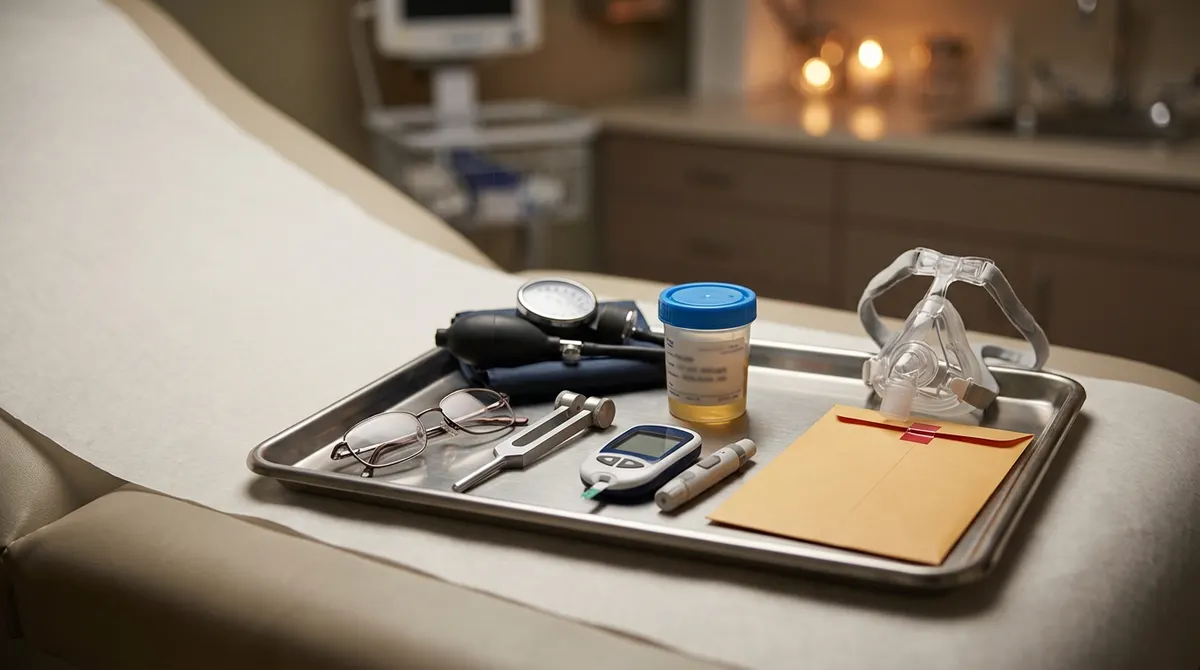
The DOT physical exam typically takes between 30 and 60 minutes and evaluates vision, hearing, blood pressure, urinalysis, and a general physical examination. If you have a managed chronic condition such as hypertension, sleep apnea, or insulin-treated diabetes, bring your current treatment records and any specialist notes confirming stable control. Arriving prepared significantly reduces the chance of a deferred or conditional outcome.
If sleep apnea is a concern, Dumbo.Health offers a home sleep apnea test for $149 (one-time), allowing commercial drivers to complete testing without a clinic visit. If a diagnosis is confirmed, monthly treatment plans start at $59/month with no contracts and no insurance required, making it one of the most accessible compliance pathways available for CDL holders.
You can also review the ultimate DOT physical guide for commercial drivers to understand exactly what each component of the exam involves and how to prepare effectively.
Step 4: Submitting the New Medical Examiner's Certificate to the State DMV

Once you pass the renewal exam, your Medical Examiner's Certificate is valid immediately. However, federal regulations require you to submit the new certificate to your State Driver Licensing Agency (SDLA) to update your CDL medical status. Instructions for submitting your certificate vary by state, and the FMCSA maintains a state-by-state submission guide on its official website. Most states accept submission by mail, fax, secure email, or in-person at a DMV office. Until your state DMV has updated your record to reflect your current certification, your CDL may still show a downgraded status in CDLIS.
TIP: Do not wait for the state to process your submission before returning to driving. Confirm with your carrier's safety manager that your new certificate is recorded in your Driver Qualification file first, and verify your CDL status has been updated before getting back behind the wheel.
KEY TAKEAWAY: Recovery from an expired medical card requires four clear steps: stop driving, find a National Registry examiner, pass the renewal exam, and submit your new certificate to the state DMV.
Understanding how the state licensing process works behind the scenes helps you anticipate how long the administrative timeline will take.
Understanding the Administrative Timeline

The administrative process following a DOT physical expiration involves both the medical examiner's reporting obligations and the state licensing agency's processing requirements. Knowing how this system works helps you avoid delays and ensures your CDL status is restored as quickly as possible.
How the State Licensing Agency Processes Your Expiration

When your Medical Examiner's Certificate expires, the FMCSA's data systems flag your certification status as "not certified." This change propagates through CDLIS to your state licensing agency, which is then required to initiate a CDL downgrade process. The speed of this process varies by state. Under the Medical Examiner's Integration Rule, states must complete the downgrade within 60 days of receiving notice, but many states now automate this change within days of the certificate expiration date.
The 10-Day Notification Requirement (49 CFR 383.73)

Under 49 CFR Part 383, Subpart E, CDL holders are required to maintain current medical certification with their state licensing agency. When you obtain a new Medical Examiner's Certificate, the FMCSA National Registry also transmits your results electronically to the appropriate state agency. This electronic transmission typically occurs within 10 business days of the exam date, but submission timelines can vary. Drivers should not rely solely on the examiner's electronic transmission. Submitting a physical copy of your certificate directly to your state DMV accelerates the update process and provides a documented submission record.
Why a Physical Copy Isn't Enough: The Importance of the Digital Record

Under the FMCSA's Medical Examiner's Integration Rule, a driver's medical certification status must be electronically linked to their CDL record in CDLIS. Physical copies of your Medical Examiner's Certificate are useful for on-the-road verification, but they do not update the electronic record. An inspector at a roadside stop who checks the CDLIS database needs to see your status as "certified" in the system, not just the paper in your hand. Keep both a physical and a digital copy of your current medical certificate, ensure your state record is updated promptly, and confirm with your carrier that your Driver Qualification file reflects the current certificate.
DID YOU KNOW: The FMCSA has issued temporary waivers allowing drivers to rely on a physical paper copy of their Medical Examiner's Certificate for up to 60 days after issuance while the electronic record is being processed, but this is an exception and not the standard requirement.
KEY TAKEAWAY: Submitting your new Medical Examiner's Certificate directly to your state DMV in addition to relying on electronic transmission is the fastest way to restore your CDL status in the digital record.
Knowing what the exam itself involves helps you prepare thoroughly and reduces the risk of a failed or conditional outcome at your renewal exam.
The DOT Physical Exam: What the Medical Examiner Evaluates

The DOT physical exam is a comprehensive health evaluation designed to confirm that a commercial driver can safely operate a CMV. Certified medical examiners assess several body systems and apply specific FMCSA standards to each. The exam typically takes 30 to 60 minutes and covers cardiovascular health, vision, hearing, urinalysis, and a review of chronic conditions and medical history.
Cardiovascular Health: Blood Pressure and Heart Function

Blood pressure is one of the most closely evaluated criteria in the DOT physical exam. Under 49 CFR 391.41(b)(6) as clarified in FMCSA guidance, a driver with blood pressure below 140/90 may receive a standard two-year certification. Stage 1 hypertension, defined as blood pressure between 140-159/90-99, results in a one-year certification. Stage 2 hypertension, at 160-179/100-109, results in a three-month conditional certification to allow time for treatment. A blood pressure reading above 180/110 is disqualifying. A driver with a diagnosis of hypertension who is on treatment should expect at least annual certification periods.
Medical examiners also evaluate cardiovascular history, including any diagnosis of heart disease, arrhythmias, or cardiovascular issues that could lead to sudden incapacitation while driving. Drivers with significant heart conditions may be referred for specialist evaluation before certification is granted.
Vision and Hearing Standards

vision standards require a visual acuity of at least 20/40 in each eye and both eyes together, with or without correction. Drivers must also demonstrate a peripheral vision of at least 70 degrees in both eyes. The vision test is conducted in both corrected and uncorrected states. If you use glasses or contact lenses, they must meet the 20/40 standard when worn. Drivers who do not meet standard vision criteria may apply for a federal vision exemption if they meet specific criteria under the FMCSA exemption program.
The hearing test requires a driver to perceive a forced whisper at 5 feet or pass an audiometric test. These hearing standards are set to ensure a driver can hear horns, emergency sirens, and verbal communication in a working cab environment.
Chronic Conditions: Managing Diabetes, Sleep Apnea, and Hypertension

Commercial drivers with chronic conditions can often still qualify for a Medical Examiner's Certificate if their conditions are well-managed and stable. The FMCSA revised its physical qualification standards to permit individuals with a stable insulin regimen and properly controlled insulin-treated diabetes mellitus (ITDM) to operate commercial vehicles in interstate commerce. Drivers with ITDM should bring their most recent HbA1c results, a letter from their treating physician confirming stable control, and a log of any hypoglycemic episodes.
sleep apnea affects an estimated 28% of commercial truck drivers according to the FMCSA's own data, making it one of the most commonly evaluated conditions during the DOT physical. Untreated moderate-to-severe obstructive sleep apnea is disqualifying under FMCSA standards because it poses a risk of sudden incapacitation while driving. However, drivers with sleep apnea who are successfully treated can continue driving and maintain their CDL. The standard treatment compliance requirement is CPAP usage of at least 4 hours per night on 70% or more of nights within any 30-day period.
Drivers who have never been evaluated for sleep apnea but display risk factors including a BMI of 30 or higher, a neck circumference of 17 inches or greater for men, or a history of hypertension or diabetes may be referred for a sleep study before receiving full certification. Testing at home is now a widely accepted and cost-effective option. Dumbo.Health's at-home sleep apnea test costs $149 and can be completed in a single night, avoiding the need for a clinic-based sleep study. For ongoing CPAP therapy and treatment compliance reporting, Dumbo.Health's CPAP treatment plans start at $59/month with no contracts, no insurance required, and no prior authorizations.
Urinalysis and Physical Qualifications

The urinalysis component of the DOT physical screens for indicators of kidney disease, uncontrolled diabetes, and other systemic conditions. It is not a drug test under DOT drug testing regulations, although employers may require separate drug screening. The physical examination component reviews neurological health, respiratory function, musculoskeletal condition, and any conditions that may affect the driver's ability to safely control a commercial vehicle.
IMPORTANT: Drivers with conditions such as sleep apnea, hypertension, or insulin-treated diabetes are not automatically disqualified. Bringing current treatment records, specialist notes, and compliance documentation to your exam is the most effective way to support your certification.
KEY TAKEAWAY: The DOT physical exam evaluates multiple body systems against FMCSA standards, and most chronic conditions can be managed in a way that supports continued CDL certification when treatment is documented and stable.
Some drivers face additional complexity due to medical variances, exemptions, or the difference between interstate and intrastate commerce rules, which require a separate layer of understanding.
Specialized Scenarios: Variances, Waivers, and Self-Certification

Not all commercial drivers are subject to the same medical certification requirements. Your specific situation depends on the type of commerce you operate in, whether you hold a medical variance or exemption, and how you have self-certified with your state licensing agency.
Handling Expired Medical Variances (Vision, Diabetes, or Seizures)

Some drivers operate under a federal medical variance or exemption, such as the FMCSA vision exemption or the insulin-treated diabetes exemption. These variances have their own expiration dates, which may differ from the expiration date on the Medical Examiner's Certificate itself. If a medical variance expires, the driver is no longer qualified to operate under the terms of that exemption, even if the Medical Examiner's Certificate itself remains current. Drivers who hold variances must track both expiration dates independently and submit renewal applications well in advance of each deadline. The FMCSA National Registry does not automatically alert drivers when a variance is approaching expiration.
Interstate vs. Intrastate Commerce Rules

The federal DOT medical certification requirements under 49 CFR Part 391 apply to drivers operating in interstate commerce. Drivers who operate exclusively within a single state in intrastate commerce may be subject to different medical standards set by that state rather than federal FMCSA requirements. However, many states adopt federal standards for intrastate drivers as well, and rules vary significantly between states.
Drivers in interstate commerce who do not operate under any excepted category are classified as "Non-Excepted Interstate" and must maintain a current federal Medical Examiner's Certificate. Drivers in excepted categories, such as those transporting farm vehicles or operating certain government vehicles, may be classified as "Interstate Excepted" and are not required to obtain a federal medical examiner's certificate. Understanding your correct self-certification category is essential because submitting the wrong category to your state DMV can create compliance problems even if your health is not an issue.
Correctly Updating Your Self-Certification Category

Every CDL holder is required to self-certify their commerce type with their state licensing agency. There are four categories: Non-Excepted Interstate, Excepted Interstate, Non-Excepted Intrastate, and Excepted Intrastate. If your operating type changes, for example if you transition from intrastate to interstate driving, you must update your self-certification category with your state DMV and provide the appropriate medical documentation to match. Failure to update your self-certification when your operating type changes can result in compliance violations even if your medical card itself remains current.
TIP: Review your self-certification category annually as part of your compliance calendar. A change in employer, route, or cargo type can affect which category applies to you.
KEY TAKEAWAY: Medical variances, interstate versus intrastate rules, and self-certification categories each carry their own compliance requirements that operate independently from your Medical Examiner's Certificate expiration date.
The financial cost of an expired medical card extends well beyond the initial fine, and understanding the full picture helps drivers and carriers make informed decisions about proactive compliance investment.
Financial Impacts of an Expired Medical Card

The real financial cost of an expired DOT medical card is rarely captured in a single fine. When you factor in reinstatement fees, carrier penalties, lost income, and the long-term impact on insurance premiums, the total cost can reach tens of thousands of dollars from a single lapsed document.
| Cost Category | Estimated Range | Notes |
|---|---|---|
| Roadside OOS fine (driver) | $2,841 to $10,000 per day | Per FMCSA civil penalty schedule |
| Carrier fine (allowing OOS operation) | $6,974 to $38,612 per violation | Per current FMCSA penalty schedule |
| State DMV CDL reinstatement fee | $40 to $175 depending on state | Examples: KY $40, CT $175 |
| Lost income during downtime | Varies by driver | Days or weeks off-road during processing |
| Insurance premium increase | Up to $18,000+ over 3 years | For carriers based on CSA score impact |
| DOT audit exposure | $10,000+ in administrative costs | Triggered by Driver Fitness BASIC violations |
CDL Reinstatement Fees and Administrative Costs

State DMV reinstatement fees for a downgraded CDL vary by state. Kentucky charges $40 for license reinstatement. Connecticut charges $175 for CDL disqualification reinstatement. Arizona requires drivers to submit a valid Medical Examiner's Certificate and pay reinstatement fees through the state's online MVD portal. In addition to state fees, drivers lose income during the period their CDL is downgraded, which can range from a few days to several weeks depending on how quickly the exam, submission, and processing cycle is completed.
Potential Carrier Fines and DOT Violations

Under current FMCSA civil penalty schedules updated in 2025, a driver convicted of operating under an out-of-service order faces a minimum fine of $3,861 for a first offense. A carrier that knowingly permits an out-of-service driver to operate faces fines between $6,974 and $38,612 per violation. If the expired certificate triggers a full DOT compliance audit, administrative costs and legal fees can add significantly to the total exposure. Drivers face up to $10,000 per day in civil penalties under FMCSA authority for operating without medical qualification.
The Long-Term Cost of Higher Insurance Premiums

Driver Fitness BASIC violations remain in the Safety Measurement System for 24 months. For carriers, a score above the FMCSA intervention threshold results in increased inspection targeting, which raises the probability of discovering additional violations. Insurance carriers use CSA scores as pricing inputs, and carriers with elevated Driver Fitness BASIC scores frequently face higher premiums at renewal. A single expired medical card, compounded by three days of operation before discovery, can produce an insurance premium increase of $18,000 or more over a three-year policy cycle on a mid-size fleet.
DID YOU KNOW: FMCSA treats each day of operation with an expired medical certificate as a separate infraction. Three days of driving before discovery equals three separate fine events and three separate data points in the Safety Measurement System.
KEY TAKEAWAY: The total financial impact of an expired DOT medical card routinely reaches five figures when reinstatement costs, lost income, carrier fines, and insurance premium increases are added together over a full compliance cycle.
Building a proactive renewal system is the most cost-effective investment any commercial driver or fleet manager can make.
Common Myths About DOT Physical Expirations Debunked

Misinformation about the DOT medical certification process is widespread among commercial drivers, and acting on inaccurate beliefs can result in CDL downgrade, federal fines, and job loss. Here are the most damaging misconceptions addressed with accurate, source-backed corrections.
MYTH: There is a short grace period after your DOT medical card expires, similar to a vehicle registration.
FACT: The FMCSA provides no grace period for an expired Medical Examiner's Certificate. Under 49 CFR 391.41, a driver is legally disqualified the moment the certificate expires. There are no exceptions, no scheduled appointment workarounds, and no state-level grace periods for federal commercial driving requirements. The disqualification is active from 12:01 AM on the day after the expiration date.
MYTH: You can keep driving after your medical card expires if you have a scheduled appointment for a renewal exam.
FACT: A scheduled renewal appointment does not extend your certification period by a single day. The FMCSA's position, confirmed by federal regulation, is that driving without a current Medical Examiner's Certificate is a federal violation regardless of your intentions or upcoming plans. The only legal solution is to obtain the new certificate before continuing to operate.
MYTH: sleep apnea automatically disqualifies you from holding a CDL.
FACT: Sleep apnea does not automatically disqualify a commercial driver. The FMCSA states clearly that once successfully treated, a driver with sleep apnea may regain their medically-qualified-to-drive status. Drivers who use CPAP therapy at the required compliance level of 4 hours per night on at least 70% of nights in any 30-day period can maintain their certification. Research published in PMC found that in one study of commercial drivers, 77.9% had some form of obstructive sleep apnea, demonstrating how common and manageable the condition is in the CDL population. Dumbo.Health's sleep apnea solutions are specifically designed to help commercial drivers get tested, treated, and compliant efficiently.
MYTH: Any licensed doctor can perform a DOT physical and issue a valid Medical Examiner's Certificate.
FACT: Only medical examiners listed on the FMCSA National Registry of Certified Medical Examiners (NRCME) can issue a valid Medical Examiner's Certificate. An exam performed by a provider who is not on the National Registry is invalid, regardless of that provider's medical qualifications. You would be required to repeat the entire exam. Always confirm your examiner's National Registry status before your appointment.
MYTH: Once your CDL is downgraded due to an expired medical card, you must retake the full CDL knowledge and skills tests to get it back.
FACT: In most states, a CDL downgraded due to an expired medical card can be reinstated by submitting a new, current Medical Examiner's Certificate to your state DMV and paying any applicable reinstatement fee. A full retesting process is generally not required unless the CDL has been downgraded for an extended period or the state has specific rules that apply to longer lapses. Check with your specific state DMV for the exact reinstatement requirements in your jurisdiction.
KEY TAKEAWAY: Most beliefs about grace periods, automatic disqualification for health conditions, and CDL retesting requirements are incorrect. Accurate knowledge of FMCSA rules is the most powerful compliance tool a commercial driver has.
Correcting these misconceptions is only half the equation. The other half is building systems that make expiration impossible to overlook.
Proactive Compliance: How to Never Let Your DOT Physical Expire Again

The most effective way to protect your CDL and your income is to treat your DOT medical card renewal the same way you treat your vehicle's maintenance schedule: with a documented, systematic process that removes the possibility of forgetting.
The 60-Day Countdown: When to Schedule Your Renewal Exam

Schedule your renewal DOT physical exam at least 60 to 90 days before your current Medical Examiner's Certificate expires. This timeline gives you sufficient buffer to address any health findings that arise during the exam, obtain specialist clearance if required, manage any treatment documentation for chronic conditions, and complete the state DMV submission and processing cycle before your current certificate lapses.
If your exam results in a conditional finding, for example a blood pressure reading in the Stage 2 hypertension range, a 60-day advance start gives you time to treat and retest within your current certification period. Waiting until 30 days or less before expiration removes that buffer entirely.
The certification period on your new Medical Examiner's Certificate runs from the date of the exam, not from the date your previous certificate expired. If you let your old certificate expire before completing the new exam, you lose that overlap period entirely and begin a new, shorter cycle.
Implementing Automated Tracking Systems and Expiration Alerts

Automated tracking systems and expiration alerts are the simplest way to remove human error from the compliance equation. Set calendar reminders at 90 days, 60 days, 30 days, and 7 days before your medical card expiration date. Use a compliance platform or fleet management system that tracks expiration dates for all drivers across your operation and sends automated notifications.
Many electronic logging device (ELD) providers and fleet management platforms include driver qualification file management features that track Medical Examiner's Certificate expiration dates, generate expiration alerts, and flag drivers who are approaching or past their renewal date. Safety managers should verify that all drivers have up-to-date certificates recorded in the DQ file at least monthly.
Utilizing MVR Monitoring and Compliance Dashboards

MVR monitoring services provide continuous monitoring of driver records across state DMV databases. For carriers, an MVR monitoring subscription can detect CDL status changes, including a medical downgrade, within 24 to 48 hours of the state DMV processing the change. This gives safety managers an early warning system that supplements but does not replace individual driver tracking.
Compliance dashboards that consolidate driver qualification data, expiration dates, and inspection histories in one interface allow safety managers to identify and act on expiring certifications before they become violations. Carriers that combine automated tracking, MVR monitoring, and proactive scheduling into a single compliance workflow effectively eliminate CDL medical card lapses as a risk category.
The Importance of Maintaining a Digital Copy of Your Medical Certificate

Always maintain a digital copy of your current Medical Examiner's Certificate stored in a secure, accessible location such as a cloud document service, a secure email folder, or a compliant fleet management system. Physical copies can be lost, damaged, or left behind. A digital copy allows you to provide proof of certification in emergency situations, verify your own record against what the state DMV has on file, and share documentation with your carrier's safety team quickly when needed.
In addition to the digital copy, confirm periodically that your state DMV record shows your certification as current and that your self-certification category remains accurate. A proactive 15-minute quarterly compliance check can prevent weeks of downtime and thousands of dollars in fines.
TIP: Set your renewal reminder as a recurring calendar event 90 days before your medical card expiration date each time you receive a new certificate. Make the reminder non-dismissable so it requires an active response.
KEY TAKEAWAY: A 60-day advance scheduling policy, automated expiration alerts, MVR monitoring, and digital record-keeping combine into a compliance system that makes CDL medical card lapses a preventable, not inevitable, risk.
Frequently Asked Questions
Can I drive my personal vehicle if my CDL is downgraded?
Yes, a CDL downgrade affects your commercial driving privileges, not your right to operate a personal non-commercial vehicle. If your CDL is downgraded to a standard non-commercial license, you can continue driving your personal car or truck legally. However, you cannot operate any vehicle that requires a CDL, including CMVs above 26,001 pounds, vehicles transporting 16 or more passengers, or vehicles carrying hazardous materials requiring placards. To restore your full CDL driving privileges, you must obtain a new Medical Examiner's Certificate and submit it to your state DMV.
Does my DOT physical expire at the beginning or end of the expiration date?
Your DOT medical card expires at midnight on the date listed as the expiration date on your Medical Examiner's Certificate. Specifically, if your card shows June 30, 2026 as the expiration date, the certificate is invalid starting 12:01 AM on July 1, 2026. You cannot legally operate a CMV on July 1, 2026, even for one minute. The FMCSA's position is unambiguous: expiration is a hard cutoff, not a soft deadline. This is why scheduling your renewal exam well before the listed date is essential, not optional.
What if I am on the road when my card expires?
If your Medical Examiner's Certificate expires while you are in the middle of a trip, you are legally disqualified from continuing to drive the moment the clock passes midnight. Contact your dispatcher immediately, inform your carrier, and arrange for an alternative driver or a safe parking location where you can wait until your compliance status is restored. Do not attempt to complete the load unless you can obtain a new Medical Examiner's Certificate from a National Registry examiner near you before continuing. Operating even a few additional miles with an expired certificate adds to your violation exposure.
Can any doctor perform a DOT physical renewal?
No. Your DOT physical must be performed exclusively by a medical examiner listed on the FMCSA National Registry of Certified Medical Examiners. Acceptable provider types include MDs, DOs, physician assistants, advanced practice nurses, and doctors of chiropractic, but only when they are actively listed on the National Registry. You can confirm a provider's registry status using the FMCSA's online search tool. An exam conducted by a non-listed provider is invalid, and you will be required to repeat the physical entirely. Finding a certified medical examiner near you through the National Registry is the only valid path to a compliant renewal.
Can I get my DOT physical after it expires?
Yes. You can obtain a new Medical Examiner's Certificate even after your current certificate has expired. There is no penalty or disqualification from taking the physical examination itself after expiration. The critical point is that you cannot legally drive a CMV during the period between expiration and obtaining your new certificate. Once you pass the renewal exam, your new certificate is valid immediately upon issuance. You must then submit it to your state DMV to restore your CDL status. Avoid driving between the expiration date and the date you physically have the new certificate in hand.
Is there a grace period for a DOT physical?
No. There is no grace period for an expired DOT medical card under federal FMCSA regulations. Unlike some state driver's license renewal programs that provide a short window after expiration, the FMCSA's physical qualification rules under 49 CFR 391.41 contain no such accommodation. Your disqualification from commercial driving is active from 12:01 AM on the day after expiration. The FMCSA has only issued temporary grace period waivers in extraordinary circumstances such as national emergencies. Under normal conditions, no grace period exists.
Can you get a DOT medical card with diabetes?
Yes, in many cases. The FMCSA revised its physical qualification standards to permit individuals with insulin-treated diabetes mellitus (ITDM) who have a stable insulin regimen and properly controlled blood glucose to operate commercial vehicles in interstate commerce. Drivers must provide documentation of stable control, a clear medical history without severe hypoglycemic episodes, and current treatment records. Non-insulin-treated diabetes that is well-controlled typically presents fewer certification challenges. If you have diabetes and are concerned about your DOT physical eligibility, consulting with a certified medical examiner in your area before your scheduled exam is strongly recommended.
Will I lose my CDL if I don't update my medical card?
Yes, in practical terms. If you fail to submit a new Medical Examiner's Certificate to your state DMV when your current one expires, your state licensing agency is required to downgrade your CDL to a non-commercial license status. This effectively removes your ability to legally operate a commercial motor vehicle. You do not permanently lose the underlying CDL credential in most states, but you cannot use it until your medical certification is current and your state record is updated. In states where automatic downgrade happens within days of expiration, the timeline is very short. Restoring your status requires a new physical, state DMV submission, and payment of any applicable reinstatement fees.
Conclusion: Protecting Your Livelihood Through Compliance

Your DOT medical card is not just a piece of paper. It is your legal authorization to operate a commercial motor vehicle and, for most drivers, the foundation of your income and career. An expired Medical Examiner's Certificate creates an immediate federal violation, exposes you and your carrier to significant fines, and can trigger a CDL downgrade that keeps you off the road for days or weeks. The recovery process is straightforward, but the disruption and cost are entirely avoidable with a proactive compliance approach.
Schedule your renewal exam 60 to 90 days before expiration, keep a digital copy of your certificate, verify your state DMV record regularly, and use automated reminders to eliminate the risk of forgetting. If you need support with a sleep apnea evaluation as part of your renewal, take the free sleep assessment at Dumbo.Health to understand your risk and explore compliant, affordable testing and treatment options built specifically for commercial drivers.
Related DOT Physical Topics
- Does a DOT Physical Test for Weed or THC The Complete Guide for Commercial Drivers
- Can You Get a Second Opinion on Your DOT Physical A Complete Guide for Commercial Drivers
- What Happens During the DOT Physical Exam The Complete Guide for Drivers
- The Ultimate DOT Physical Guide for Commercial Drivers (2025–2026)
- Remote DOT Physical The Complete Guide for Commercial Drivers
- Navigating the Florida DOT Physical Your Essential Guide for CDL Drivers
- DOT Physical Forms & Paperwork The Complete Guide for Commercial Drivers
- Online DOT Physical Without Insurance A Complete Guide for Commercial Drivers
- DOT physical self pay guide for commercial drivers paying out of pocket
- Online DOT Physical The Complete Guide for Commercial Drivers and Medical Examiners
- Can You Get a DOT Physical in Any State The Complete Guide for Commercial Drivers
- BMI for DOT Physical What Commercial Drivers Need to Know
- What are the current DOT requirements for sleep apnea testing for commercial drivers
- DOT Physical Out of Pocket What Commercial Drivers Actually Pay
- What Does DOT Stand for in a DOT Physical
- DOT Physical ICD-10 & Billing Codes The Complete Guide for Accurate Compliance and Reimbursement
- Your Complete Guide What's Included in a DOT Physical Exam
- Online DOT Physical Self-Pay The Complete Guide for CDL Drivers and Owner-Operators
- DOT Medical Exam Self-Pay A Complete Guide for Commercial Drivers
- DOT Physical at Urgent Care What Commercial Drivers Need to Know
- DOT Physical Texas The Essential Guide to Your Exam, Medical Card, and CDL Compliance
- DOT Physical Requirements A Complete Guide for CDL Drivers
- Essential 171 DOT Definitions for Commercial Drivers
- DOT Physical Cost Breakdown What Drivers Pay & Why
- Home Sleep Apnea Test for Commercial Drivers The CDL Holder's Complete Guide
- What Forms Do You Need for a DOT Physical
- What Is the Urine Test for in a DOT Physical
- New DOT Physical Requirements What Drivers MUST Know About New Updates
- DOT Physical Blood Pressure Requirements What Drivers Need to Know
- DOT Physical Insurance or Self Pay How to Choose the Right Payment Option for Your Exam
- The Comprehensive Guide to Suboxone, Sleep Apnea, and FMCSA Compliance for Commercial Motor Vehicle Operators
- DOT Physical Chiropractor Your Complete Guide to CDL Exams
- How to Pass a DOT Physical The Complete Commercial Driver's Guide
- What happens if you fail a DOT physical due to sleep apnea
- What are the current FMCSA guidelines on sleep apnea for commercial drivers
- DOT Physical & Drug Test What Drivers Need to Know
- Medical Examination Report (MER) – Form MCSA-5875 The Complete Guide for Commercial Drivers
- What Is the Difference Between a DOT and Non-DOT Physical
- What eye chart is used for a DOT physical
- Failing a DOT Physical What Every Commercial Driver Needs to Know
- What drugs do they test for in a DOT drug test
- What Can Disqualify You From a DOT Physical
- Is a drug test required for a DOT physical
- What Should You Bring to a DOT Physical
- DOT Physical Duration and Validity How Long Your Medical Card Lasts
- Why do they measure your neck during a DOT physical
- Navigating Your DOT Physical with Common Medical Conditions
- Can You Fail a DOT Physical for Being Overweight
- Why DOT Sleep Tests at Home Matter for Your Career and Health
- How can drivers with sleep apnea qualify again after a failed DOT physical
- Do They Check for Hernia During a DOT Physical
- How Do You Submit Your DOT Physical to the DMV
- What Are the Requirements to Pass a DOT Physical
- DOT Physical Insurance & Recertification The Complete Driver's Guide
- What blood pressure do you need to pass a DOT physical
- Online DOT Exam What Drivers and Medical Examiners Need to Know
- Do They Check Your Private Parts During a DOT Physical
- Is a DOT physical the same as a regular physical
- Can You Fail a DOT Physical for High Blood Pressure
- What should I expect at a DOT physical
- What Does a DOT Physical Consist Of
- Non-DOT Physical A Comprehensive Guide to Workforce Health and Safety
- Is a Sleep Study Required for a DOT Physical
- Guide to Obtaining and Managing Your DOT Medical Card Online
- What Do They Check During a DOT Physical
- The DOT Physical Exam Ensuring You're Fit for the Road
- What is DOT Physical
- Does a DOT physical include a drug test
- Can You Pass a DOT Physical with Epilepsy
- DOT Physical Self Pay Cost
- When Can Sleep Apnea Affect a DOT Physical
- Can You Pass a DOT Physical With One Eye
- Can You Pass a DOT Physical With a Pacemaker
- Telehealth Dot Physical
- Sleep Apnea Test for CDL Drivers
- Who needs a DOT physical
- Does insurance cover a DOT physical
- DOT Physical & Alcohol Requirements
- DOT Physical Online Cost
- DOT Physical Vision & Eye Requirements
- What Precautions Should Drivers With Sleep Apnea Take
- Walk In DOT Physical Self Pay
- Are there legal requirements for drivers with sleep apnea
- Can You Get a DOT Physical Online
- DOT Physical Exam Basics
- Can You Pass a DOT Physical With a Hernia
- Cheap DOT Physical Online
- Same Day DOT Physical
- Virtual DOT Physical
- DOT Physical Cash Pay
- Can you fail a DOT physical because of sleep apnea
- Can you pass a DOT physical with sleep apnea
- At Home Sleep Test for Truck Drivers
- Can You Pass a DOT Physical with Diabetes
- Can You Pass a DOT Physical with High Blood Pressure
- Do You Have to Pee During a DOT Physical
- Can You Fail a DOT Physical
- Online CDL Physical
- Are There New DOT Rules or Laws on Sleep Apnea Testing
- 2026 DOT Inspection Dates
AI summary
A DOT physical expiration means a commercial driver is no longer medically qualified to operate a commercial motor vehicle under FMCSA rules. There is no grace period; the Medical Examiner’s Certificate (Form MCSA-5876) becomes invalid at 12:01 AM the day after the listed expiration date. Key points: - Legal basis: FMCSA physical qualification requirements (49 CFR 391.41) and medical certification requirements (49 CFR 391.45). - System impact: status changes to “not certified” in CDLIS and can be verified quickly during roadside inspections. - Consequences: out-of-service orders; civil penalties (including penalties starting at $3,861 for operating under an out-of-service order); carrier exposure for permitting operation; CSA/SMS Driver Fitness BASIC impact for up to 24 months. - License impact: SDLA may downgrade a CDL/CLP and suspend endorsements; reinstatement typically requires a new certificate submission and possible state fees. - Recovery protocol: stop driving, see an NRCME-listed Certified Medical Examiner, complete the 30–60 minute exam (vision, hearing, blood pressure, urinalysis, general exam), and submit the new certificate to the state DMV. - Prevention: schedule renewal 60–90 days early, keep digital copies, verify self-certification category, and use automated reminders and MVR monitoring.

Nicolas Nemeth
Co-Founder
Nico is the co-founder of Dumbo Health, a digital sleep clinic that brings the entire obstructive sleep apnea journey home. Patients skip the sleep lab and the long wait to see a specialist. Dumbo Health ships an at home test, connects patients with licensed sleep clinicians by video, and delivers CPAP or a custom oral appliance with ongoing coaching and automatic resupply in one clear subscription.
Keep reading

How Long Does a DOT Physical Take? A Complete Guide for Commercial Drivers

What Happens If You Fail a DOT Drug Test? The Complete Guide for Commercial Drivers


