What eye chart is used for a DOT physical?
This article explains which eye chart is typically used during the DOT physical vision test and why it is used for commercial driver screening. It outlines FMCSA vision requirements, including 20/40 distance visual acuity in each eye, at least 70 degrees of field of vision in each eye, and practical recognition of red, green, and amber signal colors. It also covers when the Tumbling E chart or pinhole testing may be used. You will learn what the Medical Examiner evaluates and how results affect your medical certificate. The guide clarifies how glasses, contacts, and post-surgery vision can qualify. It also explains the alternative vision standard for monocular vision and the role and timing rules for Form MCSA-5871.
Struggling with sleep?
Find out if sleep apnea is the reason.
FDA-cleared. $149 flat. Physician-reviewed results in 48 hours.

What Eye Chart Is Used for a DOT Physical?

What eye chart is used for a DOT physical is the Snellen eye chart, which helps measure whether you meet the minimum vision standard for commercial driving. The Federal Motor Carrier Safety Administration requires at least 20/40 distance visual acuity in each eye, at least 70 degrees of field of vision in each eye, and the ability to recognize standard red, green, and amber traffic signal colors for most interstate drivers. This page explains how the Snellen eye chart is used, when the Tumbling E chart may be used instead, what the Medical Examiner is checking during the DOT physical eye exam, and what happens if your vision does not meet the standard. You will also learn how corrective lenses, monocular vision rules, and Form MCSA-5871 fit into the process. Keep reading so you know exactly what to expect before your next exam. (Federal Register)
The Snellen Eye Chart Is the Main Chart Used for a DOT Physical
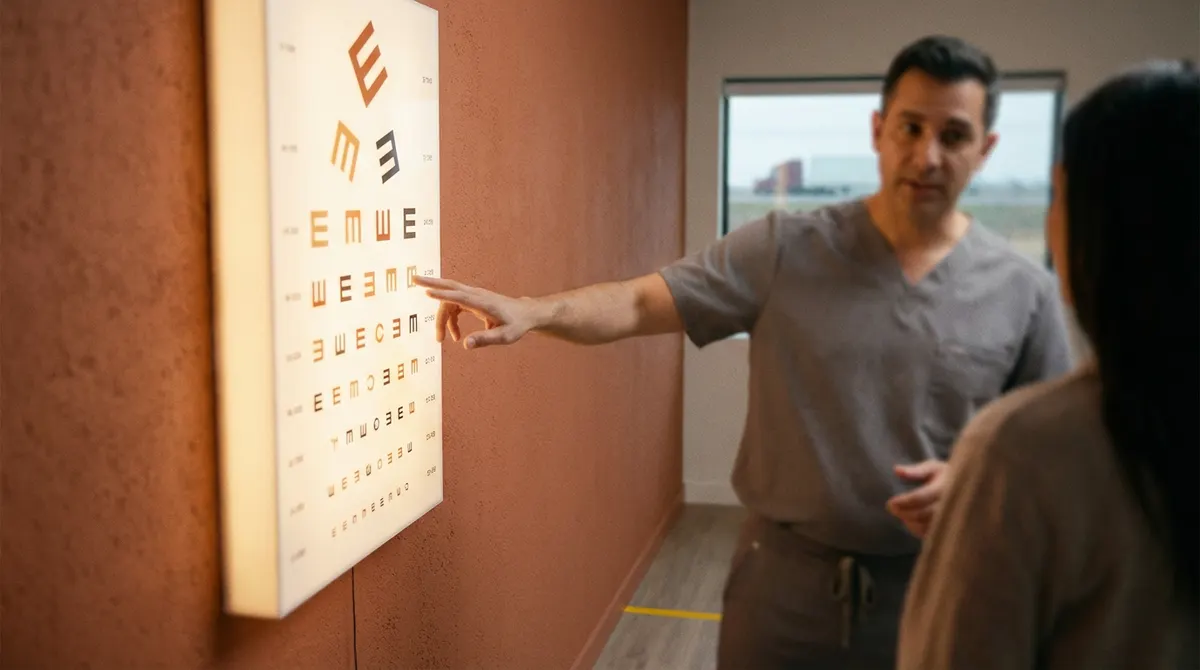
The Snellen eye chart is the standard eye chart used for a DOT physical because it measures distance visual acuity in a simple, repeatable way. The Snellen eye chart matters because the DOT physical vision test is built around whether you can see clearly enough for safe commercial driving. (Cleveland Clinic)
In practice, the chart used for most drivers is the Snellen eye chart, sometimes called the Snellen chart or Snellen Eye Test Chart. It displays rows of letters that become progressively smaller, allowing a Medical Examiner or clinic staff member to record visual acuity at a standardized distance, commonly 20 feet. According to the Cleveland Clinic, the Snellen eye test chart is the most common way providers test vision, and the Federal Register rule for 49 CFR Part 391 ties the DOT vision standard directly to Snellen-based 20/40 thresholds. (Cleveland Clinic)
The reason this matters in a DOT physical exam is straightforward. Commercial drivers need reliable distance vision to read road signs, detect hazards, judge traffic flow, and react safely in a commercial motor vehicle. A DOT Eye Test is not meant to replace a full eye examination from an eye care specialist, but it is meant to screen whether your vision meets the legal threshold for interstate driving. Many patients report that the vision portion feels quick, but the implications for your Medical certificate are significant. (Federal Register)
The Snellen eye chart is a visual acuity measurement tool developed in the nineteenth century by Herman Snellen. Research summarized by StatPearls notes that the chart uses optotypes arranged on a geometric scale, with the 20/20 line representing normal reference distance vision. For DOT purposes, the key question is not whether you have 20/20 vision. The key question is whether you meet at least 20/40 vision in each eye and binocular acuity of at least 20/40, with or without corrective lenses. (NCBI)
Not sure if sleep apnea applies to you?
Take our 2-minute sleep risk quiz to see whether sleep apnea could affect your DOT physical. No account required.
DID YOU KNOW: 20/40 vision means you can see at 20 feet what a person with standard vision can see at 40 feet. (NCBI)
KEY TAKEAWAY: The Snellen eye chart is the standard eye chart used during a DOT physical to measure whether you meet the required distance vision threshold.
Understanding the chart is only the first step, because the DOT vision standard covers more than a letter chart alone.
The Tumbling E Chart and Other Vision Test Alternatives
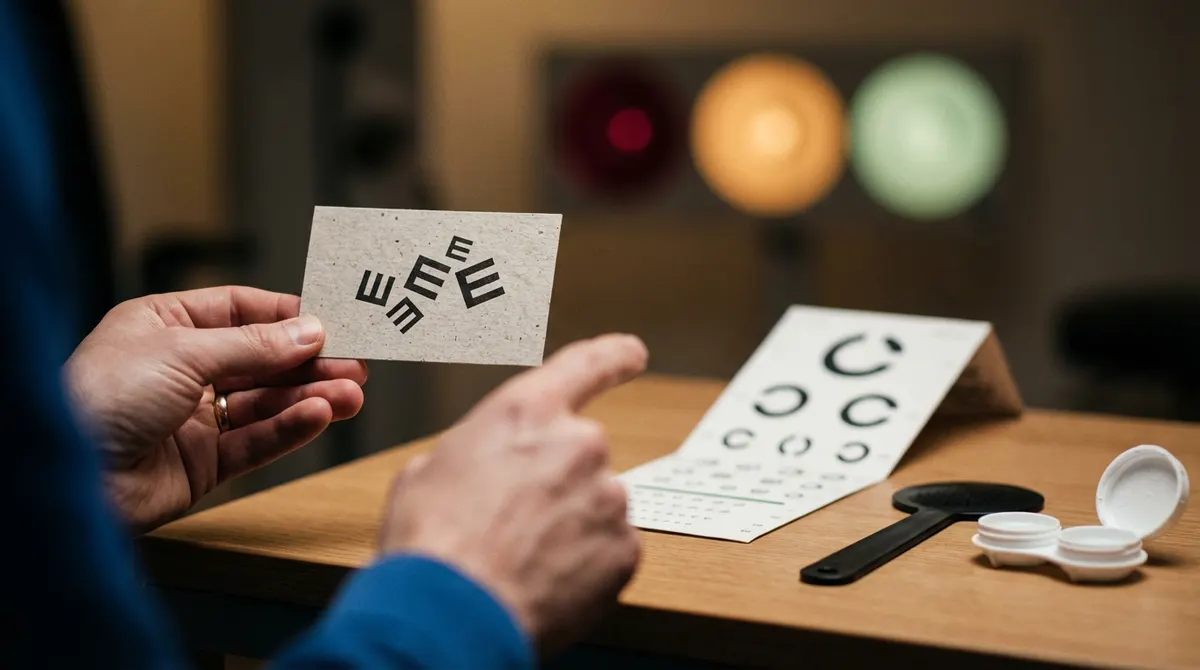
The Tumbling E chart is an accepted alternative when a standard Snellen chart is not the best fit for the driver being tested. The Tumbling E matters because a DOT physical must assess vision accurately even when letter recognition is limited. (OOA)
Some drivers do not read English letters comfortably, and some clinics use symbol-based formats to reduce that barrier. The Tumbling E chart replaces letters with a capital E facing different directions. Instead of naming letters, you identify which way the E points. This still measures visual acuity, but it does so in a format that can be more practical for certain patients. Clinical vision testing resources also describe other non-letter optotypes such as Landolt C formats, though the Tumbling E is the better-known alternative in occupational screening. (OOA)
The key difference between the Snellen chart and Tumbling E is not the legal standard. The key difference is the presentation format. The vision standard stays the same. You still need to show adequate distance vision, peripheral vision, and color recognition. In real-world use, clinics choose the method that gives the clearest and fairest measure of your functional vision during the physical exam. (Federal Register)
| Eye chart or method | What it measures | Best for | Typical use in a DOT physical exam |
|---|---|---|---|
| Snellen eye chart | Distance visual acuity | Most drivers | Primary eye chart for the vision test |
| Tumbling E | Distance visual acuity without letter naming | Drivers who struggle with letter charts | Alternative visual acuity test |
| Pinhole visual acuity test | Whether blur improves through a pinhole opening | Drivers with suspected refractive errors | Follow-up screening when vision is borderline |
For most commercial drivers, the Snellen eye chart remains the default. The Tumbling E is useful when a standard letter chart would not reflect true seeing ability, and pinhole visual acuity test methods help clarify whether reduced acuity may be caused by refractive errors that could improve with correction. (AAO)
KEY TAKEAWAY: The Tumbling E chart is an alternative format, but the underlying DOT vision requirements remain the same.
Once you know the chart options, the next question is the one most drivers care about: what score actually counts as passing.
Decoding DOT Vision Standards Beyond the Eye Chart

The DOT vision standard requires more than reading one line on an eye chart. The vision standard matters because passing depends on visual acuity, peripheral vision, and color vision together. (Federal Register)
Under 49 CFR Part 391, the Federal Motor Carrier Safety Administration requires distant visual acuity of at least 20/40 in each eye, with or without corrective lenses, plus binocular acuity of at least 20/40. The rule also requires a horizontal field of vision of at least 70 degrees in each eye and the ability to recognize standard red, green, and amber traffic signal colors. This means a driver can read the 20/40 line and still have a problem if peripheral view or color recognition does not meet the standard. (Federal Register)
Visual acuity is how clearly you see details at a set distance. Field of vision, sometimes called field of vision or visual fields, is the breadth of what you can detect to the side without moving your eyes. Color vision in the DOT context is practical rather than academic. The Medical Examiner is assessing whether you can recognize traffic-control colors safely, not whether you can score perfectly on every ophthalmic color test. FMCSA guidance specifically interprets the rule around recognizing standard red, green, and amber signal colors. (FMCSA)
Already diagnosed and need CPAP support?
Dumbo Health helps patients start CPAP without the usual confusion, paperwork, or upfront cost. Equipment, setup, supplies, and ongoing support are all handled in one place.
A common confusion is the difference between monocular and binocular requirements. Monocular vision means functional vision in one eye only. Binocular acuity means how both eyes work together. For the standard pathway, FMCSA expects each eye to meet the acuity threshold separately and both eyes together to meet binocular acuity requirements. For drivers with monocular vision, a different pathway may apply, which is discussed later in this page. (Federal Register)
This is also why the DOT physical exam is broader than a stand-alone eye exam. The Medical Examiner is reviewing overall medical conditions that may affect safe driving, including blood pressure, hearing aids, sleep apnea concerns, and medication impact. If you want a broader overview of sleep-related screening issues that can affect commercial drivers, dumbo.health has guides on what sleep apnea is and common sleep apnea symptoms to look out for. (eCFR)
IMPORTANT: A DOT vision test is a legal fitness screen, not a substitute for a full eye examination from an eye care specialist.
KEY TAKEAWAY: Passing the DOT physical eye exam requires adequate visual acuity, field of vision, and color recognition, not just reading the chart.
The next practical issue is how glasses, contact lenses, and surgery affect your ability to meet the standard.
Corrective Lenses, Contact Lenses, and Vision Correction Options

Corrective lenses can help you meet the DOT vision standard if they bring your visual acuity up to the required level. Corrective lenses matter because many commercial drivers qualify safely with glasses or contact lenses. (Federal Register)
If you use glasses or contact lenses for distance vision, wear them to the DOT physical. FMCSA rules explicitly allow drivers to meet the 20/40 vision threshold with corrective lenses. If corrective lenses are needed to qualify, that requirement is noted on the Medical certificate, and you must wear them while driving. This is one of the most common outcomes in a DOT Exam, and it is not a negative mark by itself. (FMCSA)
Contact lenses can be practical for some truck drivers and other CMV drivers because they avoid lens fogging and frame pressure during long shifts. Glasses may be the better choice for others because they are easier to remove, easier to keep as a backup, and simpler for some drivers with dry-eye symptoms. The most effective way to decide is to use whichever correction gives stable, comfortable distance vision and can be used consistently in a commercial vehicle environment. Clinicians frequently observe that comfort and reliability matter just as much as theoretical sharpness. (Mayo Clinic)
LASIK and other refractive procedures can also help drivers meet the vision requirements. The practical issue is timing and stability. If you recently had surgery, a certified medical examiner may want evidence that vision has stabilized and that no complications interfere with safe driving. A recent surgery does not automatically disqualify you, but a driver still has to meet the same acuity, field of vision, and color vision rules on the day of the DOT physical exam. (Federal Register)
Many patients preparing for a DOT physical near you make the same mistake: they assume their last everyday prescription is good enough without checking it. A simple update from an eye care provider in your area can prevent an avoidable failure. If you are also working through broader exam questions, the dumbo.health FAQs page is a useful starting point.
KEY TAKEAWAY: Glasses, contact lenses, and stable post-surgery vision can all help you meet the DOT vision standard, but you must test at or above the required threshold on exam day.
Knowing that correction is allowed makes the exam less stressful, so it helps to understand what the actual eye exam process looks like.
What Happens During the DOT Physical Eye Exam
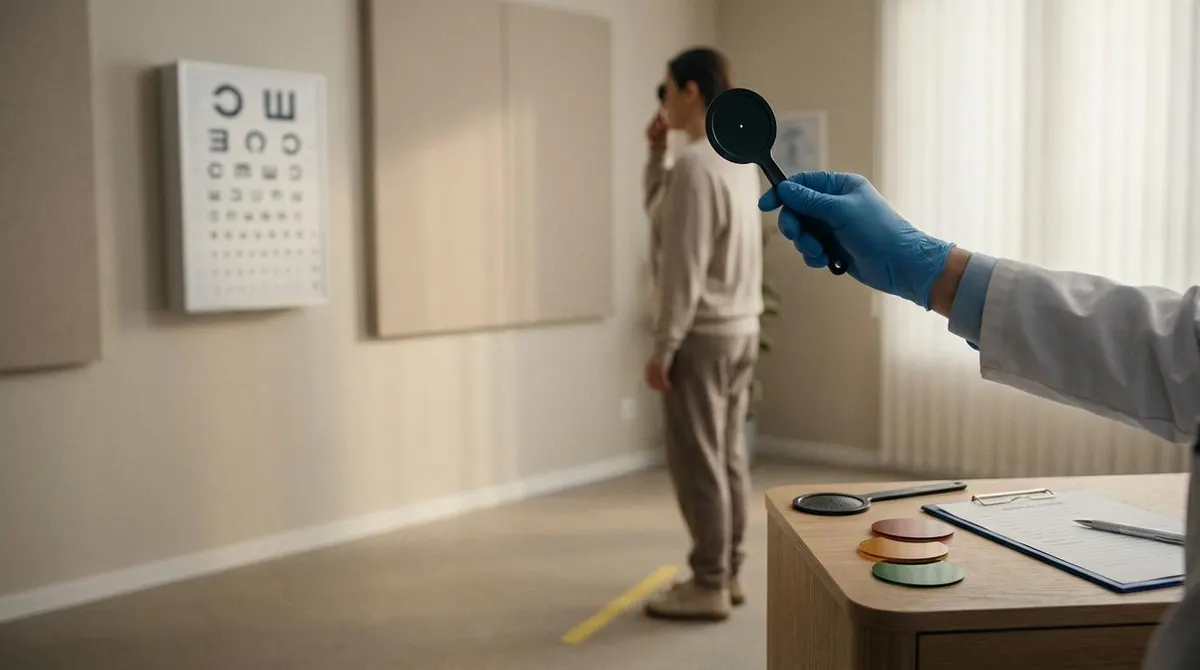
The DOT physical eye exam is usually a short visual screening performed by a Medical Examiner or trained clinic staff. The eye exam matters because the result directly affects whether you receive or renew a Medical certificate. (FMCSA)
The Medical Examiner is a clinician listed on the National Registry who evaluates whether you meet physical qualification standards for interstate driving. During the vision portion, you will typically stand or sit at the required testing distance, often 20 feet from the eye chart, and read with each eye separately and then with both eyes together. The examiner may note whether you wear corrective lenses and record the vision test result in the Medical Examination Report. (FMCSA)
The eye chart portion is only one part of the visual evaluation. The examiner also checks peripheral vision and color vision. Peripheral vision may be screened through a simple confrontation test or clinic-specific method designed to estimate your horizontal field of vision. Color recognition may be checked with color bars, signal-light simulation, or plate-based methods. FMCSA guidance makes the goal practical: can you recognize standard red, green, and amber traffic-control signals. (FMCSA)
If a reading looks borderline, a pinhole visual acuity test may be used to see whether the blur is likely caused by refractive errors. Research and clinical guidance from ophthalmology sources describe pinhole visual acuity test methods as a useful way to screen for uncorrected refractive error or media opacity. In plain terms, pinhole testing can show whether better correction might help you pass safely. (AAO)
The broader physical exam may also include blood pressure, hearing, urinalysis, and review of medical history. That matters because the DOT physical exam evaluates overall driver safety, not just one body system. If fatigue and sleep-disordered breathing are part of your concerns, dumbo.health also explains how at-home sleep studies work. (eCFR)
KEY TAKEAWAY: The DOT physical eye exam includes visual acuity, peripheral vision, and color recognition, and the findings are recorded as part of your full medical qualification exam.
If the exam does not go as planned, the next section explains what options still exist.
What Happens If You Do Not Meet the Vision Standard

Not meeting the vision standard does not always end the certification process permanently. Vision issues matter because some drivers can qualify through updated correction, specialist review, or the alternative vision pathway. (FMCSA)
When a driver does not meet the standard during the DOT physical eye exam, the first step is usually practical, not dramatic. The issue may be outdated glasses, contact lenses that are not giving stable acuity, or an unrecognized refractive error. In those cases, an eye care specialist may be able to improve visual acuity enough for the driver to return and complete the physical exam successfully. This is why many drivers who search for a provider close to you benefit from scheduling a routine eye exam before the DOT visit rather than after a failed screen. (Mayo Clinic)
The more complex scenario involves monocular vision or a lasting vision deficiency in one eye. In 2021, FMCSA adopted an alternative vision standard that replaced the older Federal vision exemption program for many interstate drivers. Under that approach, a driver with monocular vision may still qualify if the better eye has at least 20/40 visual acuity, at least 70 degrees of horizontal field of vision, the ability to recognize traffic signal colors, and enough time to adapt to the vision deficiency. FMCSA also requires a Vision Evaluation Report, Form MCSA-5871, completed by an ophthalmologist or optometrist before the Medical Examiner completes the certification decision. (Federal Register)
A particularly important timing rule often gets missed. FMCSA states that the Medical Examiner must receive the completed Vision Evaluation Report before each required physical qualification examination, and the exam must begin no more than 45 days after the ophthalmologist or optometrist signs the form. That makes paperwork timing just as important as the clinical result. (FMCSA)
People who undergo this process often find that the terms vision waiver, medical waivers, and vision exemptions are used loosely online. The more accurate current language is to follow the FMCSA alternative vision standard process and Form MCSA-5871 pathway where applicable, rather than relying on outdated forum language about the old vision waiver program. (Federal Register)
KEY TAKEAWAY: Failing the initial DOT vision test may still be fixable through updated correction or the current FMCSA alternative vision standard process.
Because so much outdated advice circulates online, it helps to separate common myths from what the rules actually say.
Common Myths About DOT Physical Vision Tests Debunked

Many online claims about the DOT physical eye exam are outdated or oversimplified. This section matters because misunderstanding the rules can lead to unnecessary anxiety or bad preparation. (Federal Register)
MYTH: You need 20/20 vision to pass a DOT physical.
FACT: The FMCSA standard is generally 20/40 vision in each eye and 20/40 binocular acuity, with or without corrective lenses. A driver does not need 20/20 vision to qualify. The practical threshold is safe legal function, not perfect eyesight. (Federal Register)
MYTH: If you fail the eye chart once, your CDL driving career is over.
FACT: A single failed screen may reflect outdated glasses, an incomplete visual evaluation, or a correctable refractive error. Some drivers also qualify through the alternative vision standard for monocular vision using Form MCSA-5871 and specialist input. (FMCSA)
MYTH: Color blindness always disqualifies you automatically.
FACT: FMCSA guidance focuses on whether you can recognize standard red, green, and amber traffic-control colors. Some color perception deficiencies may still allow a driver to meet the rule if practical color recognition is adequate. (FMCSA)
MYTH: You can memorize the eye chart and beat the DOT Eye Test.
FACT: Clinics can vary chart presentation, test one eye at a time, change lines, or use alternative formats such as Tumbling E. Memorization also does nothing for peripheral vision, color vision, or pinhole follow-up screening when results look inconsistent. (OOA)
KEY TAKEAWAY: Most DOT vision myths come from confusing perfect vision with passing vision or from relying on outdated waiver information.
The smartest approach is not gaming the test. It is maintaining healthy, stable vision over time.
Protecting Eye Health and Preparing for Your DOT Physical

The best way to pass a DOT physical vision test is to maintain eye health and prepare before exam day. Preparation matters because avoidable vision problems are easier to fix before the appointment than after a failed certification visit. (Mayo Clinic)
Start with regular eye care, even if your last DOT physical went smoothly. An eye chart screen cannot replace a full eye examination. Eye care providers can catch refractive errors, dry-eye problems, cataract changes, and other medical conditions before they interfere with visual acuity or field of vision. For commercial drivers, that is not just about compliance. It is also about reaction capability, driver safety, and long-term work capacity in a demanding job. (Mayo Clinic)
Protective habits also matter. UV protection can reduce long-term light-related damage, and some drivers find glare control helpful during long highway hours. Polarized lenses can improve comfort outdoors for some people, although lens selection should still support clear traffic-signal recognition and your clinician’s advice. Stress-reduction habits, adequate sleep, and attention to chronic conditions such as blood pressure or diabetes also support eye health over time because systemic health affects visual function. (Mayo Clinic)
Before your next DOT physical, bring your glasses or contact lenses, carry a backup pair if you use them regularly, and schedule an eye check if road signs have seemed blurrier lately. If you have a known monocular vision issue or recent vision change, see an ophthalmologist or optometrist before the DOT exam and ask whether Form MCSA-5871 may be needed. Drivers looking to find a provider near you should prioritize a clinic familiar with DOT paperwork and timeline requirements. (FMCSA)
Visual acuity testing measures how clearly a driver can see at distance. DOT vision testing adds field of vision and color recognition because safe commercial driving depends on more than reading letters. Medical Examiner decisions combine the vision portion with the full physical exam and supporting medical information. (Federal Register)
KEY TAKEAWAY: Proactive eye care, updated correction, and early paperwork preparation give you the best chance of passing the DOT physical without avoidable delays.
With the core rules covered, the remaining questions are the ones drivers ask most often.
Frequently Asked Questions
What line on the eye chart is 20/40 for a DOT physical?
The 20/40 line on a Snellen eye chart is the minimum line most interstate drivers need to read successfully in each eye, with or without corrective lenses, to meet the DOT vision standard. In plain terms, 20/40 vision means you can see at 20 feet what a person with standard vision could see at 40 feet. A certified medical examiner will usually test each eye separately and then both eyes together during the DOT physical eye exam. Reading better than 20/40 is fine, but 20/20 vision is not required for most commercial drivers. (NCBI)
How far away is the eye chart during a DOT vision test?
The chart is typically placed at 20 feet for a standard distance vision test when a Snellen eye chart is used. Some clinics may use equivalent projected or mirrored setups that simulate the same testing distance. What matters is that the test is standardized well enough to measure visual acuity accurately. During the DOT physical, you will usually cover one eye, then the other, then read with both eyes. If the result looks borderline, the clinic may repeat part of the visual evaluation or consider pinhole testing to clarify whether refractive correction could improve the score. (Cleveland Clinic)
Can you pass a DOT physical if you wear glasses or contact lenses?
Yes. Many commercial drivers pass the DOT physical with glasses or contact lenses. FMCSA rules allow you to meet the vision standard with corrective lenses if they bring each eye to at least 20/40 visual acuity and support adequate binocular acuity. If you qualify with corrective lenses, that requirement is recorded on your Medical certificate and you must wear them while driving. Bring your usual distance correction to the appointment, and bring a backup pair if possible. That is one of the easiest ways to avoid a preventable delay in certification. (FMCSA)
What happens if you fail the DOT eye test?
If you fail the DOT Eye Test, the next step depends on why you failed. Some drivers simply need an updated prescription because outdated glasses or contact lenses are reducing visual acuity. Others may need a full eye exam to document a medical issue affecting vision. If the issue involves monocular vision or another nonstandard situation, FMCSA may require a Vision Evaluation Report on Form MCSA-5871 from an ophthalmologist or optometrist before the Medical Examiner can make a certification decision. Drivers who need help finding follow-up care often do best by looking for eye care providers in your area before rebooking the physical. (FMCSA)
Can color blindness disqualify you from a DOT physical?
Color blindness does not automatically disqualify every driver. The FMCSA rule focuses on whether you can recognize and distinguish standard red, green, and amber traffic signal colors. Some people with red-green deficiencies may still function well enough on the practical color recognition requirement, while others may not. The Medical Examiner or clinic may use a color vision screening method as part of the vision portion of the physical exam. The key issue is safe signal recognition in real driving conditions, not perfection on every ophthalmic color test. (FMCSA)
Can you get a DOT medical card with vision in only one eye?
Possibly, yes. Under the FMCSA alternative vision standard, some drivers with monocular vision can still qualify if the better eye has at least 20/40 distance vision, at least 70 degrees of horizontal field of vision, and adequate color recognition, and if the driver has adapted to the deficiency. The process requires documentation from an ophthalmologist or optometrist on Form MCSA-5871 before the Medical Examiner completes the decision. Timing matters because FMCSA says the physical qualification exam must begin within 45 days after the form is signed. (Federal Register)
Does the DOT physical include a full eye examination?
No. The DOT physical includes a vision test and visual screening, but it is not the same as a full eye examination by an eye care specialist. The clinic is checking whether you meet the legal fitness standard for commercial driving, not performing a complete diagnostic workup of all eye diseases. A separate eye examination may still be needed if your result is borderline, if you have symptoms, or if you need specialist documentation for monocular vision or another eye condition. That is why regular preventive eye care remains important even if you pass every DOT physical exam. (Mayo Clinic)
Can a DOT eye test detect an aneurysm or other hidden disease?
A DOT eye test is not designed to detect an aneurysm. The purpose of the vision portion is to measure visual acuity, peripheral vision, and color recognition for safe driving. A full eye examination from an eye care specialist may sometimes reveal signs that lead to further medical workup, but that is outside the core purpose of the DOT physical exam. If you have sudden vision changes, severe headaches, neurologic symptoms, or other concerning signs, you should seek prompt medical evaluation rather than relying on a certification visit. (Mayo Clinic)
Conclusion
The eye chart used for a DOT physical is usually the Snellen eye chart, but the real standard goes beyond one chart line. To qualify, you generally need 20/40 vision in each eye, adequate binocular acuity, at least 70 degrees of horizontal field of vision, and practical color recognition for traffic signals. The good news is that many drivers meet the standard with corrective lenses, and some drivers with monocular vision may qualify through the current FMCSA pathway and Form MCSA-5871. For broader screening guidance and support resources, review the dumbo.health FAQs before your next exam. (Federal Register)
Related DOT Physical Topics
- What Does DOT Stand for in a DOT Physical
- What Forms Do You Need for a DOT Physical
- What Is the Urine Test for in a DOT Physical
- What are the current DOT requirements for sleep apnea testing for commercial drivers
- BMI for DOT Physical What Commercial Drivers Need to Know
- What Happens During the DOT Physical Exam The Complete Guide for Drivers
- What Is the Difference Between a DOT and Non-DOT Physical
- What Can Disqualify You From a DOT Physical
- DOT Physical Vision & Eye Requirements
- Remote DOT Physical The Complete Guide for Commercial Drivers
- DOT Physical Out of Pocket What Commercial Drivers Actually Pay
- The Ultimate DOT Physical Guide for Commercial Drivers (2025–2026)
- Navigating the Florida DOT Physical Your Essential Guide for CDL Drivers
- DOT Physical Cost Breakdown What Drivers Pay & Why
- What happens if you fail a DOT physical due to sleep apnea
- Can You Get a Second Opinion on Your DOT Physical A Complete Guide for Commercial Drivers
- What Should You Bring to a DOT Physical
- What should I expect at a DOT physical
- DOT Physical Forms & Paperwork The Complete Guide for Commercial Drivers
- Can You Pass a DOT Physical With One Eye
- What Are the Requirements to Pass a DOT Physical
- Can You Fail a DOT Physical for Being Overweight
- Online DOT Physical Without Insurance A Complete Guide for Commercial Drivers
- Your Complete Guide What's Included in a DOT Physical Exam
- Do They Check for Hernia During a DOT Physical
- Online DOT Physical Self-Pay The Complete Guide for CDL Drivers and Owner-Operators
- What blood pressure do you need to pass a DOT physical
- DOT physical self pay guide for commercial drivers paying out of pocket
- Is a drug test required for a DOT physical
- DOT Physical Blood Pressure Requirements What Drivers Need to Know
- Can You Fail a DOT Physical for High Blood Pressure
- Online DOT Physical The Complete Guide for Commercial Drivers and Medical Examiners
- DOT Physical at Urgent Care What Commercial Drivers Need to Know
- DOT Physical ICD-10 & Billing Codes The Complete Guide for Accurate Compliance and Reimbursement
- New DOT Physical Requirements What Drivers MUST Know About New Updates
- DOT Physical Insurance or Self Pay How to Choose the Right Payment Option for Your Exam
- Is a DOT physical the same as a regular physical
- What Does a DOT Physical Consist Of
- Is a Sleep Study Required for a DOT Physical
- DOT Physical & Drug Test What Drivers Need to Know
- DOT Physical Requirements A Complete Guide for CDL Drivers
- What Do They Check During a DOT Physical
- The DOT Physical Exam Ensuring You're Fit for the Road
- Failing a DOT Physical What Every Commercial Driver Needs to Know
- What is DOT Physical
- How can drivers with sleep apnea qualify again after a failed DOT physical
- DOT Physical Online Cost
- Can You Pass a DOT Physical with Epilepsy
- How Do You Submit Your DOT Physical to the DMV
- Virtual DOT Physical
- Who needs a DOT physical
- DOT Physical Self Pay Cost
- Navigating Your DOT Physical with Common Medical Conditions
- How to Pass a DOT Physical The Complete Commercial Driver's Guide
- Does a DOT physical include a drug test
- Essential 171 DOT Definitions for Commercial Drivers
- When Can Sleep Apnea Affect a DOT Physical
- DOT Physical Chiropractor Your Complete Guide to CDL Exams
- Can you pass a DOT physical with sleep apnea
- Can you fail a DOT physical because of sleep apnea
- Can You Get a DOT Physical Online
- Walk In DOT Physical Self Pay
- Can You Pass a DOT Physical With a Pacemaker
- Telehealth Dot Physical
- DOT Physical Exam Basics
- DOT Physical & Alcohol Requirements
- DOT Physical Duration and Validity How Long Your Medical Card Lasts
- DOT Physical Insurance & Recertification The Complete Driver's Guide
- Why do they measure your neck during a DOT physical
- Can You Pass a DOT Physical with High Blood Pressure
- Why DOT Sleep Tests at Home Matter for Your Career and Health
- Cheap DOT Physical Online
- Can You Pass a DOT Physical With a Hernia
- DOT Physical Cash Pay
- Online DOT Exam What Drivers and Medical Examiners Need to Know
- What are the current FMCSA guidelines on sleep apnea for commercial drivers
- Same Day DOT Physical
- DOT Medical Exam Self-Pay A Complete Guide for Commercial Drivers
- Do They Check Your Private Parts During a DOT Physical
- Can You Pass a DOT Physical with Diabetes
- Non-DOT Physical A Comprehensive Guide to Workforce Health and Safety
- DOT Physical Texas The Essential Guide to Your Exam, Medical Card, and CDL Compliance
- Do You Have to Pee During a DOT Physical
- Can You Fail a DOT Physical
- Online CDL Physical
- Are There New DOT Rules or Laws on Sleep Apnea Testing
- Sleep Apnea Test for CDL Drivers
- 2026 DOT Inspection Dates
- Home Sleep Apnea Test for Commercial Drivers The CDL Holder's Complete Guide
- Best Treatments for Sleep Apnea to Improve Driving Safety
- Are there legal requirements for drivers with sleep apnea
- CDL PHYSICAL SELF PAY
- DOT sleep apnea test at home
- The Comprehensive Guide to Suboxone, Sleep Apnea, and FMCSA Compliance for Commercial Motor Vehicle Operators
- At Home Sleep Test for Truck Drivers
- Medical Examination Report (MER) – Form MCSA-5875 The Complete Guide for Commercial Drivers
- What Precautions Should Drivers With Sleep Apnea Take
- Guide to Obtaining and Managing Your DOT Medical Card Online
- Expected 2027 DOT Inspection Dates
- How Sleep Apnea Affects Overall Driving Safety
Take the next step before your DOT physical
Start with the free quiz if you are unsure about your risk, or order an at-home sleep test if you have already been flagged for possible sleep apnea.
AI summary
A DOT physical vision test is a legal screening used to determine whether a commercial driver meets FMCSA vision standards for interstate driving. The primary eye chart used is the Snellen eye chart, which measures distance visual acuity at a standardized distance, commonly 20 feet. Key requirements under 49 CFR Part 391 include: at least 20/40 distant visual acuity in each eye (with or without corrective lenses), at least 20/40 binocular acuity, at least 70 degrees of horizontal field of vision in each eye, and the ability to recognize standard red, green, and amber traffic signal colors. If letter recognition is a barrier, clinics may use the Tumbling E chart; the legal standard remains the same. If results are borderline, a pinhole visual acuity test may help indicate refractive error. Corrective lenses are allowed but may be recorded as required on the medical certificate. Drivers with monocular vision may qualify under the FMCSA alternative vision standard using a Vision Evaluation Report (Form MCSA-5871), which must be submitted with specific timing (exam started within 45 days of the form being signed).

Nicolas Nemeth
Co-Founder
Nico is the co-founder of Dumbo Health, a digital sleep clinic that brings the entire obstructive sleep apnea journey home. Patients skip the sleep lab and the long wait to see a specialist. Dumbo Health ships an at home test, connects patients with licensed sleep clinicians by video, and delivers CPAP or a custom oral appliance with ongoing coaching and automatic resupply in one clear subscription.
Keep reading

How Long Does a DOT Physical Take? A Complete Guide for Commercial Drivers

What Happens If You Fail a DOT Drug Test? The Complete Guide for Commercial Drivers


